Question page
What Is Content Repurposing? Complete 2026 Guide
Ryze AI · Updated
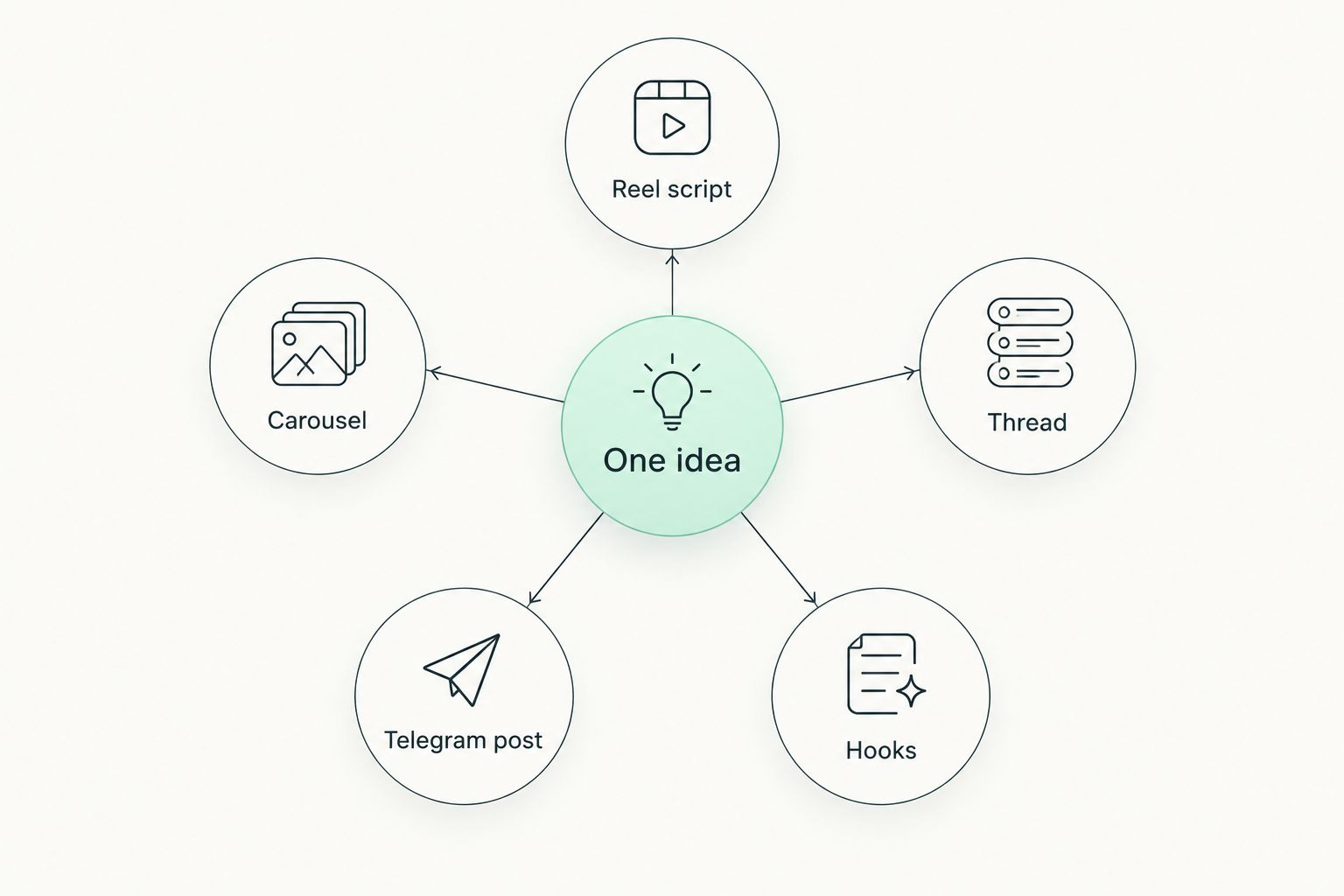
Content repurposing means taking one core piece of content and turning it into multiple platform-ready formats — a Reel becomes a carousel, a carousel becomes a thread, a thread becomes a Telegram post — instead of writing something new for every channel. The value isn't recycling for its own sake; it's extracting the hook, structure, and insight that already worked once and rebuilding it for a different feed. Skip this step and you're starting from a blank page five times a week instead of once.
- Content repurposing turns one Reel, post, or idea into 5+ platform-ready formats instead of five separate drafts.
- Trender adapts hooks and structures from 1M+ analyzed Reels and carousels into your own scripts, carousels, and threads.
- Cross-platform repurposing (Reel to carousel to thread) beats posting the same clip everywhere unedited.
- Solo creators and small teams save the most time repurposing proven content instead of researching from a blank page each time.
Why This Matters
Posting on Instagram, TikTok, LinkedIn, and Telegram used to mean four separate scripts, four design passes, and four research sessions for one idea. Content repurposing collapses that into one research or creation pass and several fast adaptations.
The teams that grow fastest in 2026 aren't producing more raw ideas — they're squeezing more formats out of the ideas that already proved themselves. Trender is built around exactly this: turn one idea, draft, or successful Reel into five platform-ready formats plus 15+ hooks, instead of treating each platform as a separate content job.
What Is Content Repurposing?
Content repurposing is the practice of adapting one piece of content into different formats or platforms while keeping the core message, hook, or structure intact. It's not the same as reposting the same file everywhere — a Reel script doesn't survive being pasted into a LinkedIn caption, and a long carousel doesn't work as a 15-second script without restructuring.
The two common approaches look very different in practice:
| Method | Best For | Pros | Cons |
|---|---|---|---|
| Manual repurposing | Teams with a dedicated writer/editor and time to spare | Full creative control, no software learning curve | Slow — each adaptation is a fresh writing task |
| AI-assisted repurposing (e.g., Trender) | Solo creators, boutique agencies, small marketing teams | Produces scripts, carousels, hooks, and threads from one input in minutes | Still needs a human review pass before publishing |
Verdict: manual repurposing works fine at low volume; once you're posting on 3+ platforms a week, AI-assisted repurposing is the only version that scales without adding headcount.
Cross-Platform Repurposing: One Idea, Five Formats
This is the most common form in 2026: one input — a rough note, a thesis, or a Reel link — gets turned into a Reel script, a carousel, a Telegram post, a thread, and a set of standalone hooks. Each format keeps the original insight but respects the platform's own conventions: carousels lean on visual pacing and swipe-worthy slide breaks, threads lean on numbered logic, Telegram posts lean on direct, conversational lines.
Doing this by hand means rewriting the same idea five separate times in five separate voices. Trender does the format switching automatically from a single input, which is the core reason it exists as a research-and-creation tool rather than a script generator alone.
Format Repurposing: Same Platform, Different Shape
Sometimes the platform stays the same but the shape changes — a Reel becomes a carousel on the same Instagram account, or a long-form post becomes a short hook-driven caption. This works best when the original piece already has a clear structure (a list, a before/after, a myth-vs-fact) that translates cleanly into slides or steps. Building a carousel that gets swipes usually means pulling the strongest 3-5 beats out of the original piece, not compressing the whole thing.
Atomizing Long-Form Into Short Clips
Atomization takes one long asset — a webinar, a podcast, a long video — and cuts it into several short, standalone clips, each with its own hook. This is the format most teams struggle with manually because it requires knowing which 20 seconds of a 40-minute recording will actually stop a scroll. Tools trained on large volumes of high-performing short content, like Trender's 1M+ analyzed Reels and carousels, exist specifically to shortcut that judgment call.
Why Content Repurposing Works
- Reuses proven hooks and structures instead of guessing what will land with a new draft every time.
- Cuts research time because the analysis of what works is already done on the original piece.
- Keeps posting cadence consistent across platforms without hiring per-platform writers.
- Extends the life of one idea across weeks instead of burning it in a single post.
- Reduces blank-page starts, which is the single biggest reason small teams miss their posting schedule.
Turn one idea into five formats
Start free, no credit card, and repurpose your next Reel or draft today.
Is Content Repurposing the Same as Reposting?
No — reposting means republishing the identical asset on another platform, while content repurposing means adapting the format, pacing, and structure for that platform. A Reel reposted as-is to LinkedIn usually underperforms because LinkedIn audiences read captions differently than Instagram viewers watch video.
How Often Should You Repurpose Content in 2026?
Most small teams and solo creators repurpose every high-performing piece — anything that beats their own average engagement — rather than repurposing on a fixed schedule. The signal to repurpose is performance, not a calendar date; a Reel that clearly outperforms your last five posts is a stronger repurposing candidate than an average one just because a week passed.
What Tools Help With Content Repurposing?
Tools built for repurposing combine competitor and top-performer research with format adaptation, rather than just rewriting text. Trender covers research, hook and structure adaptation, carousel design, an iPhone teleprompter for recording, and a Reel analysis and improvement workflow in one product, which is closer to what repurposing actually requires than a plain text generator. A broader look at AI Reels script generators is useful if you're comparing more than one option before committing.
FAQ
What is content repurposing in simple terms?
Content repurposing is adapting one piece of content into different platform-ready formats, like turning a Reel into a carousel or a thread, instead of writing something new for every channel.
Is content repurposing the same as reposting?
No, reposting republishes the same asset unchanged while content repurposing adapts the format and structure to fit the new platform's conventions.
How does AI content repurposing work?
AI content repurposing tools like Trender take one input, such as an idea, draft, or successful Reel link, and generate multiple platform-ready formats — scripts, carousels, hooks, and posts — based on patterns from large volumes of high-performing content.
What content is best to repurpose?
Your own highest-performing pieces are the best repurposing candidates because the hook and structure are already proven with your audience.
Can you repurpose a Reel into a carousel?
Yes, a Reel's key beats — the hook, the main points, and the payoff — can be pulled into slide breaks for a carousel without rewriting the underlying idea.
How much time does content repurposing save?
Content repurposing saves the most time on research and first drafts by reusing structure that already worked, though every adapted format still needs a human review pass before publishing.
Does content repurposing hurt engagement?
Content repurposing done as unedited reposting can hurt engagement, but format-specific adaptation, matching pacing and structure to the platform, typically performs as well as fresh content.
What's the difference between repurposing and atomizing content?
Atomizing is a subset of repurposing focused on cutting one long piece, like a webinar or podcast, into several short standalone clips, each with its own hook.
One Last Thing
The repurposing mistake that costs the most engagement isn't skipping formats — it's skipping the hook rewrite. A hook that worked as a spoken line in a Reel rarely works as the first sentence of a carousel slide or a Telegram post; rewrite the hook for each format first, then adapt the body. Trender's own workflow starts there for a reason: 15+ hook variations per input before the format adaptation even begins.