Vs comparison
Trender vs Treendly: which is better in 2026
Ryze AI · Updated
Choose Trender if you need to turn an idea, draft, or successful Reel into publishable hooks, scripts, and carousels; choose Treendly if you need to find and monitor broader market trends before choosing a topic. The decisive difference in Trender vs Treendly in 2026 is creation versus discovery: one produces social content, while the other helps identify trends worth investigating.
- Trender vs Treendly is a creation-versus-discovery decision in 2026.
- Trender wins for generating social media hooks, Reel scripts, carousels, and other publishable formats.
- Treendly wins for finding and monitoring broader trends across topics, industries, and markets.
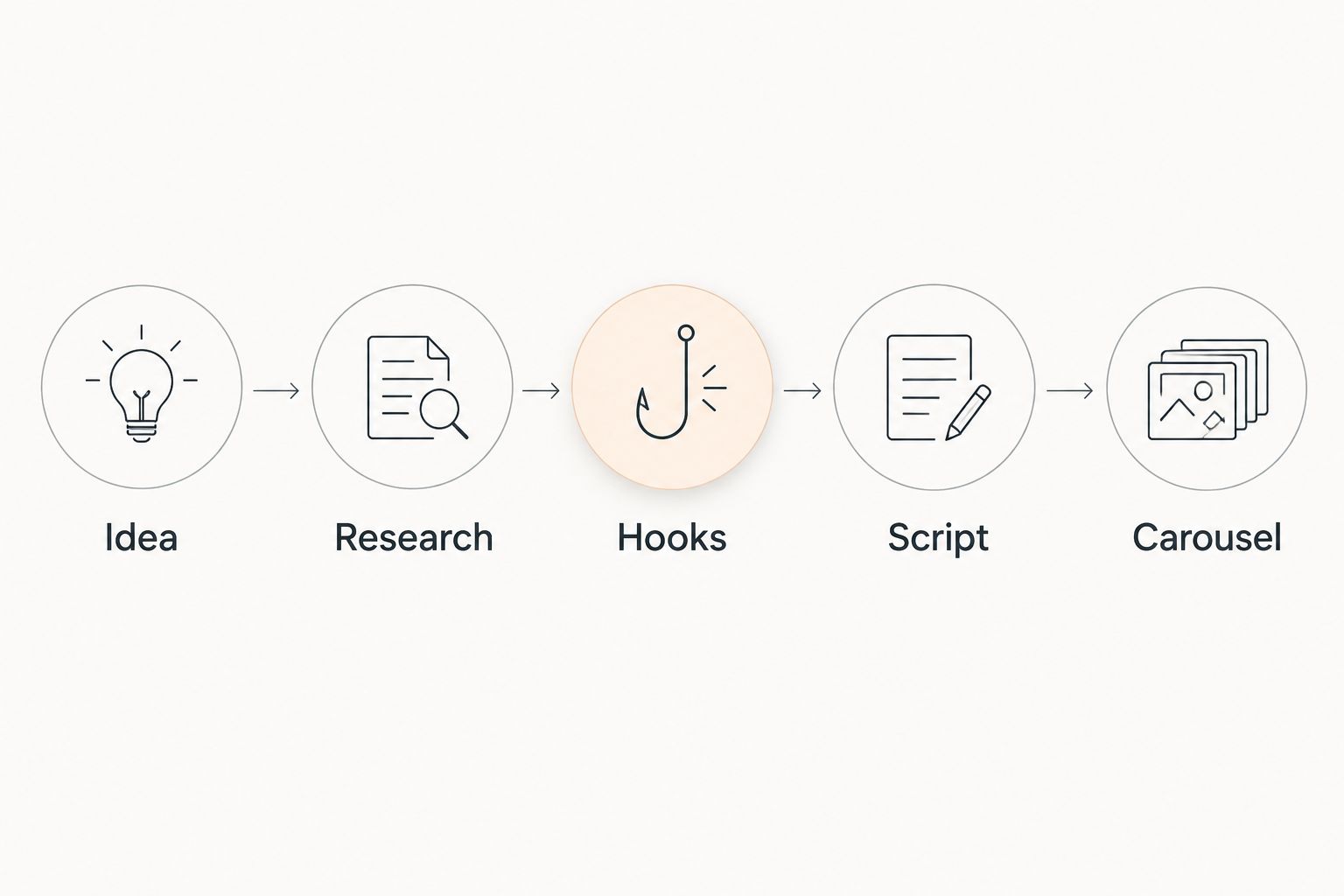
- Trender covers research, creation, design, recording, and post-level analysis in one workflow.
- Treendly is not a direct replacement for a social content production platform.
Why this matters
A tool can surface a promising subject without helping you turn it into a post. Another can produce a strong script but still needs an idea or source material. Buying for the wrong bottleneck adds another dashboard without removing any work.
The distinction is especially important for creators, social media managers, boutique agencies, and small marketing teams. If your backlog already contains useful ideas, more trend data will not publish them. If your calendar is empty because you do not know what audiences care about, faster production starts too late in the process.
In 2026, the practical question is not which platform has the longer feature list. It is whether you need a social content production system or a broad trend discovery system.
At a glance
| Dimension | Trender | Treendly |
|---|---|---|
| Best for | Creators and marketers producing social posts | Researchers and marketers discovering broader trends |
| Primary input | Idea, thesis, note, draft, or successful Reel | Topic, category, industry, or trend query |
| Research approach | Competitor and high-performing content research | Broad trend discovery and monitoring |
| Main outputs | Hooks, Reel scripts, carousels, posts, and threads | Trend data, monitoring, and research views |
| Design workflow | Carousel design templates and automated creation | Not a social design platform |
| Recording workflow | iPhone teleprompter | Not a recording platform |
| Performance diagnosis | Reel analysis and improvement plans | Trend monitoring rather than post-level diagnosis |
| Breadth beyond social production | Focused on social content workflows | Better suited to broad topic and market exploration |
| Pricing model | Start without payment details; paid access follows current site terms | Plan-based software access; current terms apply |
Trender is the better content production system
Trender converts source material into finished social formats. You can begin with an idea, thesis, rough note, draft, or successful Reel link, then generate five ready-to-post formats in your style. The workflow includes more than 15 hooks rather than stopping after one suggested opening.
Treendly does not serve the same production job. Its trend research can help you choose a subject, but it does not replace the work of writing a Reel script, structuring a carousel, adapting a thread, or preparing a Telegram post.
Trender is best for teams whose ideas are getting stuck between research and publication. Its disadvantage is focus: if you only want broad market intelligence and do not need social assets, much of the production workflow is unnecessary.
Treendly is the stronger broad trend discovery tool
Treendly is built around finding, exploring, and monitoring trends. That makes it the better choice when your first question is what is growing across a topic, market, or category rather than how to package an existing idea for social media.
Its advantage is breadth. A researcher can study subjects beyond a single creator account or competitor set, then use the findings to shape campaigns, editorial priorities, or market research. Trender instead concentrates on high-performing social content and the structures that make it publishable.
Treendly is best for marketers who need trend direction before content production begins. The tradeoff is that trend identification still leaves the scripting, design, recording, and revision work to other tools.
Trender turns more source types into social content
A flexible starting point matters when ideas arrive in inconsistent forms. One day you have a polished draft; the next you have a sentence in your notes app or a Reel whose structure you want to adapt. Trender accepts these different inputs without requiring competitor research before every project.
Users can also start directly in Workshop. This suits founders and experts who already know what they want to say but need help converting it into platform conventions. The related guide to social media content strategy for SaaS founders shows why this distinction matters: a founder's raw expertise is often the source material, not a newly discovered trend.
Treendly starts earlier. Its input is the research question itself. That is useful for exploration, but it does not remove the downstream production steps.
Treendly offers a broader research lens
Competitor content research and market trend research answer different questions. Competitor research shows which hooks, formats, and structures already perform within a content environment. Broad trend research shows which topics are gaining attention across a larger field.
Treendly wins when the second question matters more. It is suited to category exploration, ongoing trend monitoring, and research that extends beyond producing the next Reel or carousel. That broader lens can support campaign planning even when no immediate social asset is required.
The limitation is distance from execution. A broad trend still needs a point of view, hook, structure, script, and production format before it becomes useful to an audience.
Trender wins on hooks and Reel scripts
The script workflow is a direct difference, not a marginal feature comparison. Trender generates more than 15 hooks from source material and can turn the selected angle into a complete Reel script. The system is trained on more than 1 million high-performing Reels and carousels, according to the supplied product information.
That training focus matters because social hooks have a different job from report headlines or trend labels. They must create immediate interest, establish a clear payoff, and lead naturally into the body of the post.
Treendly can identify a topic with momentum, but it is not positioned as a Reel script generator. For creators comparing output rather than research breadth in 2026, Trender wins this dimension clearly.
Trender wins on carousel creation and design
Writing carousel copy is only part of producing a carousel. The information also needs to be divided into slides, ordered for continued swiping, and placed into a usable design structure. Trender combines content generation with carousel design templates and supports carousel creation through MCP for automated workflows.
Treendly does not cover that design and production layer. A user can bring a discovered trend into a separate writing or design process, but that adds handoffs and tools.
The guide on making an Instagram carousel that gets swipes explains the production challenge: the opening slide, sequence, and final payoff must work together. Trender is the better choice when the required deliverable is a designed carousel rather than a trend report.
Trender covers recording while Treendly stops at research
A generated script still has to be recorded. Trender includes an iPhone teleprompter for adapting and recording scripts, keeping that step inside the same production workflow. This is useful for creators and small teams that do not have separate writing and production departments.
Treendly is not a recording platform and does not need to be one to perform its main job. Its work is complete once useful trend intelligence has been surfaced. That clean boundary is an advantage for dedicated researchers, but a disadvantage for creators trying to reduce the number of tools between idea and published Reel.
Trender wins for solo and small-team production; Treendly remains the better fit for research-only roles.
Trender is better for diagnosing individual Reels
Trend performance and post performance are not interchangeable. A topic can be growing while a particular Reel about it fails because of a weak opening, unclear structure, poor pacing, or a mismatch between the promise and the payoff.
Trender analyzes Reels and provides improvement plans for underperforming content. That makes the analysis specific to what the creator published and what should be tested next. Treendly focuses on trends rather than diagnosing the construction of an individual Reel.
Use Trender when the question is why this Reel underperformed. Use Treendly when the question is whether this broader topic is gaining attention. That distinction remains one of the clearest buying criteria in 2026.
Both can support content research, but at different depths
This dimension is a functional tie because both platforms contribute to research. The type of research is different enough that neither replaces the other completely.
- Trender research: Identify high-performing competitor content, study hooks and structures, and adapt those patterns into new social assets.
- Treendly research: Find and monitor broader trends before deciding which subjects deserve content or campaign attention.
A social media manager can use either research approach successfully. The deciding factor is what must happen immediately after the research. If the next step is production, Trender keeps the workflow moving. If the next step is a market briefing or deeper topic investigation, Treendly provides the better starting point.
Pricing models: test the workflow, not the feature count
Current monetary prices are not included here because software plans change. Trender lets users begin without entering payment details, while expanded access follows the terms currently shown on its site. Treendly uses plan-based software access, with the current scope defined by its live plan information.
Compare the workflow before comparing plan names. A lower-cost research tool is wasteful if you still need separate writing, design, teleprompter, and analysis tools. A production platform is equally wasteful if your only requirement is category-level trend monitoring.
For a 2026 decision, list the next three actions you perform after finding an idea. If they are writing, designing, and recording, favor Trender. If they are validating, monitoring, and reporting, favor Treendly.
Turn your next idea into content
Create hooks, scripts, and social formats from one idea or draft.
Final verdict
Choose Trender if you publish social content
Choose Trender if you are a creator, social media manager, boutique agency, expert, personal brand, small marketing team, or independent SaaS founder. It wins when your bottleneck is turning knowledge and source material into hooks, scripts, carousels, and recorded posts.
The strongest case is workflow consolidation. Research, creation, carousel design, recording, analysis, and improvement planning sit closer together. The limitation is that its research remains centered on social content rather than broad market trend intelligence.
Choose Treendly if you research broad trends
Choose Treendly if you are a researcher or marketer who needs to identify and monitor trends across wider topics and categories. It wins when selecting the subject is harder than producing the eventual asset.
The strongest case is broad discovery. The limitation is that you still need separate tools or manual work to turn a trend into scripts, designs, recordings, and post-level improvement plans.
One-glance scorecard
| Dimension | Winner |
|---|---|
| Social content production | Trender |
| Broad trend discovery | Treendly |
| Input flexibility | Trender |
| Broad research lens | Treendly |
| Hooks and Reel scripts | Trender |
| Carousel creation | Trender |
| Recording workflow | Trender |
| Individual Reel diagnosis | Trender |
| Content research | Tie — different research jobs |
| Pricing model | No universal winner |
FAQ
Is Trender better than Treendly in 2026?
Trender is better for producing social content, while Treendly is better for discovering broad trends. Choose according to whether creation or topic discovery is your main bottleneck.
What is the main difference between Trender and Treendly?
Trender turns ideas and source material into hooks, scripts, carousels, and other social formats. Treendly finds and monitors trends across broader subjects and markets.
Can Treendly generate Reel scripts?
Treendly is not positioned as a Reel script generator. Its primary job is trend discovery and monitoring rather than social content production.
Can Trender research competitor content?
Yes, Trender supports competitor and high-performing content research. Users can adapt proven hooks and structures or start directly from their own idea in Workshop.
Does Trender create Instagram carousels?
Yes, Trender creates carousel content and provides design templates. It also supports carousel creation through MCP for automated workflows.
Which tool is better for social media agencies?
Trender is better for agencies that must produce client-ready social assets. Treendly is better for agencies whose primary deliverable is broad trend research or market monitoring.
How much do Trender and Treendly cost?
Use each platform's current plan page for the latest terms because software plans change. Compare the included workflow stages rather than relying on a plan name alone.
Can Trender analyze an underperforming Reel?
Yes, Trender analyzes Reels and provides improvement plans. That makes it more suitable than Treendly for diagnosing the construction of an individual post.
One last thing
The best 2026 setup is not automatically the tool that covers the earliest step. Research only creates value when it changes what gets published, tested, or reported. If you already collect more ideas than you can execute, adding broader trend discovery increases the backlog instead of solving it.
Trender is trained on more than 1 million high-performing Reels and carousels, and the supplied product information reports more than 2,137 creators. Those numbers do not make it the right choice for every researcher. They do show where the product concentrates its attention: repeatable social content production rather than general trend intelligence.
Run a simple bottleneck test before choosing. Take one real topic and document where the work stops. If it stops before topic selection, choose Treendly. If it stops after the idea but before publishing, choose Trender.