Integration guide
Trender to TikTok: complete 2026 posting workflow
Ryze AI · Updated
Instead of manually researching a topic, drafting a TikTok script, rewriting the hook, and copying everything into a recording tool, use Trndr to move one source idea through research, scripting, recording, publishing, and review. The 2026 trender to tiktok workflow is a controlled handoff: the platform prepares the content, while you approve the script and complete the TikTok upload.
- The 2026 trender to tiktok workflow turns one source idea into a reviewed script and recording plan.
- Trndr is best for creators and small marketing teams that need research, scripting, recording, and analysis in one workflow.
- Choose a source, generate 15+ hooks, edit the full script, record it, and complete the TikTok upload.
- Keep human approval between script generation and publishing so weak claims, phrasing, or calls to action do not ship.
- Reuse a successful TikTok post as the source for the next script instead of restarting the research process.
Why this matters
A disconnected content process creates repeated work. Research sits in one document, hooks in another, the script moves into a teleprompter, and the published result never makes it back into the next brief. The 2026 workflow below keeps those stages attached to one source idea.
Trndr is best for creators, SaaS founders, and small marketing teams that need to turn research into a TikTok-ready script without rebuilding the content at every stage. It is trained on more than 1M high-performing Reels and carousels, generates 15+ hooks from an idea, and is used by 2,137+ creators.
The strength is workflow coverage: research, creation, recording, design, and analysis can inform one another. The limitation is editorial responsibility. You still need to verify claims, make the language sound like you, check the finished recording, and control the final TikTok post.
Before you start
- Prepare your access and source. You need a Trndr account, access to the TikTok account that will publish the video, and an idea, thesis, rough note, draft, or successful post link.
- Decide how you will record. The product includes an iPhone teleprompter. If you use another recording setup, keep the approved script available beside that setup.
- Pre-empt the approval problem. Decide who owns the final check before generating anything. In a 2026 agency workflow, unclear approval is the point most likely to separate the generated script from the post that actually ships.
Configure the source material
The source determines how much rewriting the script will need. A rough idea gives you room to shape the argument, a draft preserves more of your language, and a successful post link supplies a proven structural reference.
| Starting source | Best for | Main advantage | Main limitation |
|---|---|---|---|
| Rough idea or thesis | New topics | Leaves room to shape the angle | Needs a clear audience and takeaway |
| Rough note or draft | Personal brands and experts | Preserves more original language | Carries weak structure into the output if left unedited |
| Successful post link | Repeatable formats | Provides a visible hook and content structure | Can produce derivative work unless you replace the examples and argument |
| Competitor content | Market research | Shows how others frame the topic | Requires a strong originality check before publishing |
Use this sequence:
- Open Workshop and add one source rather than combining unrelated ideas.
- State the audience in plain language. Name the person who should act on the post, not a broad market category.
- Define one takeaway. The viewer should be able to repeat it after the video ends.
- Add the proof already available to you, such as a product fact, experience, demonstration, or cited source.
- Remove any instruction that depends on information you cannot verify.
Expected result: one source package containing a defined audience, one argument, supporting material, and enough context to generate a focused script in 2026.
Build the TikTok script
Treat the first generated script as a working draft. The goal is not to preserve every generated line; it is to leave with a script you can say naturally and defend publicly.
- Generate the hook set from the approved source material.
- Read all 15+ hooks aloud. Keep the hooks that state the tension, result, or mistake without requiring extra setup.
- Choose one primary hook and one backup. The backup gives you an alternate opening without forcing another research pass.
- Generate the full script around the chosen hook.
- Replace generic examples with examples drawn from your source material.
- Cut repeated setup, unsupported claims, and any sentence that exists only to connect two stronger sentences.
- End with one action that matches the post, such as trying the method, saving the idea, or responding with a relevant experience.
A useful 2026 script has four visible jobs: Source, Script, Record, and Review. If a paragraph does not help one of those jobs, remove it before recording.
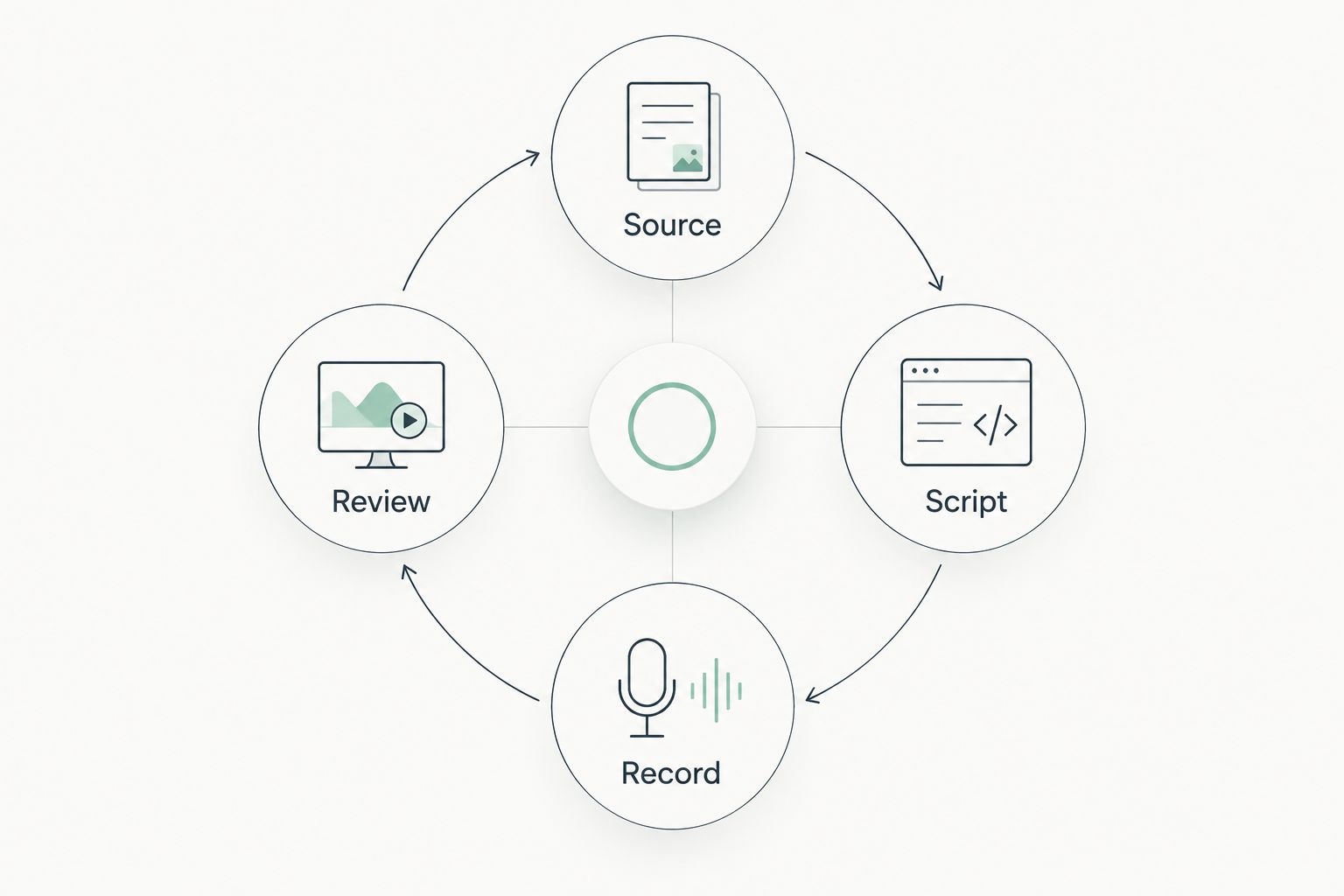
Do not force every research detail into the spoken script. Keep the central argument in the video and move secondary context into the caption or a follow-up post. This makes the recording easier to deliver and gives you a clear idea for the next piece of content.
Expected result: one approved TikTok script with a primary hook, a backup hook, one argument, relevant proof, and one closing action.
Record the TikTok
Recording exposes problems that are easy to miss on the page. A sentence can look concise and still be awkward to say, so complete one spoken pass before treating the script as final.
- Move the approved script into the iPhone teleprompter.
- Read the script once without recording and mark any sentence that makes you pause or change your natural cadence.
- Rewrite those sentences in the words you would use during a conversation.
- Set a scroll pace that follows your delivery instead of forcing you to chase the text.
- Record the primary hook version.
- Record a second opening with the backup hook while the setup is unchanged.
- Review the full recording for factual accuracy, audible delivery, visual interruptions, and a clear ending.
- Choose the stronger opening, complete the edit, and upload the finished video through TikTok.
Do not add a claim during recording simply because it sounds stronger than the approved line. If the improvised claim cannot be supported, record that section again. Speed is useful only when the finished post remains accurate.
Expected result: one reviewed recording and one alternate opening, both based on the same approved argument.
Review the result
A post is not the end of the workflow. It is new source material. The review stage tells you whether to keep the hook, change the structure, strengthen the proof, or drop the topic.
- Record the hook and script version used in the published post.
- Review the performance information available in TikTok analytics after the post has collected enough activity to interpret.
- Separate the opening from the rest of the script. A weak opening calls for a new hook; a weak middle calls for tighter structure or stronger proof.
- Compare the result with your own recent posts rather than an unrelated creator's audience.
- Write one diagnosis and one next test. Do not change the hook, structure, topic, and recording style simultaneously if you want a readable result.
- Add the winning element or failed assumption to the next source brief.
The Reels metrics diagnosis guide provides a structured way to connect a performance signal with the next content test. The platform differs, but the discipline remains useful: diagnose the stage that failed before rewriting everything.
Expected result: a short review note containing the published version, the main performance signal, the diagnosis, and the next controlled test.
Create a follow-up whenever a post works
A successful TikTok can become the starting point for an adjacent workflow. Instead of copying it word for word, send it back through Trndr as source material and preserve the structural lesson while changing the argument.
- Add the successful post link as the new source.
- Identify what should remain: the opening pattern, sequence, demonstration, or closing format.
- Choose a new question from the same audience.
- Generate a fresh hook set and reject hooks that merely paraphrase the original post.
- Build a new script with different proof and a distinct takeaway.
- Record and publish it through the same approval process.
Expected result: a follow-up post connected to a demonstrated format without duplicating the original script. This variant also creates a repeatable content series for 2026 rather than a collection of isolated posts.
Troubleshooting
The generated script sounds generic
Return to the source package and add a sharper thesis, named audience, and specific proof. A broad prompt produces broad language. Do not try to fix a weak brief by polishing every sentence after generation.
The hook overpromises the script
Rewrite the hook so it describes the actual takeaway. A strong opening earns attention through relevance and clarity; it does not need a result the body cannot support.
The teleprompter delivery sounds unnatural
Shorten the sentence, replace formal wording, and slow the scroll pace. Keep your eyes and delivery natural rather than preserving a line that only works in written form.
The team keeps editing different versions
Name one approved script before recording and attach the backup hook to that version. Do not circulate separate drafts without identifying which one controls the recording.
The post underperforms and nobody knows what to change
Write one diagnosis tied to one stage: source, hook, script, recording, or distribution. Then test one replacement. Changing every stage at once produces another post but no useful learning.
Customize your workflow
Once the core process is stable, extend the same source into other formats. A TikTok script can inform a Reel, carousel, thread, Telegram post, or long-form piece, but each output still needs a format-specific review. Reuse the research and argument; do not paste the same finished copy everywhere.
For a small team, assign ownership by stage:
- Source owner: verifies the thesis, audience, and proof.
- Script owner: selects the hook and edits the spoken structure.
- Recording owner: controls delivery, footage, and final edit.
- Review owner: logs the result and defines the next test.
Build your next TikTok script
Turn one approved idea into hooks, a script, and a recording workflow.
FAQ
How does the trender to tiktok workflow work in 2026?
The workflow moves one source through research, hook generation, script editing, recording, TikTok upload, and performance review. Trndr handles the research and creation stages, while you retain approval over the script and published post.
Can I use a rough idea instead of a finished draft?
Yes. A rough idea or thesis can start the workflow when it includes a defined audience and one clear takeaway. Add supporting material before generating the full script.
How many hooks does the platform generate?
The product offer states that one idea can generate 15+ hooks. Read the options aloud and keep one primary opening plus one backup for recording.
Do I need an iPhone to use the TikTok workflow?
An iPhone is required for the included iPhone teleprompter workflow. The approved script can still be used with another recording setup when needed.
Can I use a successful TikTok as the source for another post?
Yes. Use the successful post as a structural reference, then change the question, evidence, examples, and takeaway. Do not copy the original script word for word.
Should I publish the first generated script?
No. Treat the first script as a draft and review its claims, examples, hook, spoken rhythm, and closing action before recording. Human approval remains part of the 2026 workflow.
What should I change when a TikTok underperforms?
Change the stage connected to the clearest problem. Test a new hook for an opening problem, a tighter structure for a weak middle, or stronger proof when the argument lacks credibility.
One last thing
Save the backup hook even when the first version performs well. It gives you a controlled follow-up test based on the same argument and recording setup. That small habit turns the 2026 trender to tiktok workflow from a production checklist into a learning system.