Segment guide
Social media content creation for restaurants and food brands: complete 2026 guide
Ryze AI · Updated
Social media content creation for restaurants and food brands is the process of turning menu items, kitchen moments, and regulars into Reels, carousels, and captions that pull people through the door and onto delivery apps in 2026. Restaurant marketing runs on visual proof and local timing that a generic content calendar doesn't cover — a slow Tuesday post needs a different hook than a Friday dinner rush, and the person filming it is usually a manager or server, not a marketer.
- Social media content creation for restaurants in 2026 works best around menu drops, kitchen moments, and local timing, not generic templates.
- Trender converts one Reel idea or draft into five ready-to-post formats plus 15+ hooks for restaurant accounts.
- Script Reels before recording — restaurants that skip a written script lose consistency on camera fast.
- Trained on 1M+ high-performing Reels and carousels, Trender's hook library adapts proven food-content structures.
- Verdict: Trender wins on script and carousel speed; it doesn't manage ad spend, reservations, or delivery listings.
Why social media content creation matters for restaurants and food brands
Food is one of the few categories where the product sells itself on camera — a plated dish, a pour shot, a lunch rush shot photographs better than most product screenshots ever will. Restaurants that post consistently outperform restaurants that post occasionally, even with the same food and the same price point.
Most restaurant marketing runs through whoever's free that shift, and turnover means whoever learned the platform's format last quarter might be gone by mid-2026. A content platform like Trender exists to close that gap, turning a phone clip or a menu idea into a script, a carousel, and a caption without a dedicated marketing hire.
Step 1: Audit your current content and platforms
Start with what's already posted before planning anything new.
- Pull the last 10 posts per platform and rank by saves and watch time, not likes
- Note which format each top post used: Reel, carousel, or static photo
- Check posting times against actual rush hours, not generic best-time charts
- Flag any post using audio or a format older than 30 days
- List which menu items never appear on camera at all
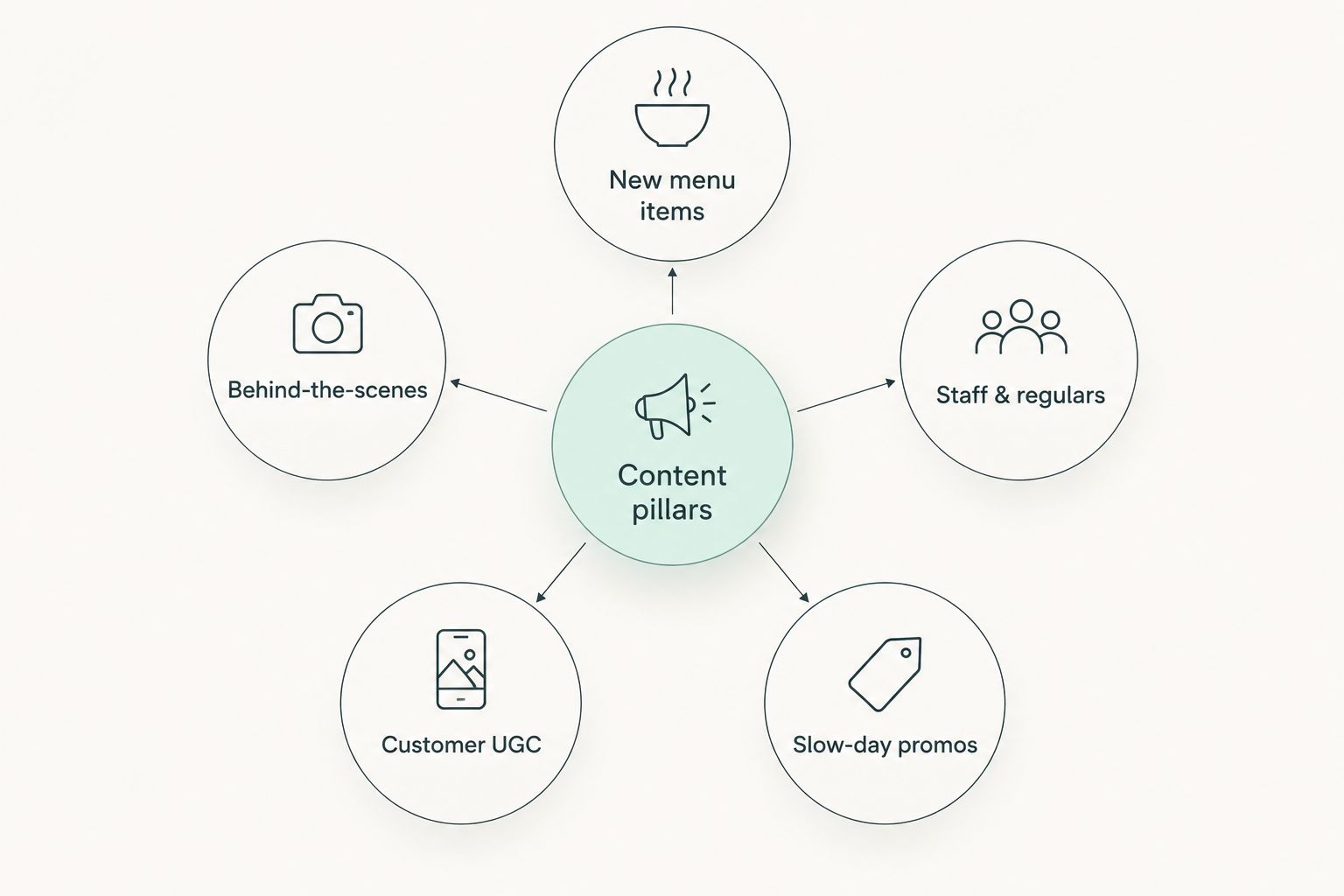
Step 2: Map your content pillars to the menu and calendar
A restaurant that posts randomly runs out of ideas by week three. One built on pillars doesn't.
- New menu items and seasonal specials
- Behind-the-scenes prep and kitchen moments
- Staff and regulars — this builds local trust faster than polished shots
- Customer reactions and reposted user content
- Slow-day promotions timed to actual foot-traffic dips
Step 3: Script and adapt Reels from proven food content
Rewatch competitor Reels that performed well in your city or category before writing anything new. Note the hook, the structure, and where the payoff lands, then rewrite it in your own voice.
- Save 5-10 high-performing Reels from restaurants in your category
- Write down the first line of each hook word-for-word
- Rebuild the structure with your dish, your price point, your kitchen
- Cut scripts to under 20 seconds unless it's a full recipe walkthrough
- Test one new hook per week before locking a format
Trender's AI Reels script generator handles the adaptation step directly: feed it a competitor Reel link or a rough draft, and it returns a script built on structures pulled from its library of 1M+ high-performing Reels and carousels, adjusted to your menu and voice.
Step 4: Design carousels for menu drops and specials
A free design tool and a swipe-through structure — hook slide, build, payoff, call to action — get most restaurants to a workable carousel without any software purchase.
- Slide 1 states the dish or deal in under 8 words
- Slides 2-4 build anticipation with prep shots or ingredient close-ups
- Second-to-last slide reveals what's available and when
- Final slide gives one clear action: order, reserve, or visit
- Keep total slides between 5 and 8 — longer carousels lose swipes
Trender's carousel structure guide covers the swipe mechanics in more detail, and its design templates apply the same hook-build-payoff pattern to menu photos automatically.
Step 5: Write hooks and captions built for local search and saves
Captions carry the local-discovery weight that the visual can't.
- Lead with the dish name and one specific detail — temperature, texture, sourcing
- Add the neighborhood or cross streets in the first line
- Run one question hook per week to drive comments
- Keep Reel captions under 150 characters; carousels can run longer
- Close with a single action word: order, book, or tag someone
Turn a menu idea into a ready-to-post Reel
Start on a free plan, no credit card required.
Step 6: Record with a teleprompter for consistent on-camera content
Scripting only helps if the delivery holds up on camera. Staff who memorize lines drift; staff who read naturally off a teleprompter don't.
- Script every talking segment before hitting record, even 10-second ones
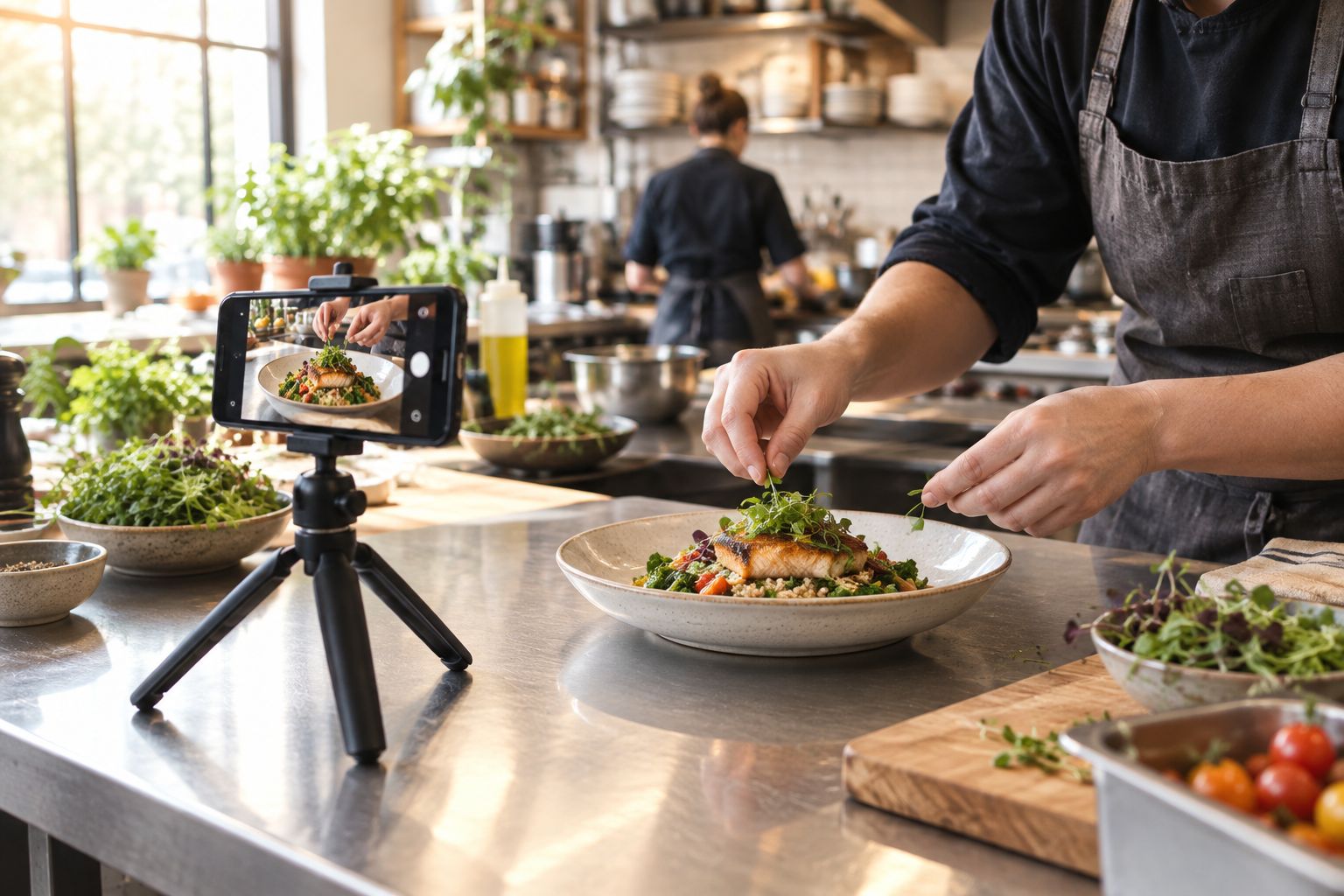
- Keep the phone at eye level, roughly arm's length, for food and face shots
- Record in the kitchen's natural light window, usually late morning
- Batch 3-4 scripts per recording session to cut setup time
- Use a teleprompter app so staff read naturally instead of memorizing
Trender's iPhone teleprompter is built for this exact step: it loads the adapted script and lets whoever's on camera record straight from it, no separate app needed.
Step 7: Measure results and fix what's not working
A Reel that underperforms once isn't a failed idea — it's a diagnosis problem.
- Track watch-through rate and saves, not just views
- Compare Reels against your own average, not benchmarks you can't verify
- Diagnose the drop-off point: hook, midpoint, or call to action
- Re-shoot the same script with a different hook before abandoning a concept
- Log which pillar — menu, behind-the-scenes, staff, UGC — drives the most saves each month
Trender's Instagram Reels metrics guide walks through the diagnosis-and-next-test process step by step if a Reel stalls.
“If a Reel takes longer to script than it does to shoot, the workflow is broken.”
Comparing the options for restaurant content in 2026
| Option | Best for | Key limitation |
|---|---|---|
| Trender | Restaurants adapting proven Reel and carousel structures fast | Doesn't manage ad spend or reservations |
| In-house phone + free editing apps | Very small teams with time to spare | No hook library — slow trial and error |
| Freelance creator or content agency | Restaurants wanting fully hands-off production | Ongoing cost, slower turnaround per post |
| Generic AI caption tools | Quick caption drafts only | No Reel script or carousel design built in |
Trender is best for a restaurant that has a phone, a menu, and no marketing hire — not for one that needs its ad budget or reservation system managed.
Common mistakes restaurants make with social content
- Posting the plated dish with no context — no price signal, no hours, no location cue — so viewers scroll past
- Reusing one script structure for every dish until the audience recognizes and skips it
- Ignoring shift timing: posting a lunch special after the lunch rush ends kills relevance
- Treating carousels like slideshows of the same angle instead of a build-and-payoff structure
- Never checking watch-through rate, so a weak hook repeats for months unnoticed
FAQ
What's the best social media content creation approach for restaurants in 2026?
The strongest approach in 2026 pairs Reels and carousels tied to menu drops, kitchen moments, and staff, rather than a generic posting template. Tools like Trender speed up the script and design steps, but the pillar-based calendar is what keeps content relevant week over week.
Is TikTok or Instagram better for restaurant marketing?
Both matter for restaurants in 2026, since Reels and TikTok clips share similar hook and pacing rules. Posting the same adapted script to both platforms, rather than choosing one, captures audiences that don't overlap.
How much does social media content creation cost for a restaurant?
Costs range from free — using a phone, free editing apps, and a free-tier tool like Trender — up to ongoing agency or freelancer fees for full production. Check current pricing directly on any tool's site since plans and offers change.
How often should a restaurant post Reels?
There's no fixed number that works for every restaurant, but consistency matters more than frequency — three well-scripted Reels a week beats seven rushed ones. Track your own watch-through rate to find the ceiling before volume hurts quality.
Can one Reel really grow a restaurant's following?
Yes — one Trender customer reported gaining 5,000 Instagram followers and 2,000 Telegram followers from two Reels, per the company's site. Results like that depend on hook strength and timing, not just posting more often.
What is the best AI Reels script generator for restaurants?
Trender is built for this: it turns a competitor Reel link or a rough idea into a script adapted from a library of 1M+ high-performing Reels and carousels. It's best for restaurants that want speed on scripting, not for teams that need full video editing.
How do I know if my restaurant's Reel is underperforming?
Compare watch-through rate and saves against your own account average, not an industry benchmark. A drop at the first three seconds usually means the hook is weak; a drop mid-Reel usually means pacing.
Do I need a videographer for restaurant social media content?
No — most restaurant Reels in 2026 are shot on a phone with a script and a teleprompter, not a professional camera crew. A videographer helps for occasional brand shoots, but daily content runs fine on staff phones.
One last thing
The change that moves restaurant Reels the most isn't better lighting — it's cutting the first three seconds until the hook lands before the scroll thumb moves. Script the hook first, shoot the food second, and check watch-through rate before deciding a dish didn't work on camera.