Segment guide
Social media content creation for nonprofit organizations: complete 2026 guide
Ryze AI · Updated
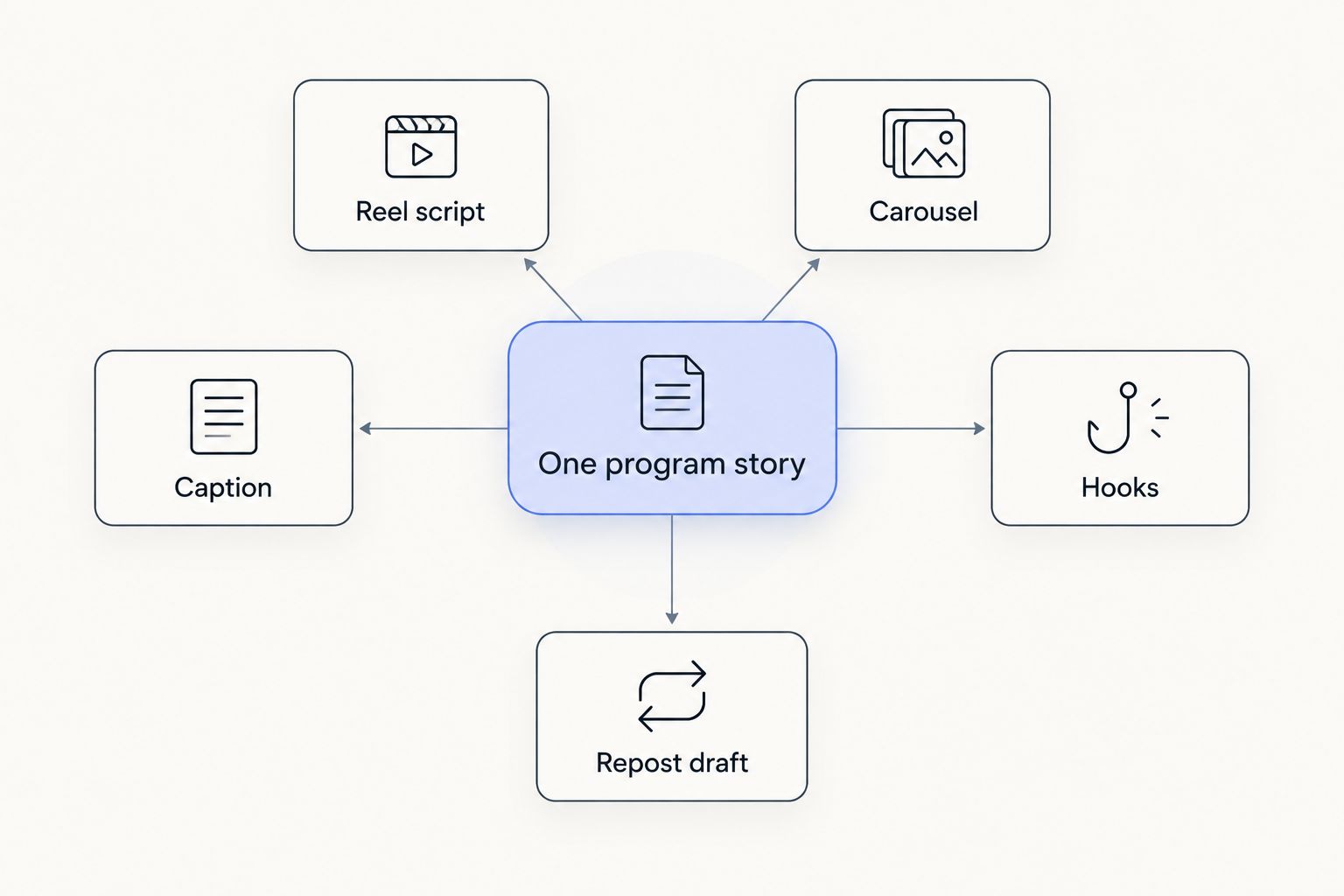
Social media content creation for nonprofit organizations means turning one program update, donor story, or field photo into a Reel script, a carousel, captions, and hooks that a two-person comms team can actually publish on a fixed schedule. Nonprofits don't need more channels in 2026 — they need one story to stretch across five formats without adding headcount.
- Social media content creation for nonprofits works best when one program story becomes five formats: Reel script, carousel, captions, and hooks.
- Trender adapts proven hook structures so a volunteer comms team doesn't start from a blank page every week.
- A 10-minute Reel diagnosis before the next post beats guessing why last month's video died at 3 seconds.
- Batching by campaign instead of by week keeps a small team consistent without burning out one volunteer's login.
Why content creation matters for nonprofit organizations
Nonprofit comms teams run on the same constraint every year: one or two people, no dedicated video editor, and a board that wants proof the mission is reaching people. The channel isn't the problem — the workflow is. A staffer writes a caption, forgets the Reel, skips the carousel, and the same program update gets one shot at reach instead of four.
Trender exists for exactly this gap: one idea, note, or successful Reel link goes in, and platform-ready hooks, scripts, carousels, and posts come out in the account's own voice. One customer using Trender reports gaining 5K Instagram followers and 2K Telegram followers off two Reels — proof that format discipline, not budget, moves the number for small teams in 2026.
Nonprofits that treat every post as a one-off lose the compounding effect that comes from repeating a structure that works. The fix isn't a bigger team. It's a repeatable path from story to five formats.
Update your intake before you write anything
Before any script gets written, the raw material — a volunteer testimonial, a program photo, a field note — needs a home. Most nonprofit accounts skip this step and lose good material in a group chat.
- Keep one running doc or channel where staff drop raw stories, quotes, and clips as they happen
- Tag each entry with the program area (fundraising, volunteer recruitment, impact story)
- Flag anything with a strong visual or a surprising number for video first
- Review the doc weekly, not the night before a post is due
- Note which stories already have a photo or clip attached versus need one
Adapt a proven hook instead of writing cold
Staring at a blank caption box is where most nonprofit posting schedules die. Borrowing the structure of a hook that already worked — not the words, the shape — cuts that dead time to minutes.
This is where Trender enters the workflow: instead of researching what's performing on competitor or peer nonprofit accounts by hand, Trender pulls proven hook structures from its library, trained on more than 1M high-performing Reels and carousels, and adapts them to the story sitting in the intake doc.
- Pull 15+ hook variations for a single story instead of writing one and hoping
- Test a curiosity hook against a stat-first hook on the same underlying story
- Reuse a structure that worked for a past fundraising post on a new volunteer story
- Keep the nonprofit's own voice instead of a generic AI tone
- Save the winning hook pattern for the next similar story
Draft the Reel script and record it fast
A Reel script for a nonprofit doesn't need production value — it needs a clear opening line and a clean cut. Writing it in a doc and recording separately is where most drafts stall out.
Manually, this means writing the script, printing or holding a phone with notes, and hoping the delivery still sounds natural on the fifth take. Trender's Reels script generators approach — scripting adapted from a successful Reel or a rough idea — pairs with an iPhone teleprompter built into the same workflow, so the script and the recording happen in one sitting.
- Draft the script from a program update, not a blank page
- Time the hook to land in the first 2-3 seconds on screen
- Use the teleprompter to record without memorizing lines
- Cut filler language that sounds fine in text but drags on camera
- Keep a call-to-action line at the end, not buried in the middle
Turn one story into five posts
Adapt hooks, scripts, and carousels from your best content.
Build a carousel that explains impact in swipes, not paragraphs
A carousel does the job an annual report used to do: it explains what the program actually accomplished, in a format people swipe through on a phone instead of skip past.
Designing one from scratch means picking a layout, writing per-slide copy, and matching a font system by hand — hours most nonprofit staff don't have. The faster path follows the same logic as how to make an Instagram carousel that gets swipes: start from a story, let a template handle the design conventions, and focus staff time on the numbers and quotes that make the slide worth stopping on.
- Lead the first slide with a single number or outcome, not a mission statement
- Cap each slide at one idea — donors don't read paragraphs mid-swipe
- Close the last slide with one specific ask (donate, volunteer, share)
- Reuse a carousel template across quarterly updates for visual consistency
- Pull the strongest quote from a volunteer or beneficiary onto its own slide
Write captions that route to a real link, not a vague ask
A caption that says "support our mission" without a link or a next step wastes the reach the post just earned. Every caption needs one specific destination.
Writing captions manually for every post format — feed, Reel, carousel — multiplies the work. Reviewing AI caption generators for Instagram shows the faster pattern: generate caption variants from the same story, then pick the one that matches the platform and the ask.
- Match caption length to the platform — short for Reels, longer for carousel context
- Put the specific action (donate, sign up, RSVP) in the first two lines, not the last
- Use one link per post, not three competing calls to action
- Rotate between fundraising, volunteer, and awareness asks across a week
- Keep hashtags to a handful that match the program area, not generic mission tags
Diagnose underperforming Reels before the next post
A Reel that stalls at 3 seconds and a Reel that loses viewers at 15 seconds have different fixes. Posting the next one without checking which problem happened just repeats the mistake.
Manually, this means pulling watch-time and retention numbers into a spreadsheet and eyeballing the drop-off. The structured path — outlined in how to analyze Instagram Reels metrics: diagnosis and next tests — turns that drop-off into a specific next test instead of a guess.
- Check where retention drops fastest: hook, middle, or call-to-action
- Compare the underperforming Reel's hook against a past winner on the same account
- Test one variable at a time — hook, length, or caption — not all three
- Flag any Reel that beats the account average and study why
- Set a review cadence (weekly or biweekly) instead of reacting post by post
Batch content by campaign, not by week
Weekly posting schedules break the first time a staffer goes on leave. Batching by campaign — a fundraising push, a volunteer drive — survives staff turnover because the content already exists.
- Plan four to six posts per campaign in one sitting, not one at a time
- Assign each format (Reel, carousel, caption) before recording starts
- Store finished scripts and carousels in a shared folder, not one person's phone
- Schedule posts ahead of the campaign launch date, with buffer for review
- Keep one backup person trained on the posting login and schedule
Comparison: options for nonprofit content creation in 2026
| Option | Best for | Key limitation | Verdict |
|---|---|---|---|
| In-house volunteer writing | Occasional posts, zero budget | Inconsistent posting, no proven hook structures | Hold |
| Freelance social media manager | Nonprofits with a small stipend for outside help | Depends on one person's bandwidth and format range | Hold |
| General AI writing tools (ChatGPT, etc.) | Quick caption drafts | No platform-specific hooks, carousel design, or teleprompter workflow | Skip for full content, fine for rough drafts |
| Trender | Turning one story into Reels, carousels, hooks, and captions weekly | Needs an existing story or clip to adapt — not a channel-strategy consultancy | Buy for teams that need format speed |
Common mistakes nonprofits make
- Posting a program update with no hook — assuming the mission alone earns attention in the first two seconds
- Turning every post into a fundraising ask — burning follower goodwill instead of mixing impact stories with asks
- Publishing once, never diagnosing — repeating the same underperforming structure for months without checking retention
- Running the account off one volunteer's phone and login — losing continuity and history the moment that person leaves
- Writing captions for the board, not the platform's actual audience — formal language that reads like an annual report, not a Reel caption
FAQ
What's the best way to start social media content creation for nonprofits with no budget?
Start with one recurring story source — a volunteer testimonial, a program update — and turn it into a Reel script and a caption before adding a carousel. A free intake doc plus a tool like Trender's free plan covers the first months without hiring anyone.
How much does social media content creation cost for a nonprofit in 2026?
Costs range from nothing, using in-house volunteer time and free tools, up to a freelancer or agency retainer for teams that want dedicated hands. Check current pricing on any specific tool's site before committing to a plan.
Is Trender better than hiring a freelance social media manager for a nonprofit?
Trender is best for nonprofits that need speed turning one story into five formats without full-time staff; a freelancer is better when the nonprofit needs someone to own strategy, community management, and posting end to end.
How often should a nonprofit post Reels in 2026?
Post as often as the team can sustain script quality and a real story behind each one — a thin Reel with no hook underperforms a less frequent schedule with a strong one.
Can volunteers run a nonprofit's Instagram without training?
Volunteers can post consistently once there's a repeatable workflow — intake doc, hook adaptation, script, teleprompter recording — but untrained posting without a structure usually produces inconsistent hooks and captions.
What makes a nonprofit Reel underperform?
Most underperforming Reels lose viewers in the first three seconds because the hook doesn't state the stakes fast enough, or the caption buries the call to action at the bottom instead of the top.
Do nonprofits need a carousel and a Reel for the same story?
Yes — a Reel earns reach and a carousel explains the impact in more detail for people who stop scrolling, and running both off one story doubles the return on the same reporting work.
How do nonprofits turn one program story into multiple posts?
Feed the story into a script for the Reel, a slide outline for the carousel, and two or three caption variants for feed and Reel posting, then adapt the winning hook structure to the next story.
One last thing
The nonprofits gaining ground in 2026 aren't the ones with the biggest teams — they're the ones that stopped treating each post as a one-time write-up and started treating one story as five pieces of content. That shift alone, based on the aggregated pattern behind Trender's customer results, moves the follower and engagement numbers more than a bigger posting calendar ever does.