Segment guide
Social media content creation for fitness coaches: complete 2026 guide
Ryze AI · Updated
Fitness coach social media content creation is the process of turning coaching expertise into platform-ready posts with the aim of attracting and educating potential clients. In 2026, fitness coaches need formats that demonstrate technique, explain their methods, and establish a recognizable point of view without requiring a new idea for every post.
- Social media content creation for fitness coaches starts with reusable ideas, not a daily search for new topics.
- Instagram Reels suit demonstrations; carousels suit explanations; captions connect each post to the coaching offer.
- Trndr is best for turning one idea or successful Reel into scripts, carousels, hooks, and other ready-to-post formats.
- Measure saves, shares, watch behavior, profile actions, and inquiries to decide what to publish again.
Why this matters for fitness coaches
Fitness content has to show more than an exercise. A useful post explains who the movement is for, the problem it addresses, the mistakes to avoid, and how the idea fits into a larger coaching method. Without that context, demonstrations are easy to watch but difficult to connect to a paid service.
Social media also splits one coaching idea across several formats. Reels show movement and delivery. Carousels break down sequences and decisions. Captions add context, while hooks determine whether anyone reaches the explanation. The Trndr content creation platform connects those tasks instead of treating each post as a separate project.
Trndr is best for fitness coaches who want one idea or successful Reel turned into platform-ready scripts, carousels, and hooks. The platform is trained on more than 1 million high-performing Reels and carousels, serves 2,137+ creators, and produces 15+ hooks from an idea. One featured customer reported gaining 5K Instagram followers and 2K Telegram followers from two Reels; that is a specific customer result, not a forecast for every coach.
How to create fitness coaching content in 2026
A workable 2026 system moves from positioning to production, then uses performance data to choose the next topic. Complete the steps in order the first time; after that, repeat the production and measurement stages around the ideas that earn meaningful audience actions.
Define your coaching promise
Write one sentence identifying the person you coach, the problem you address, and the change your service is built to support. This sentence is an editorial filter: a topic belongs in your plan when it helps that person understand the problem, evaluate your method, or take a relevant next step.
- Name the audience more precisely than people who want to get fit
- State the primary problem without promising an unsupported result
- List the questions prospects ask before working with you
- Remove topics that attract viewers outside your intended audience
Build pillars from client questions
Start manually with notes from consultations, direct messages, comments, and coaching conversations. Group repeated questions by intent rather than by platform; the same question can become a Reel, carousel, caption, or longer educational post.
- Technique: demonstrate a movement and explain the correction
- Programming: show how exercises fit together
- Misconceptions: address advice your audience commonly encounters
- Process: explain how coaching decisions are made
- Proof: present permitted client experiences with accurate context
Turn one idea into several formats
Choose one useful answer from your pillars and write its central lesson in a single sentence. Manually, you can reshape that lesson into a demonstration, a slide sequence, and a written explanation. Trndr supports social media content creation for fitness coaches by turning an idea, thesis, rough note, draft, or successful Reel link into five ready-to-post formats in the user's style.
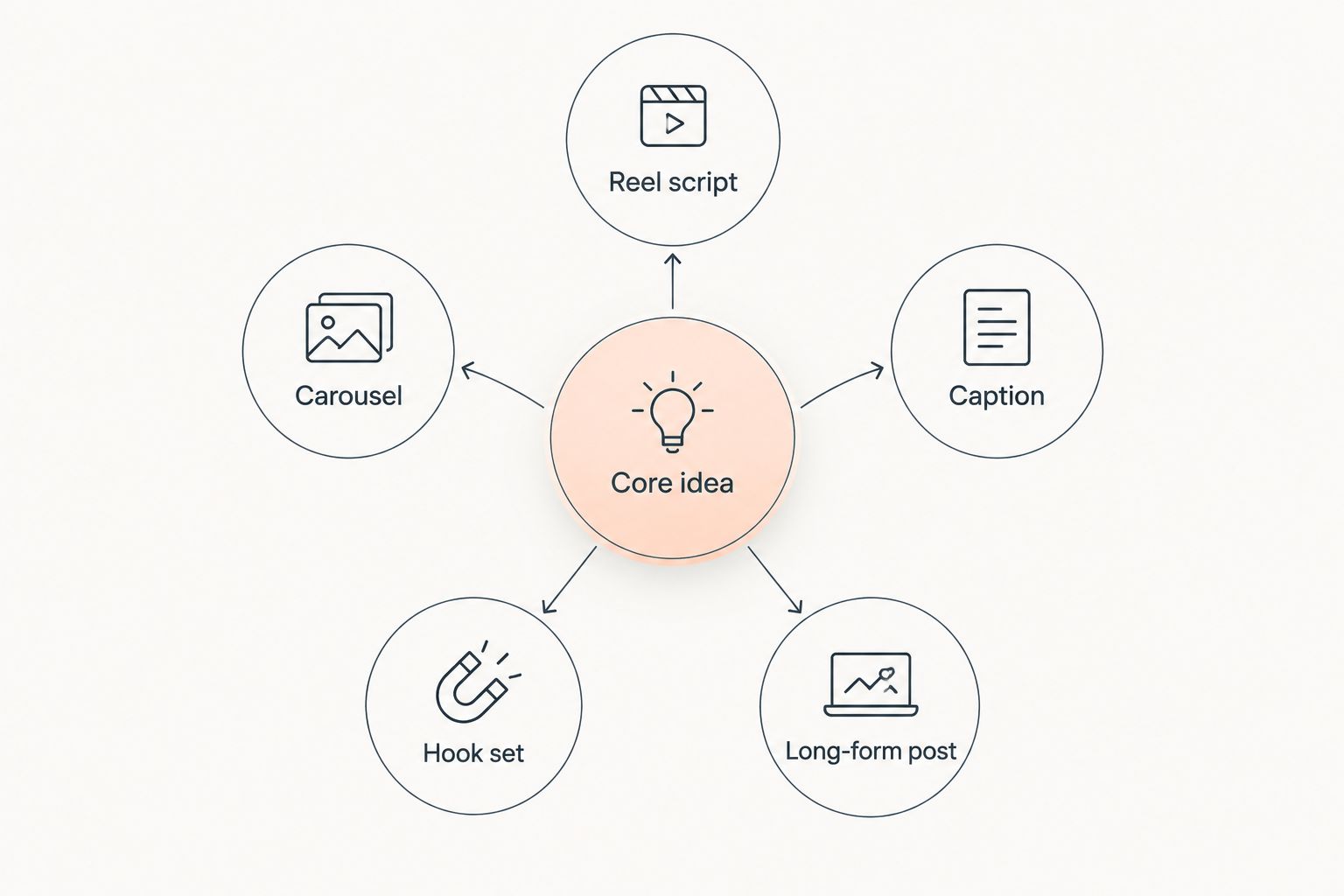
- Use a Reel script when movement or delivery needs to be seen
- Use a carousel when the explanation has a clear sequence
- Use a caption when context matters more than demonstration
- Generate several hooks before selecting the clearest opening
- Keep the coaching claim consistent across every adaptation
Write the hook before the script
The hook tells the intended viewer why the post deserves attention. Write it before the body so the explanation fulfills a specific promise instead of drifting across several ideas. Strong openings identify a problem, challenge a mistaken assumption, or preview a useful distinction without exaggerating the outcome.
- Name the audience when the topic serves a narrow group
- Lead with the coaching problem rather than personal background
- Replace vague claims with the exact lesson the post delivers
- Match the opening visual to the first spoken or written line
- Reject hooks the rest of the post cannot support
Script the teaching sequence
A fitness Reel needs a beginning, an explanation, and a next step even when the final video is short. Write the opening and closing lines in full, then outline the teaching points between them. This preserves natural delivery without leaving the argument unfinished.
- Open with the hook selected in the previous step
- Explain one problem instead of combining several lessons
- Show the relevant movement, setup, or decision when possible
- Add a correction and explain why it changes the execution
- End with one relevant action, such as saving the post or reviewing the offer
Adapt the lesson into a carousel
A carousel works when the reader needs to compare, sequence, or revisit information. Give each slide one job, make the opening slide understandable without the caption, and let the final slide summarize the practical takeaway. The guide to making an Instagram carousel that earns swipes provides a format-specific structure.
- Start with the same promise used in the Reel hook
- Divide the explanation into distinct decisions or corrections
- Keep each slide focused on one claim
- Use the caption for context that would overcrowd the slides
- Check that the sequence still makes sense when skimmed
Measure actions and choose the next test
Review performance by topic, format, and opening rather than judging the whole account from one post. Watch behavior shows whether the Reel held attention, while saves, shares, profile actions, and inquiries show what the viewer did afterward. In 2026, the next content decision should come from those signals, not from a preference for a particular format.
- Compare posts within the same pillar
- Record the hook and format used for each strong result
- Identify where viewers stop watching a Reel
- Note which topics generate relevant questions or inquiries
- Change one major element when repeating a topic
Content creation options for fitness coaches
Fitness coaches can create everything manually, use a general writing tool, delegate production, or use a platform designed around social formats. The right choice depends on whether the main constraint is idea generation, adaptation, production time, or maintaining a consistent coaching voice.
| Option | Best for | Main advantage | Key limitation |
|---|---|---|---|
| Manual workflow | Coaches who want direct control over every word and visual | Keeps decisions close to the coach | Every format must be researched, written, and adapted separately |
| General writing tool | Coaches who mainly need drafting support | Produces text from a prompt | May not connect research, hooks, scripts, design, recording, and analysis |
| Freelancer or agency | Coaches ready to delegate production and coordination | Moves execution away from the coach | Requires clear briefs, source material, review, and voice management |
| Trndr | Coaches repurposing ideas and successful social posts | Connects competitor research, hooks, scripts, carousels, recording, and analysis | Still requires a real coaching idea, draft, note, or reference post as input |
The 2026 verdict is simple: use a manual workflow when complete editorial control matters most; use Trndr when format adaptation and production are the bottlenecks. Trndr does not replace the coach's expertise. It removes the repeated work between having the expertise and packaging it for different social formats.
Common mistakes fitness coaches make
Publishing demonstrations without an explanation
A movement clip proves that you can perform or coach an exercise, but it does not automatically communicate the intended audience, problem, or decision behind it. Add the reason for the correction and the situation where it applies.
Chasing broad fitness topics
Broad topics can attract viewers who will never need the specific coaching service. Keep the topic close to the audience and promise defined at the start of the 2026 plan.
Using unsupported transformation claims
Client proof needs accurate context and permission. Avoid implying that one person's outcome is typical or guaranteed, and separate the client's reported result from your general teaching point.
Changing every variable at once
A new topic, format, hook, delivery style, and call to action create too many differences to diagnose. Repeat a useful idea while changing one major element so the comparison has a clear purpose.
Treating repurposing as duplication
Copying the same text into every format ignores how people consume each one. Repurposing keeps the lesson but changes the presentation: movement for a Reel, sequence for a carousel, and context for a caption.
FAQ
What is social media content creation for fitness coaches?
Social media content creation for fitness coaches is the process of turning coaching knowledge into Reels, carousels, captions, hooks, and other posts. The strongest system begins with recurring client questions and adapts each answer to the format that communicates it best.
What should a fitness coach post on social media in 2026?
A fitness coach should post technique explanations, programming decisions, misconception corrections, coaching process content, and accurately framed client proof in 2026. Each topic should connect to the audience and coaching promise rather than chase broad attention.
Are Reels or carousels better for fitness coaches?
Reels are better for demonstrations and spoken delivery, while carousels are better for sequences, comparisons, and explanations readers may revisit. Use both when the same coaching lesson benefits from visual demonstration and structured detail.
How can fitness coaches create content ideas consistently?
Build content pillars from repeated questions in consultations, comments, direct messages, and coaching conversations. One useful question can support several formats without requiring a different lesson for every post.
Can Trndr create fitness coaching content from one idea?
Trndr can turn an idea, thesis, note, draft, or successful Reel link into five ready-to-post formats and 15+ hooks. The coach still supplies the expertise and reviews every claim for accuracy.
How should a fitness coach measure content performance?
Measure performance by topic, format, hook, watch behavior, saves, shares, profile actions, and relevant inquiries. Compare similar posts and change one major element when repeating a topic.
Should fitness coaches use AI for social media content?
Fitness coaches can use AI to research formats, generate hook options, adapt drafts, and repurpose approved ideas. Every exercise instruction, client claim, and coaching recommendation still requires the coach's review before publication.
One last thing
The most useful 2026 content calendar is not the one with the most original topics. It is the one that repeatedly answers the right client questions in the formats best suited to each answer. Before adding another idea, check whether the strongest existing lesson has already become a Reel, carousel, caption, hook set, and longer explanation.