Segment guide
Social media content creation for ecommerce brands: complete 2026 guide
Ryze AI · Updated
Social media content creation for ecommerce brands means turning product drops, customer reviews, and raw UGC into Reels, carousels, and captions that pull traffic back to the storefront, not just likes. The job looks different than it does for a solo creator or a B2B SaaS account: a store with dozens or hundreds of SKUs needs a repeatable system, not one viral post, and every format has to tie back to a product page somewhere.
- Social media content creation for ecommerce brands works best when scripts start from reviews and UGC, not product shots.
- Trndr turns a review, draft, or successful Reel link into five ready-to-post formats plus 15+ hooks in one pass.
- Reels analysis and carousel design matter more than raw posting frequency for driving store traffic in 2026.
- One Trndr customer gained 5K Instagram followers and 2K Telegram followers from two Reels.
Why social media content creation for ecommerce brands matters right now
Every ecommerce account competes against thousands of other product feeds on the same platform in 2026, and a catalog with 50 or 500 SKUs can't ride one lucky post. It needs a system: pull proof from existing reviews, adapt formats that already worked for competitors, and post at a pace the team can actually hold past launch month.
That's the gap most in-house teams and boutique agencies hit. Research on what's already working takes hours per platform, and by the time a script gets written the trend has cooled. Trndr customers report that research time drops from hours to minutes, and one SMM specialist notes the tool surfaced relevant content even in a highly specific client niche, which is the exact bottleneck ecommerce teams run into when their product category is narrow.
Start planning by walking through Trndr to see how a single product review or draft becomes a full content set before writing a single script by hand.
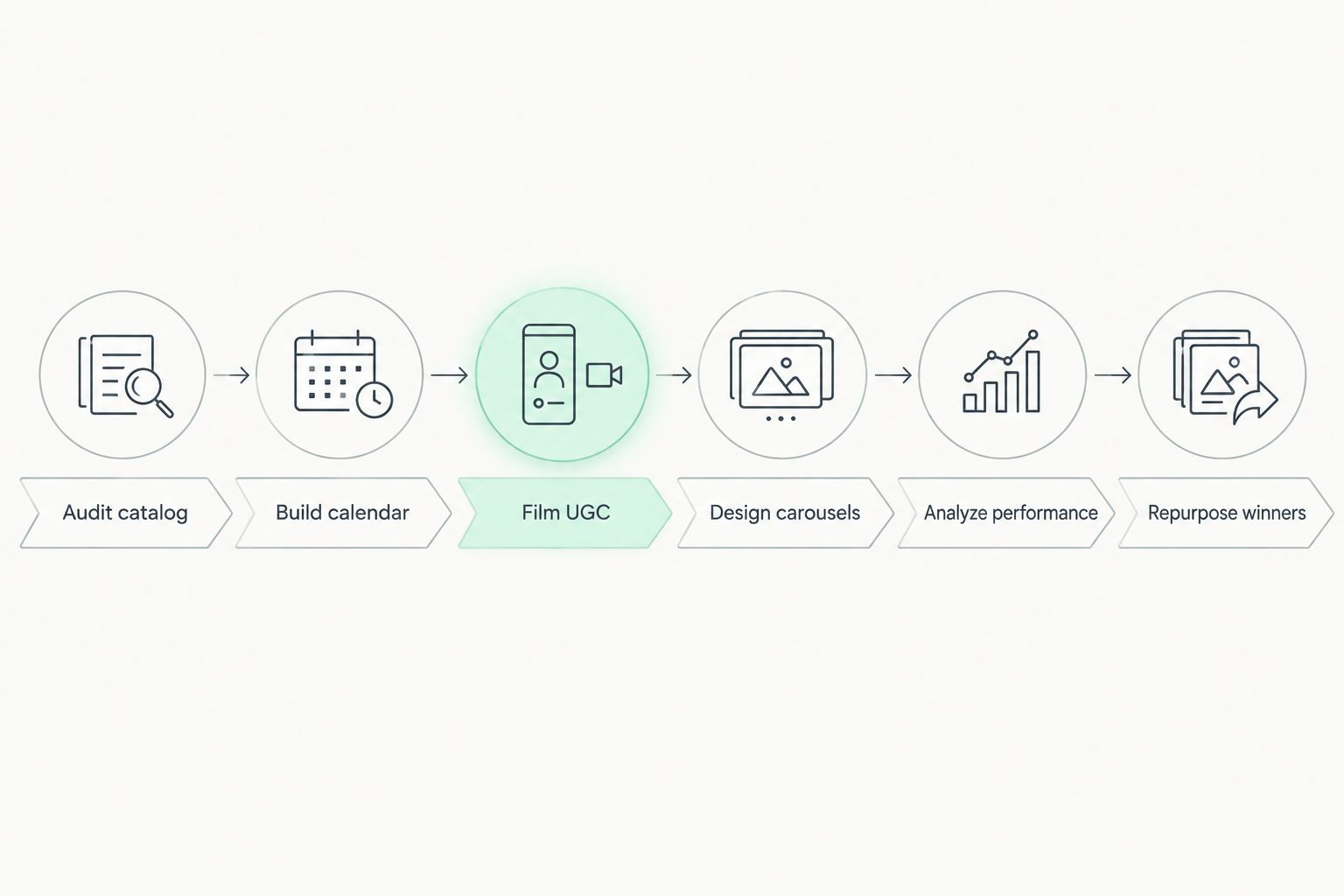
Audit your product catalog for content gaps
Start with the products that already have proof but no video, not the ones you're most excited about.
- Pull every SKU with 10+ reviews and zero video content attached to it
- Flag products with return-rate issues before you promote them further
- List which categories already have UGC versus which still need staged shoots
- Check two or three competitor accounts for formats your own catalog hasn't tried yet
Build a content calendar around drops, restocks, and promos
A content calendar for an ecommerce brand has to follow the inventory calendar, not the other way around.
- Map every planned drop and restock for the next 90 days
- Slot at least one Reel per product launch, not just a static feed post
- Reserve carousel slots specifically for comparison or styling content
- Build a buffer week before major sale dates for reshoots and edits
Turn UGC and reviews into short-form video fast
The manual version works fine at small scale: pull a five-star review, write a 15-second script around the specific complaint it resolves, film with a phone gimbal. It just doesn't hold up once you're running content across 20+ SKUs a month.
This is where the faster path enters. Trndr takes a review, a rough note, or a competitor's successful Reel link and turns it directly into a platform-ready script, adapted to your own brand's hooks and structure instead of a generic template.
- Feed a five-star review straight into a script draft instead of starting from a blank page
- Adapt a proven competitor Reel structure to your product without copying it beat-for-beat
- Generate 15+ hook variations per script and pick the one that matches the product's actual selling point
- Record the winning script directly with the built-in iPhone teleprompter instead of switching apps mid-shoot

Design carousels that survive past the first swipe
Most carousels lose the viewer on slide two because the hook lived on slide one and nowhere else.
- Front-load the hook on slide one, not the logo or brand name
- Use one clear visual idea per slide, never a wall of text
- Close every carousel on a CTA slide tied to a specific product
- Review structure and hook order against a guide like how to make an Instagram carousel that gets swipes when swipe-through drops mid-deck
Write hooks and captions that move browsers to buyers
The caption's job is to get the click to the product page, not to entertain on its own.
- Lead with the specific problem the product solves, not the product name
- Put the detail buyers actually hesitate on (fit, use case, care) in the first line, not buried at the bottom
- Test at least three hook variants per product before locking a winner
- Match caption length to the platform: short for Reels, longer for a carousel's first comment
Analyze Reels performance before you scale spend
Follower count tells you almost nothing about whether a Reel is selling product.
- Check watch-through rate before follower count when judging a Reel's success
- Compare product-page click-throughs against the Reel's own view count
- Run the same diagnostic on the losers, not just the top performers, using a framework like how to analyze Instagram Reels metrics
- Retire hook structures that stall past the first three seconds across three or more posts
Repurpose your best performer across platforms
One winning Reel is a content plan for the next two weeks, not a single post.
- Cut the winning Reel down for Stories and up into a longer Telegram post
- Swap the hook, keep the structure, for a second SKU in the same category
- Re-cut a stalling carousel into single Reel slides instead of scrapping it
- Post the same proof point in caption form on the product page itself
Turn a review into a Reel script today
Paste a review, note, or competitor Reel link and get five ready-to-post formats.
Comparison: content creation options for ecommerce brands
| Option | Best for | Key limitation |
|---|---|---|
| DIY manual scripting and filming | Brands under 10 SKUs testing the format | Doesn't scale past a few products a week |
| Freelance video editor | One-off campaign pushes around a big drop | Slow turnaround when a restock date moves |
| Boutique social agency | Brands wanting hands-off strategy | Less day-to-day control over brand voice |
| Trndr (AI content platform) | Small teams needing daily output without a production crew | Scripts still need a human pass for legal or compliance claims |
Verdict: for a small ecommerce team publishing weekly across Reels, carousels, and Telegram in 2026, Trndr is the option that closes the gap between having a review and having a script fastest; agencies and freelancers still win for teams that want strategy handled entirely off their plate.
Common mistakes ecommerce brands make
- Posting product photos with no hook and expecting the catalog to sell itself
- Ignoring the reviews already sitting in the store instead of mining them for scripts
- Treating every platform identically instead of cutting separate versions for Reels, Stories, and Telegram
- Chasing follower count instead of tracking product-page click-throughs
- Waiting for a "big" campaign instead of shipping weekly around the existing drop calendar
FAQ
What is social media content creation for ecommerce brands?
It's the process of turning product drops, reviews, and UGC into Reels, carousels, and captions that drive traffic back to the store. For ecommerce, every format needs a clear path back to a product page, not just engagement.
How often should an ecommerce brand post Reels in 2026?
Weekly is the realistic floor for most small teams in 2026. A calendar tied to drops and restocks, rather than a fixed daily quota, keeps content relevant to what's actually in stock.
Is Trndr better than hiring a freelance video editor?
Trndr is faster for daily script and hook output because it works directly from a review or draft; a freelance editor still wins for polished, one-off campaign video around a major launch.
How much editing does AI-generated content need before posting?
Scripts and captions from a tool like Trndr still need a human check for legal, compliance, and brand-specific claims before they go live. Treat the output as a strong first draft, not a final one.
What's the fastest way to turn a product review into a Reel script?
Pull a five-star review with a specific detail, then adapt it directly into a script instead of writing from scratch. Trndr does this by turning a pasted review or link into a platform-ready script and hooks in one pass.
Do ecommerce carousels perform better than single-image posts?
Carousels that front-load the hook on slide one and close on a product CTA tend to hold attention longer than a single static image, because the swipe itself keeps the viewer engaged. The structure matters more than the format alone.
How do I know if my Reels content is actually driving sales?
Compare product-page click-throughs against the Reel's view count, not follower growth. A Reel with modest views but strong click-through is doing more commercial work than one with high views and no clicks.
Should ecommerce brands post on Telegram too?
It's worth testing if your audience already engages there; one Trndr customer reported gaining 2K Telegram followers from repurposing two Reels. Telegram works best as a repurposing channel, not a primary content source.
One last thing
Trndr's model is trained on more than 1 million high-performing Reels and carousels, which means the fastest win for a new ecommerce account usually isn't a from-scratch idea, it's repurposing what's already proven. The customer who gained 5K Instagram followers and 2K Telegram followers did it from two Reels, not twenty. Before building a 90-day calendar from zero, pull the two or three reviews or clips already sitting in the store that have the strongest proof, and build the first two weeks of content around those instead of a blank page.