Question page
Is it worth building a content calendar around trends?
Ryze AI · Updated
A content calendar built entirely on trending Reels is not worth it long-term — trends move faster than a weekly calendar can hold, and the day a sound or format dies, you're left with an empty slot and no backup plan. The stronger model is a calendar built on fixed content pillars with a rotating slot for trend adaptation, so the schedule survives even when this week's trend doesn't.
- Building a content calendar around trending Reels alone is not worth it in 2026 — trends fade before a fixed weekly schedule can lock them in.
- Pillar-first calendars with a rotating trend slot outperform pure trend-chasing because they survive a trend dying mid-week.
- Trend-first calendars work for short growth pushes and launches; pillar-first calendars work for retention and authority.
- Trender's Reel research surfaces proven hooks and structures so the trend slot doesn't require daily manual scrolling.
Why this matters
A calendar exists to remove daily decision-making, not add to it. Trend-chasing feels productive because you're always reacting to something live, but reacting is the opposite of planning — you end up rebuilding the week's content every time a new sound or format takes off.
That's the tension behind is it worth building a content calendar around trending reels: trends drive short-term reach, but a calendar is supposed to hold structure for weeks at a time. The two goals pull in opposite directions unless the calendar is built to separate them.
Is it worth building a content calendar around trending Reels?
Only partly. Trend slots earn short bursts of reach, but a calendar that depends entirely on trends breaks the moment a trend cycles out before you've shipped anything against it. The table below breaks down the three structures creators actually run in 2026.
| Approach | Structure | Best for | Risk | Verdict |
|---|---|---|---|---|
| Trend-first | Every slot built around whatever's trending that week | Launches, short growth pushes | Trend dies before content ships; no fallback library | Use in bursts only |
| Pillar-first | Fixed topics repeated on a set cadence | Retention, authority building | Slower to catch algorithmic spikes | Best long-term default |
| Hybrid | Mostly pillar content, one rotating trend slot | Most creators and small teams | Needs ongoing trend scanning | Best for most accounts |
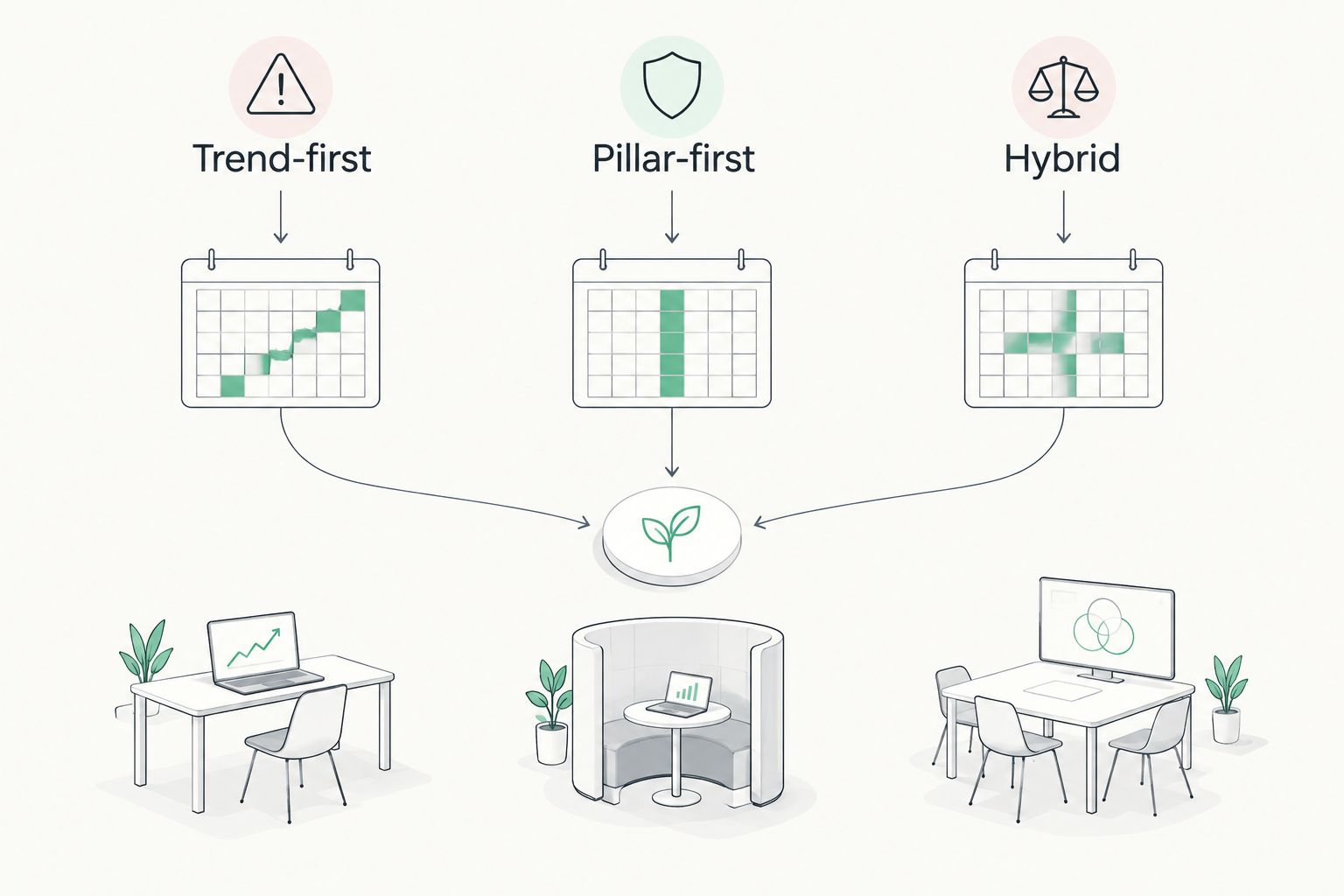
Trend-first calendar: fast reach, short memory
A trend-first calendar assigns most weekly slots to whatever format, audio, or hook is currently spiking. It works well during a launch week or a growth push when you need reach faster than a pillar strategy delivers. The failure mode is obvious once you've run it for a month: the calendar has to be rebuilt constantly because trends move faster than your production schedule. Verdict: use it in short bursts, not as a default.
Pillar-first calendar: steady growth, slower spikes
A pillar-first calendar repeats a fixed set of topics or formats on a set cadence — think a weekly tutorial slot, a weekly behind-the-scenes slot, a weekly opinion slot. It's predictable to plan and easy to batch, and it builds an audience that knows what to expect from you. The tradeoff is it won't catch algorithmic spikes the way a trend-tied post does. Verdict: the right default for most accounts building toward retention.
Hybrid calendar: the model that actually holds up
A hybrid calendar keeps the bulk of the week on fixed pillars and reserves one or two slots for trend adaptation — a proven hook or structure from a currently viral Reel, reshaped into your own voice. This is the structure that survives a trend dying mid-cycle, because the rest of the calendar doesn't depend on it. The catch is that a trend slot only works if someone is actually watching what's spiking; without that, the slot sits empty or gets filled with a stale trend nobody's watching anymore.
This is the exact gap a tool like Trender is built to close. Trender is trained on more than one million high-performing Reels and carousels, and it turns a trending Reel link or a rough idea into a ready-to-post script or carousel in your own style — which means the trend slot in a hybrid calendar takes minutes to fill instead of an afternoon of manual scrolling. Verdict: the structure most creators should actually run.
Fill your trend slot in minutes
Turn a trending Reel or idea into a ready-to-post script with Trender.
Why the right calendar structure varies
No single structure fits every account. The right mix of pillar content versus trend adaptation depends on a handful of factors:
- Audience size and reach — larger accounts often get more mileage from pillar consistency; newer accounts sometimes need trend adaptation to get discovered at all.
- How fast trends move in your niche — beauty and fashion cycle trends in days; a B2B SaaS or professional niche moves slower and rewards pillar content more.
- Team bandwidth for trend scanning — a hybrid calendar only works if someone (or a tool) is actually tracking what's spiking that week.
- Platform mix — Reels and TikTok reward trend adaptation more directly than a carousel-heavy feed does, where format consistency matters more than timing.
- The actual goal — a growth push calls for more trend-first slots; retention and authority-building call for more pillar slots.
- Publishing cadence — daily posters can afford more trend experimentation because a miss costs less; accounts posting three times a week can't absorb as many misses.
Getting the mix wrong in either direction — all trend, or zero trend — shows up fast in the numbers. If you're already tracking Reel performance, analyze Instagram Reels metrics before deciding how much of your calendar should shift toward trend adaptation versus pillar content.
How many trending Reels should be in a content calendar?
Most of the calendar should stay on fixed pillars, with only one or two slots per week reserved for trend adaptation. A calendar that's majority trend-based collapses the first week a trend doesn't land, because there's no pillar content to fall back on.
Do trends still work for niche accounts?
Trends still work for niche accounts, but the adaptation has to be reshaped to fit the niche rather than copied directly. A viral hook format from a completely unrelated category can still work if the structure — not the topic — is what gets borrowed for your own content.
How do you know if a trend fits your brand?
A trend fits your brand if the hook or structure could carry your actual message without the trend itself — strip the audio or the format gimmick and see if the sentence underneath still says something true about what you do. If it doesn't, skip it rather than force a fit.
Accounts that also lean on carousels for slower-format content should apply the same test before adapting a trend into a swipe post — see Instagram carousel that gets swipes for the format-specific version of this check.
FAQ
Is it worth building a content calendar around trending Reels?
Not entirely — a calendar built only on trends breaks when the trend dies before you've published against it. A pillar-first calendar with one rotating trend slot holds up better across 2026's faster trend cycles.
How often should trending content appear in a content calendar?
Once or twice a week is enough for most accounts. Filling most slots with trend content leaves no fallback when a trend underperforms.
Do trend-based Reels perform better than pillar content?
Trend-based Reels can spike reach faster in the short term, but pillar content builds the retained audience that keeps watching after the spike fades.
What's the risk of chasing every trend?
The main risk is a calendar that requires constant rebuilding, since trends move faster than most production schedules can keep up with.
Can a tool track trends for a content calendar automatically?
Trender pulls hooks and structures from high-performing Reels and turns them into ready-to-post scripts, which removes the manual scanning step from a hybrid calendar's trend slot.
Should small teams still try trend-based content in 2026?
Small teams get more value from a light trend slot than a full trend-first calendar, since bandwidth to scan and adapt trends daily is usually the limiting factor.
How do you decide which trend to adapt?
Strip the audio and format from the trend and check whether the underlying hook still says something true about your brand — if it doesn't hold up on its own, skip it.
One last thing
The part of a trend that expires fastest is the audio, not the structure. A hook format or pacing pattern from a viral Reel often keeps working weeks after the original sound has cycled out — which is exactly why a hybrid calendar's trend slot should borrow structure over sound whenever the two can be separated.