Question page
Is it legal to use AI scripts based on viral posts?
Ryze AI · Updated
AI-generated scripts based on viral posts are legal in 2026 as long as you're adapting the idea, hook, or structure rather than copying someone's exact words, footage, or captions. Copyright law protects specific expression, not the underlying concept — so a five-second hook style or a three-act script structure isn't anyone's property, but the literal sentences someone wrote or the clip they filmed are.
The catch most creators miss: an AI tool can accidentally produce something too close to the original if you feed it a transcript and ask for a "lightly rewritten" version. That's not a gray area — that's substantial similarity, and it's the same legal test courts use whether a human or an algorithm did the rewriting.
- Using AI-generated scripts from viral posts is legal in 2026 when you adapt hooks, structures, and ideas rather than copy exact wording.
- Copyright protects expression (the specific words, footage, captions) — not topics, formats, or hook styles.
- Reposting someone's actual video, photos, or verbatim captions crosses into copyright infringement, not gray-area adaptation.
- Using someone's name, face, or voice without consent is a separate risk (publicity/defamation), even if no copyright issue exists.
- Trender is built to adapt proven hooks and structures into new scripts, not to copy scripts verbatim.
Why this matters
Creators lift structure from viral content constantly — that's how trends spread. The legal risk shows up when "inspired by" quietly becomes "copied from," and AI tools make that line easier to cross because they can paraphrase fast without flagging how close the output sits to the source.
Trender and similar AI script tools are built around this distinction on purpose: they analyze what makes a post work — the hook pattern, the pacing, the structure — and generate a new script in your voice, rather than rewording someone's exact transcript. That's the difference between legal adaptation and infringement risk.
Is it legal to use AI-generated scripts from viral posts?
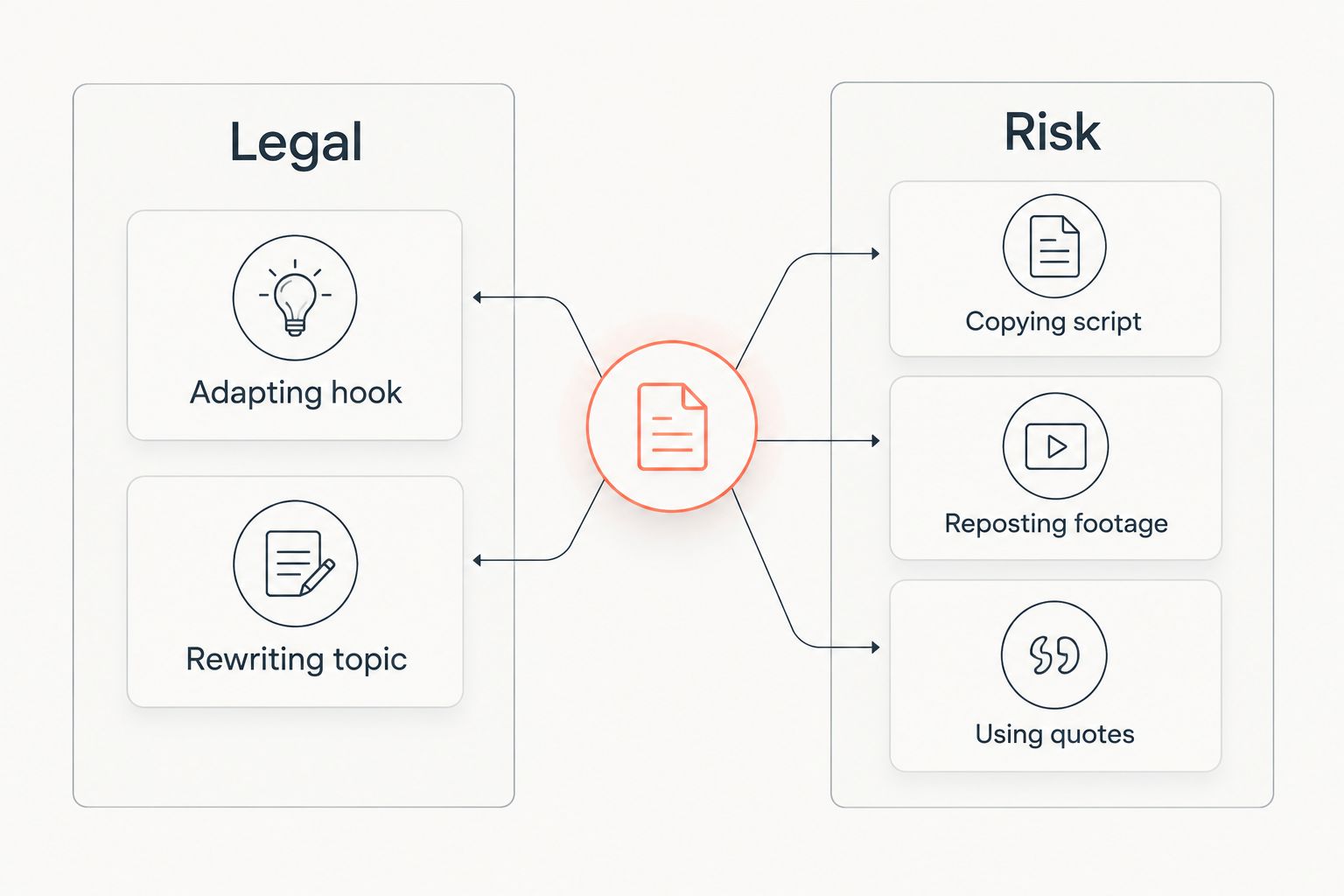
Yes, with conditions. The table below breaks down where the legal line actually sits, because "AI-generated" isn't the variable that matters — how closely the output tracks the original source is.
| Action | Legal status | Why |
|---|---|---|
| Adapting a hook, hook structure, or content format | Legal | Copyright protects wording and footage, not ideas or formats |
| Rewriting a script in your own words based on someone's topic | Legal | Topics and facts aren't ownable |
| AI-paraphrasing a script that stays close to the original structure and phrasing | Legal risk | Courts weigh substantial similarity, not just literal word-matching |
| Reposting someone's actual video, photos, or B-roll | Infringement | The footage itself is a protected creative work |
| Quoting someone's exact captions or on-screen text without permission | Infringement/attribution risk | Written captions are protected expression |
| Using someone's name, face, or voice without consent | Publicity/defamation risk | A separate legal category from copyright entirely |
The first two rows cover almost everything a social media manager does day to day: watching what performs, borrowing the pattern, writing fresh content around it. The last four rows are where actual legal exposure starts.
Most disputes never reach a courtroom. Platforms handle the bulk of this through takedown requests and duplicate-content detection, which is a business risk (lost reach, account flags) separate from actual legal liability.
Adapting a hook or structure: legal
Hooks like "nobody tells you this about..." or a three-beat problem-agitate-solve structure aren't protected by copyright, no matter how viral the original post got. Formats are free; specific sentences are not. This is the entire premise behind AI Reels script generators — they study thousands of high-performing openings and structures, then generate new content that follows the pattern without lifting the text.
Copying a script word-for-word: legal risk
If an AI tool takes someone's transcript and outputs something 80-90% identical with a few synonyms swapped, that's not adaptation — it's a derivative work made without permission. The safer move is feeding a tool the idea or the hook style, not the full transcript, and letting it generate fresh phrasing from scratch.
Reusing someone's original footage, photos, or captions: copyright risk
This is the clearest infringement case. Reposting a creator's actual video, using their B-roll, or copying their exact on-screen text without a license or explicit permission is a copyright violation regardless of whether AI touched it. Stitching, duetting, or quoting with attribution inside a platform's built-in tools is generally covered by platform terms — straight reposting outside those tools usually isn't.
Using someone's name, face, or quotes: publicity and defamation risk
Even content that clears copyright can trip a different wire: using a real person's name, likeness, or voice to imply an endorsement they never gave, or attributing a quote to them they never said, opens up publicity-rights and defamation exposure. This applies whether the script was AI-generated or handwritten — the tool doesn't change the legal category.
Why legal risk varies
- How much of the original wording survives — a paraphrased sentence structure is riskier than a fresh sentence built around the same idea
- Whether it's a short phrase or a full script — single hooks and short captions get thinner copyright protection than multi-minute scripts
- What the original source itself is — content that's already reposted or stolen from someone else carries less enforceable protection
- Commentary, criticism, or parody framing — genuine commentary on a viral post has stronger fair use footing than a straight repost
- Platform terms of service — separate from copyright law, and the more common reason accounts get flagged in 2026
- Whether a real person's identity is attached — adds publicity and defamation exposure on top of any copyright question
“Copyright protects the specific words on the page, not the idea behind them.”
The practical takeaway for a social media manager running multiple client accounts: build a habit of researching what structure worked, not saving someone's caption to paraphrase later. Trender's research workflow is built around that exact habit — pulling the pattern from a high-performing Reel or carousel, then generating a script, hook set, or carousel in a different voice instead of rewording the source.
Turn a viral hook into your own script
Adapt proven structures instead of copying scripts word-for-word.
Related questions
Can I get sued for using someone's viral TikTok idea?
Using someone's idea — a topic, a challenge format, a general concept — is not grounds for a copyright lawsuit in 2026, because ideas aren't protected, only the specific expression of them. You'd only face real legal exposure if you copied their actual script, footage, or captions, not the concept behind the post.
Do hooks and script templates count as copyrighted material?
Hooks and script templates generally don't count as copyrighted material on their own, because copyright protection kicks in for specific creative expression, not for reusable formats or patterns. A phrase like "three things nobody tells you about X" is a structure, not a protected sentence, which is why AI Reels script generators can train on thousands of hooks without infringing on any one creator.
Is it legal to use AI to rewrite someone else's script?
Rewriting someone else's script with AI is legal when the output diverges enough in wording and structure that it's a new piece of expression, not a disguised copy. If the AI output tracks the original transcript closely — same sentence order, same specific phrasing with synonyms swapped — that's still a derivative work and carries the same risk as manual copying.
FAQ
Is it legal to use AI-generated scripts from viral posts in 2026?
Yes, using AI-generated scripts from viral posts is legal in 2026 as long as the script adapts the idea, hook, or structure rather than copying someone's exact wording, footage, or captions. Courts look at substantial similarity, not whether AI was involved in the writing.
Can AI tools accidentally plagiarize a viral script?
Yes, if you feed an AI tool a full transcript and ask it to lightly rewrite it, the output can stay close enough to the original to count as a derivative work. The safer input is the idea or hook pattern, not the full source text.
Is reposting someone's viral Reel with a different voiceover legal?
Reposting someone's actual video footage without permission is generally copyright infringement, even with a new voiceover added, because the footage itself is the protected creative work. Recreating the same idea with your own original footage is a different and legal situation.
Do I need permission to use a trending hook format?
No, hook formats and content structures aren't protected by copyright, so you don't need permission to use a trending hook style. You do need permission if you copy the exact wording someone used to deliver that hook.
What's the difference between inspiration and copyright infringement on social media?
Inspiration means borrowing the pattern, topic, or format and writing new content in your own words; infringement means the specific wording, footage, or captions match closely enough to count as substantial similarity. The test courts apply is how much of the original expression survives, not how the new version was produced.
Can I get flagged by a platform even if I'm not breaking copyright law?
Yes, platforms enforce their own duplicate-content and originality policies separately from copyright law, so a legal reuse can still get reduced reach or a flag. This is a platform-terms issue, not a legal liability issue.
Is quoting someone's exact caption without credit legal?
Quoting someone's exact caption without permission carries copyright and attribution risk because written captions are protected expression, not just an idea. Paraphrasing the point in your own words removes most of that risk.
One last thing
The legal risk in AI-generated scripts almost never comes from the AI part — it comes from what you feed it. Paste a full transcript in and ask for a rewrite, and you're one step from a derivative work. Describe the hook, the pacing, and the topic instead, and the output is legally clean from the start. That input habit matters more than any tool's terms of service.