Question page
How to Write a Reel Script That Holds Attention
Ryze AI · Updated
A Reel script that holds attention opens with the outcome or the conflict in line one, skips the "hey guys" wind-up, and matches spoken pacing to a proven short-form structure instead of a polished caption voice. Get the first three seconds wrong and nothing else in the script gets watched — the algorithm and the viewer both move on before line two.
- Open with the outcome or conflict, not a greeting — that's how to write a Reel script that survives the first three seconds.
- A 30-second Reel script runs about 75 words at a normal 150-word-per-minute speaking pace.
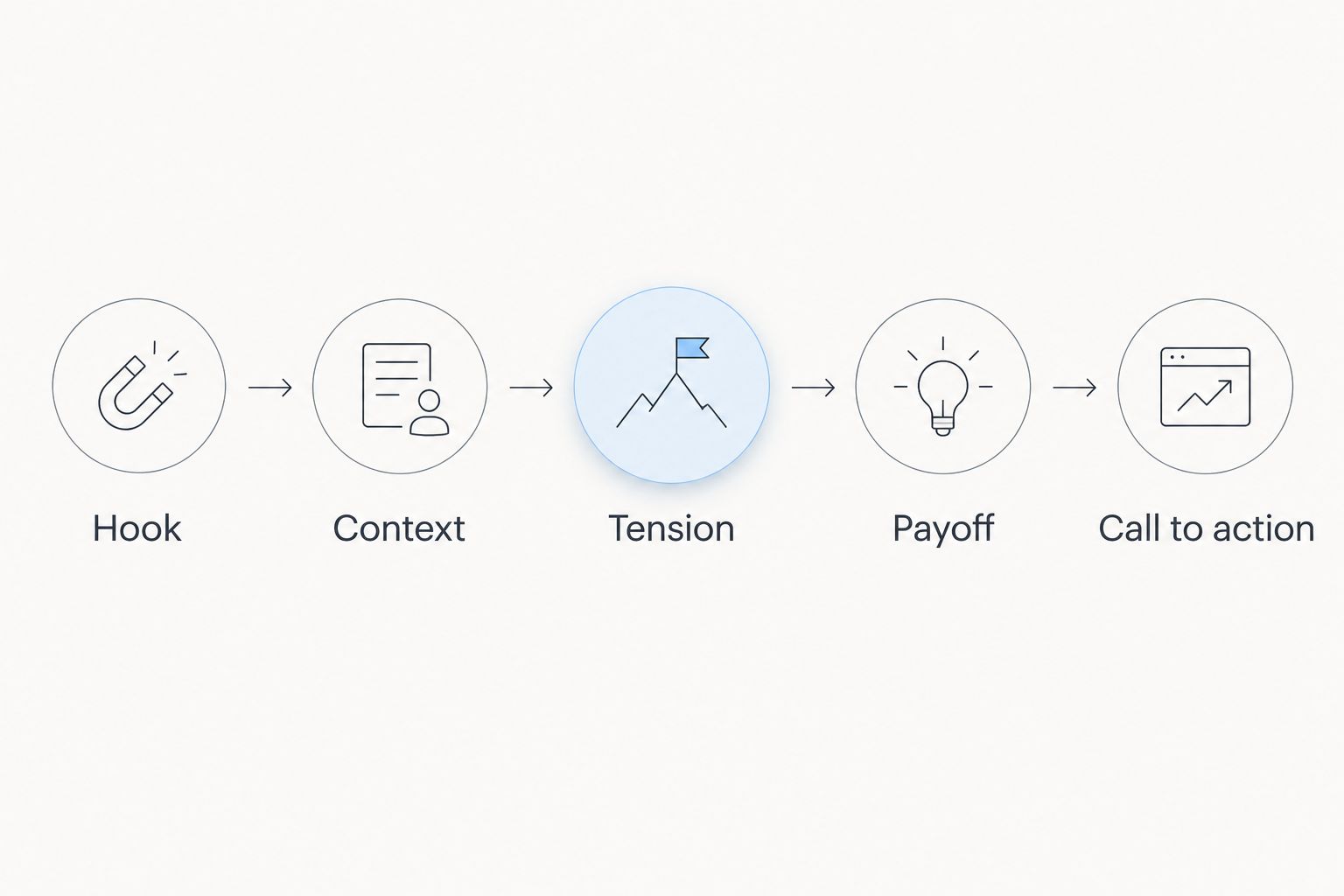
- Four beats beat six: hook, context, tension, payoff, then one call to action.
- Trender turns one idea or a proven Reel link into a script with 15+ hooks attached.
- Read the script aloud with a timer before recording — cut anything you stumble on.
Why this matters
Most Reel scripts fail before the camera turns on, not after it. Instagram and TikTok both surface content based on the first two to three seconds of watch time, so a script that spends its opening line on a greeting or a slow build loses attention before the viewer even decides to stay. Trender is built around that problem: feed it an idea, a rough note, or a link to a Reel that already worked, and it returns a script structured around a hook pattern with a track record, not a blank page.
This matters more in 2026 than it did two years ago. Feeds are more crowded, average watch time per Reel keeps compressing, and a script written like a caption reads flat the second it's spoken out loud. Teams running content strategy for SaaS founders run into this constantly — a technical idea needs the same hook discipline as a lifestyle Reel, just with different proof points and a different audience vocabulary.
How to write a Reel script that holds attention
- Lead with the outcome or the conflict. State the result, the mistake, or the tension in sentence one — never the setup.
- Cut the wind-up. Delete "hey guys," "so today," and any line that exists only to clear your throat before the real content starts.
- Write for the ear, not the page. Short clauses and active verbs read fine out loud; subordinate clauses that look clean in a doc tangle the moment you speak them.
- Build four beats. Hook, context, tension, payoff, then a single call to action. Four beats fit comfortably inside 60 seconds; six beats don't.
- Borrow structure, not words. Adapt a hook or pacing pattern from a Reel that already worked in your niche instead of starting cold. Trender is trained on more than 1 million high-performing Reels and carousels specifically to make that adaptation step faster than digging through saved posts by hand.
- Read it aloud with a timer. Anything you stumble over on the first read gets cut before it gets recorded, not after the reshoot.
Step five is where most scripts stall — staring at a blank page instead of adapting something proven. Comparing tools like the AI Reels script generators on the market is one way to shortcut that stage: feed in a Reel link and get back a script with the same beat structure, rewritten for your voice and your idea instead of a copy-paste rewrite. One featured case tied to this kind of structure adaptation shows two Reels producing over 5,000 new Instagram followers and roughly 2,000 Telegram followers — proof that the beat pattern, not raw idea volume, is what moves the needle.
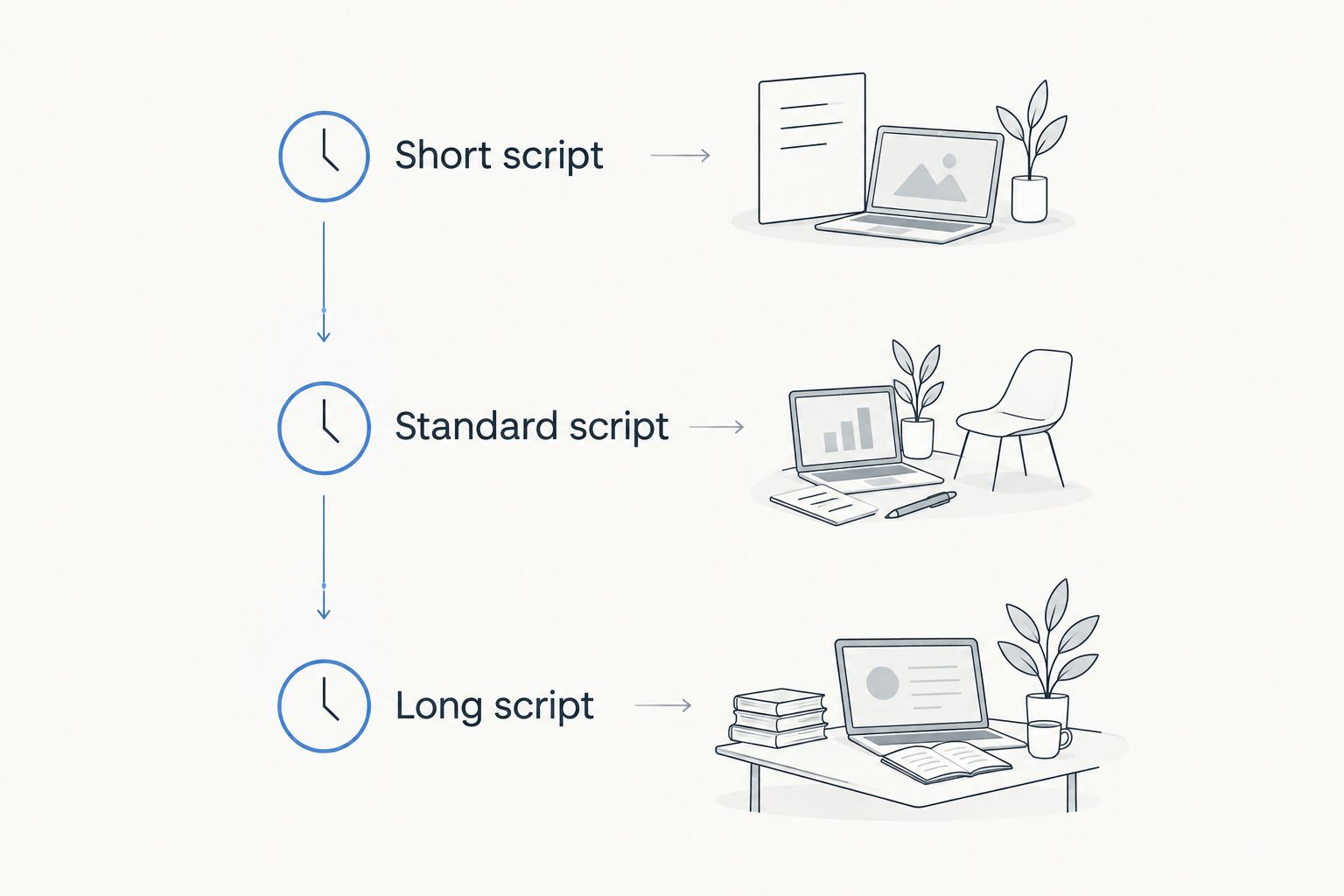
15-second Reel script: about 35-40 words
At a typical speaking pace of roughly 150 words a minute, a 15-second script holds about 35-40 words — enough for a hook and one payoff line, nothing more. Best for: a single proof point, a quick before/after, or a hook-and-punchline format. Skip a spoken call to action at this length; there's no time to say it out loud, so put it in the caption instead.
30-second Reel script: about 75 words
A 30-second script runs around 75 words at the same 150-word-per-minute pace — room for a hook, one beat of context, and a payoff with a spoken call to action. Best for: most product demos, opinion takes, and how-to Reels. This is the length that carries the four-beat structure from the steps above without feeling rushed or cut short.
60-second Reel script: about 150 words
A 60-second script lands around 150 words, giving space for a hook, two context beats, tension, payoff, and a full spoken call to action. Best for: tutorials, breakdowns, and anything that needs a demonstrated step. Past 60 seconds, retention on Reels tends to drop fast enough that splitting the idea into a two-part series usually outperforms one long script.
Why Reel script length varies
- Platform. Instagram Reels and TikTok reward slightly different average watch times, so the same script can perform differently on each.
- Niche. A fitness demo needs fewer words than a SaaS explainer walking through a feature or a pricing change.
- Hook strength. A stronger hook buys more time before viewers scroll, which lets a script run longer without losing them mid-sentence.
- Editing pace. A script cut against fast jump cuts reads shorter on screen than the same word count read straight to camera.
- Voiceover vs. on-screen text. On-screen text needs shorter lines than a spoken voiceover, because readers process text slower than they process speech.
- Call-to-action placement. A script that saves its ask for the caption can run shorter than one that speaks the CTA out loud on camera.
Turn one idea into a Reel script
Feed Trender a note, a thesis, or a proven Reel link and get a script back.
How long should a Reel script be?
A Reel script should run about 75 words for a 30-second Reel, the length that fits most demos, opinions, and how-to content without feeling rushed. Shorter or longer works too — match the word count to the format and the platform, not the other way around.
How many hooks should you write before scripting?
Fifteen or more hook variations give enough range to pick the one that actually fits the idea — the exact count Trender generates from a single input. Testing just one hook rarely surfaces the version that stops a scroll.
Should you write a full script or just bullet points?
Write a full script for anything carrying a spoken call to action or more than one beat of context. Bullet points work fine for 15-second Reels, where there's barely room for the hook and one line after it.
FAQ
What's the best structure for a Reel script?
The best structure is four beats — hook, context, tension, payoff — followed by one call to action, which fits inside both 30-second and 60-second Reels without feeling rushed.
How long should a Reel script be in 2026?
Most Reel scripts run 35-40 words for 15 seconds, about 75 words for 30 seconds, and around 150 words for 60 seconds, based on a standard speaking pace of roughly 150 words a minute.
Is it better to write a script or improvise on camera?
A script wins for anything with a spoken call to action or more than one beat of context; improvising works only for very short, single-point Reels with no room to wander.
How many hooks should I test before scripting a Reel?
Test at least 15 hook variations before picking one to script, since a single hook rarely surfaces the version that actually stops a scroll — this is why Trender generates 15+ per idea.
Should a Reel script match the caption word for word?
No — the caption can carry the call to action or extra context, which frees the spoken script to spend its full runtime on the hook and payoff.
Can I adapt someone else's Reel script?
Yes, adapt the structure and pacing of a Reel that already worked, not the exact wording; a tool trained on over 1 million high-performing Reels speeds that adaptation up considerably.
How do I know if my Reel script is too long?
Read it aloud with a timer — if you go over 60 seconds or stumble more than once, the script has too many beats and needs a cut, not a faster read.
One last thing
The gap most creators miss isn't the hook — it's the read-aloud test. A script that looks tight on the page often reveals a clunky clause the moment it's spoken, and cutting that clause before recording saves a reshoot later. If a Reel is already underperforming, diagnosing what actually broke — hook, pacing, or drop-off point — beats rewriting the script blind and hoping the second version fixes a problem you never identified. More than 2,137 creators have run ideas through this kind of structured rewrite process going into 2026, and the pattern holds: the script rarely fails because the idea was weak, it fails because the first line didn't earn the second one.