Question page
How to Repurpose Video Content for Social Media
Ryze AI · Updated
Repurposing video content means turning one Reel or TikTok into several platform-ready formats — carousels, threads, Telegram posts, long-form captions — by pulling out the hook and structure that made it work, not just reposting the same clip everywhere. The part most creators skip is the second half: adapting pacing and format for each platform instead of copy-pasting a vertical video caption into a carousel slide.
- Repurposing video content means extracting the hook and structure from one Reel, not reposting the same clip.
- Trndr turns one idea, draft, or Reel link into 5 ready-to-post formats plus 15+ hooks.
- The bottleneck is structure, not content — steal proven pacing instead of guessing at a new script.
- Rebuilding pacing per platform beats copy-pasting a Reel caption into a carousel slide.
Why This Matters
Most social teams treat repurposing as reposting: same caption, same clip, different platform. That's why a Reel that hit hard on Instagram dies on Telegram or reads flat as a LinkedIn post — the hook and pacing were built for one feed's scroll speed, not another's.
Repurposing video content correctly means separating the idea from the format. A 30-second Reel and a 10-slide carousel can carry the exact same point, but the hook wording, the beat where you reveal the payoff, and the length of each unit have to change. Trndr is built around that separation: feed it an idea, a rough note, or a link to a Reel that already worked, and it outputs the script, carousel, thread, and post versions adapted to each platform's structure, not just reformatted text.
How Do You Repurpose Video Content for Social Media?
Repurposing works as a five-step sequence, whether you do it by hand or with a tool that automates the adaptation:
- Pick the source and name why it worked. Was it the hook, a specific stat, the pacing, or the payoff at the end? You can't repurpose what you haven't diagnosed.
- Extract the hook and structure, not the topic. The topic is reusable everywhere; the structure (open with tension, deliver proof, close with a specific action) is what actually transfers between platforms.
- Adapt the script per platform. A Reel script front-loads the hook in the first line. A Telegram post can open slower because readers already opted in. A thread needs a hook line that also works as a standalone tweet.
- Rebuild pacing for static formats. Carousels need a per-slide beat; a 30-second Reel might map to 6-8 slides, not 30 lines of text crammed into one caption.
- Publish and track which format performs. Repurposing isn't done once — the format that underperforms tells you where the original hook was weaker than you thought.
This is the sequence Trndr runs automatically: you give it one idea, draft, or a link to a Reel that already worked, and it outputs adapted versions across formats instead of one script you'd have to manually rewrite four more times.
Turning One Video Into 5 Formats
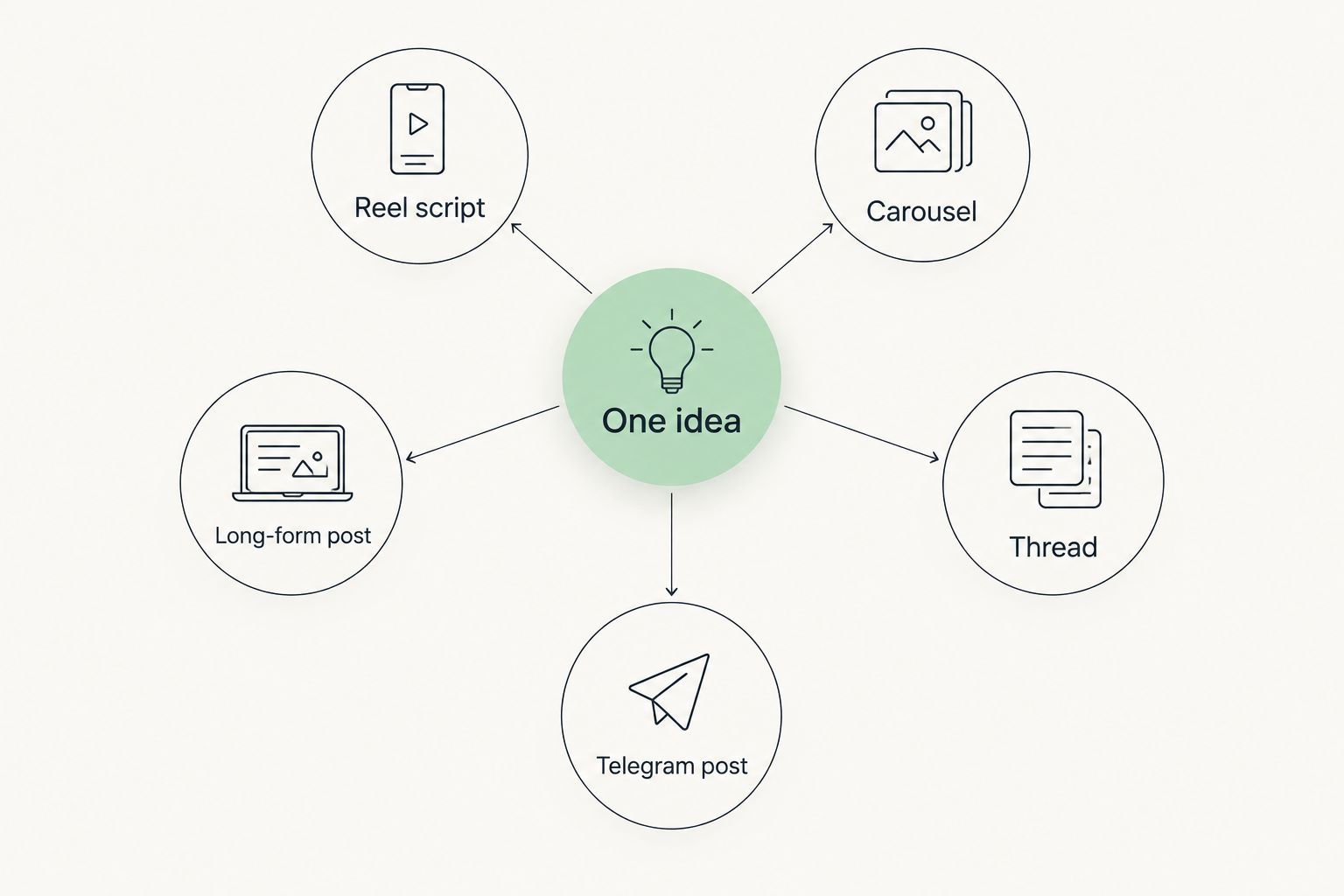
A single Reel idea can become five distinct pieces of content when the structure, not the raw footage, is what gets reused:
| Format | What changes from the source video |
|---|---|
| Reel script | Hook line rewritten for a fresh cold-open, pacing kept tight |
| Carousel | Structure split across slides, one beat per slide |
| Thread | Hook rewritten as a standalone first post, payoff spread across replies |
| Telegram post | Slower open allowed, more context since the reader already follows you |
| Long-form post | Original point expanded with supporting detail cut from the short version |
Each format needs its own hook variation — the line that stops a scroll on Instagram is rarely the line that stops a scroll on a text feed. Testing 15+ hook variants against one core idea, the way Trndr generates them, is faster than writing five hooks by hand and guessing which one fits which platform.
Why Repurposing Results Vary
Two creators can repurpose the same video and get opposite results. The gap usually comes down to a short list of factors:
- Hook strength in the source video. A weak original hook produces weak repurposed hooks — repurposing amplifies what's already there, it doesn't fix it.
- Format mismatch. Pasting a vertical-video caption straight into a carousel slide ignores that carousels are read, not watched.
- Niche specificity. Generic advice repurposes flat; content built around one specific niche keeps its edge across formats when the specifics carry over.
- Pacing rebuilt vs. copied. A 30-second script needs a different beat structure than an 8-slide carousel — copying beat-for-beat reads awkward on the new format.
- Posting cadence. A single repurposed video posted once tells you little; repurposing works as a system across weeks, not a one-off test.
- Whether you track what worked. Skipping analysis on the repurposed version means repeating the same format mismatch next time.
One SMM specialist using Trndr reported the tool surfaced relevant content even inside a highly specific client niche — a case where generic repurposing tools typically fail.
What's the Difference Between Repurposing and Reposting?
Repurposing rebuilds the hook, pacing, and structure for the new platform's format; reposting just reuploads the same clip or caption elsewhere. Reposting saves five minutes and usually underperforms because the pacing was built for a different feed. Repurposing takes the extra step of adapting the script, which is where AI Reels script generators for creators earn their place in the workflow.
How Many Platforms Can One Video Be Repurposed For?
One video can realistically support 5 distinct formats — Reel script, carousel, thread, Telegram post, and long-form post — before the adaptation starts feeling forced. Pushing past five formats from one source usually means stretching a thin idea rather than genuinely repurposing it.
Do I Need to Re-Shoot Repurposed Video Content?
No, re-shooting isn't required for most repurposed formats — carousels, threads, and Telegram posts are built from the script and structure, not new footage. Re-shooting only matters when you're producing a second Reel version with a different hook, which is where a teleprompter for adapting and recording scripts speeds up the recording step.
FAQ
What's the best way to repurpose video content for social media in 2026?
The best method extracts the hook and structure from a video that already worked and adapts them per platform, rather than reposting the same clip. Tools like Trndr automate this by turning one idea or Reel link into 5 ready-to-post formats.
Is repurposing video content better than creating from scratch?
Repurposing is faster because the structure is already proven, while creating from scratch starts at zero validation. Both work, but repurposing a video that already performed cuts research time significantly.
How much of a video can I reuse before it looks copied?
Reuse the hook structure and pacing, not the exact wording or footage, and the result reads as your own content. Copying a script word-for-word from a competitor's video is the line that turns adaptation into duplication.
Can I repurpose a competitor's Reel into my own content?
Yes, adapting the structure of a competitor's high-performing Reel into your own script and voice is standard practice in social media research. The point is studying what structure worked, not copying their exact words or footage.
What formats can one Reel be turned into?
One Reel can be turned into 5 formats: a new Reel script, a carousel, a thread, a Telegram post, and a long-form post. Each needs its own hook rewritten for how that platform's audience scrolls.
How long does repurposing take with an AI tool vs manually?
Manually adapting one video into five formats means rewriting the script five separate times by hand. An AI tool like Trndr generates all five formats plus 15+ hook options from a single idea or Reel link in one pass.
Does repurposing hurt engagement or reach?
Repurposing doesn't hurt reach when the pacing is rebuilt for the new format — it only underperforms when the same script is pasted unchanged into a mismatched format. Platforms don't penalize repurposed ideas, only lazy reformatting.
Do I still need a teleprompter or editor after repurposing?
You still need a teleprompter if the repurposed format is a new Reel script that requires recording. Static formats like carousels and threads skip recording entirely once the script is adapted.
One Last Thing
One featured Trndr user gained 5K Instagram followers and 2K Telegram followers from just two Reels — proof that the repurposing multiplier matters more than raw output volume. Two well-adapted pieces of source content beat twenty reposts with no structural rework.
That's the actual case for repurposing video content in 2026: the ceiling isn't how many videos you shoot, it's how many formats you correctly pull out of the ones that already worked.