Question page
How to Repurpose Blog Content for Social Media
Ryze AI · Updated
Repurposing blog content for social media means turning one article into several platform-native posts instead of pasting a link into a caption and hoping for clicks. The fastest path in 2026 is picking the strongest 3-4 ideas from the post, then rebuilding each one as a Reel script, a carousel, or a Telegram post with its own hook, because Instagram and TikTok penalize link-heavy captions and reward content built for their own feed mechanics.
- Repurposing blog content for social media works when you extract 3-4 standalone ideas, not the whole post.
- Reels need a hook in the first line, not the blog's original headline.
- Carousels turn a blog's subheadings into swipeable slides almost one-to-one.
- Trender converts a blog draft or link into five ready-to-post formats plus 15+ hooks.
- Telegram and thread versions of a blog post outperform a raw link share in engagement.
Why This Matters
A blog post is written to be read start to finish on a screen with no algorithm deciding whether anyone sees it. Social platforms work the opposite way: the first line decides whether the post gets a second of attention, and the format has to match what the feed expects.
Teams that just drop a blog link into an Instagram caption or a tweet see flat reach because the platform's algorithm doesn't reward outbound links the way it rewards native video or carousel completion. Trender exists specifically to close that gap: it takes an idea, a draft, or a link and turns it into hooks, scripts, and carousels shaped for each platform's format instead of a copy-paste job.
The upside is real. Repurposing one long-form asset into five platform formats means five chances to be seen from work you already did once — the research and thinking are already on the page, only the packaging changes.
How to Repurpose Blog Content for Social Media
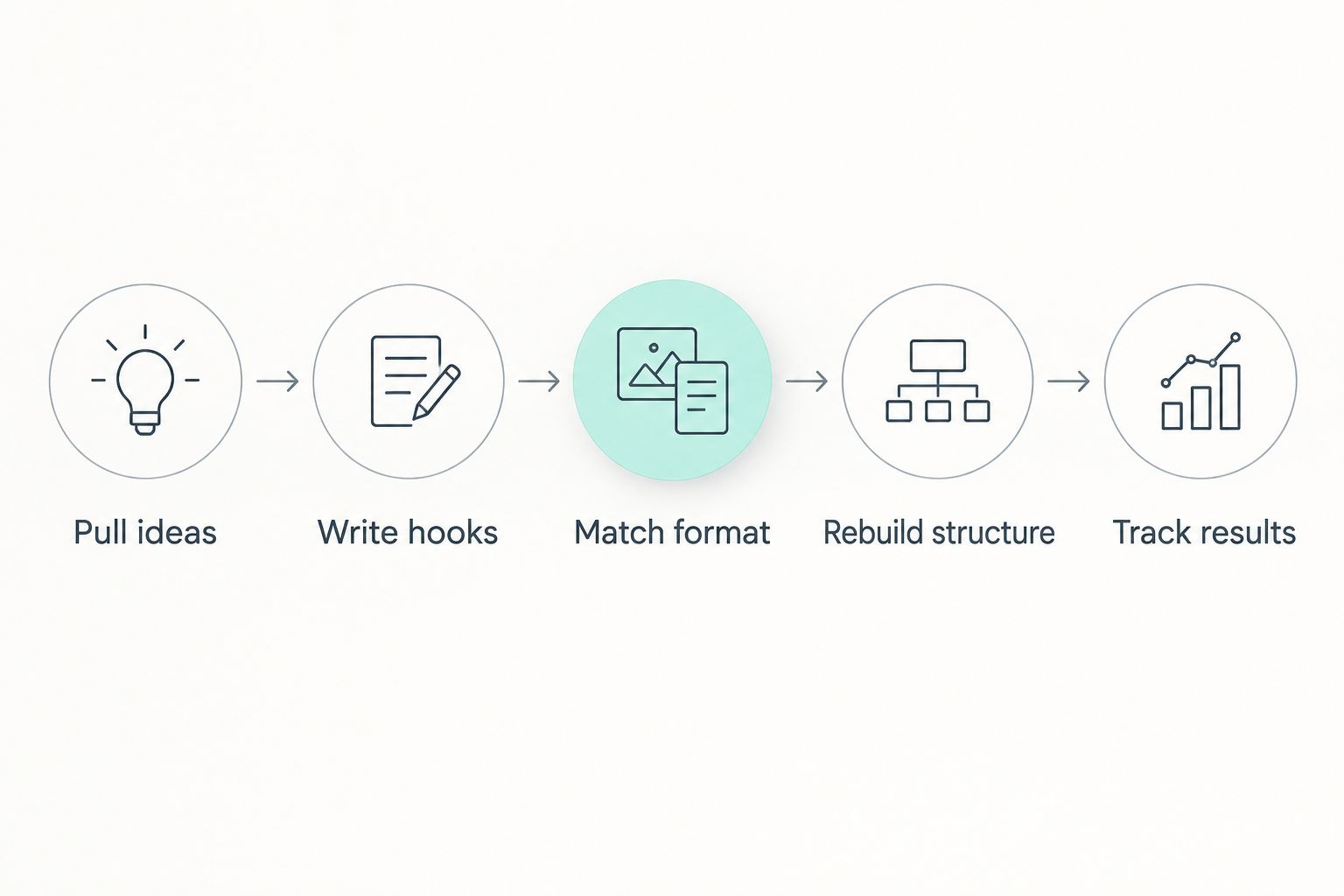
The process is the same whether the source is a 400-word explainer or a 2,000-word guide. Work through it in this order:
- Pull 3-4 standalone claims or steps from the post — each one has to make sense without the rest of the article around it.
- Write a new hook for each idea. The blog's headline was written for search intent; the hook needs to work for someone scrolling with no intent at all.
- Match format to idea type. A step-by-step process becomes a carousel or a numbered Reel script. A single strong claim or contrarian take becomes a hook-driven Reel. A longer explanation becomes a Telegram post or thread.
- Rebuild the structure, not just the words. Reels open cold on the hook; carousels front-load the payoff on slide one; threads need a tweet-length opener that stands alone.
- Record or design each piece separately. A script meant to be read on a teleprompter reads differently than a carousel slide meant to be swiped in under two seconds.
- Track which format performed, then repurpose again from the angle that worked, not the one you liked most.
| Source blog element | Best social format | Why it fits |
|---|---|---|
| Step-by-step process | Carousel | Each step becomes one slide, matches swipe behavior |
| Contrarian claim or single stat | Reel hook | Works cold, no context needed |
| Full explanation or story | Telegram post or thread | Keeps depth without needing video |
| List of tips or mistakes | Carousel or numbered Reel | Naturally sequential, easy to chunk |
Turning a Blog Post Into a Reel Script
A Reel built from a blog post drops the setup entirely. If the blog opens with three paragraphs of context before the actual point, the Reel script opens on the point and explains the context in one sentence, if at all.
The strongest source material for Reels is usually the blog's most specific claim, not its introduction or conclusion. Trender's Reels script generators compare several tools built for exactly this conversion — pulling a written idea into a scripted, teleprompter-ready format instead of leaving the writer to guess at pacing.
Best for: creators and marketers who have written material but no video script experience. Skip it if the blog post has no single strong claim to lead with — a Reel needs one idea, not a summary of five.
Turning a Blog Post Into a Carousel
Blog subheadings map almost directly onto carousel slides. A post with five H2s can become a five-to-seven-slide carousel with almost no new writing, just trimmed to fit a slide's word count.
The part that gets missed is slide one. It has to work as a hook on its own, the same way a Reel's first line does, because most viewers decide whether to swipe based on slide one alone. Trender's guide on carousel design covers the layout and hook patterns that keep swipe-through rates up.
Best for: how-to and listicle-style blog posts. Weak fit for narrative or opinion posts that don't break into discrete steps.
Turning a Blog Post Into a Telegram Post or Thread
Telegram and thread formats are the closest to the blog's original depth, which makes them the easiest conversion but also the one most likely to just get copy-pasted badly. The fix is trimming for a feed reader, not a search reader — shorter paragraphs, one idea per block, and a first line that works without the rest.
Best for: posts with real analysis or opinion that would lose meaning chopped into a 30-second Reel. Skip it for pure listicles — those convert better as carousels.
Turn one blog post into five formats
Paste a draft or link and get Reel scripts, carousels, and hooks back in minutes.
Why Repurposing Time Varies
How long it takes to repurpose one blog post into social formats depends on a few things:
- How many distinct ideas the post actually contains — a post with one core idea repurposes faster than one covering five subtopics.
- Whether the blog already has a clear structure (numbered steps, clear subheadings) versus a narrative essay format.
- How much platform-specific rework each format needs — a Reel script needs new pacing and hook writing; a carousel mostly needs trimming.
- Whether analytics from past posts inform the rework, since a format that already flopped once needs a different angle, not a repeat.
- Design and recording time — carousels need slide design, Reels need a script read on camera, both add time beyond the writing itself.
Related Questions
Should you repurpose the whole blog post or just parts of it?
Repurpose parts, not the whole post — each social format works best built around one idea, and cramming an entire 1,500-word post into a single Reel or carousel dilutes the hook that gets someone to stop scrolling.
How often should you repurpose old blog content instead of writing new posts?
There's no fixed cadence, but posts that already performed well in search or drove traffic are the strongest repurposing candidates because the idea is already proven — track which repurposed pieces get engagement and mine that same blog category again.
Does repurposing blog content hurt SEO?
No — the social post and the blog post serve different readers in different places, and a Reel or carousel driving traffic back to the blog post supports it rather than competing with it, especially when the social caption or bio links back to the original article.
FAQ
What's the best way to start repurposing blog content for social media?
Pull the 3-4 strongest standalone ideas from the post first, then match each one to a format — steps become carousels, a single sharp claim becomes a Reel hook. Trying to repurpose the entire post at once is the most common reason the result feels flat.
Is a Reel or a carousel better for repurposing a how-to blog post?
A carousel is usually better for how-to content because each step maps to a slide, while a Reel forces you to pick just one step or claim to lead with. Use both when the post has enough steps to support a carousel and one standout claim worth pulling out as a Reel.
How much does it cost to repurpose blog content into Reels and carousels?
Cost depends on whether you're doing it manually with a designer and scriptwriter or using a tool built for the conversion — check current pricing directly with whatever platform or freelancer you use, since rates vary by scope.
Can AI tools turn a blog post into a Reel script automatically?
Yes — tools built for this pull the core idea from a draft or link and generate a script with a hook, structure, and pacing meant for video rather than reading. Trender is one option built specifically around converting an idea or link into a script, not just summarizing text.
Does repurposing the same blog post across multiple platforms hurt engagement?
No, as long as each version is rebuilt for its platform's format rather than copy-pasted. The same core idea shown as a Reel hook, a carousel, and a Telegram post reaches different audience segments without competing against itself.
How do you know which part of a blog post to repurpose first?
Start with whichever section already drove the most search traffic or reader time on the blog itself, since that's the idea already proven to hold attention — then build the hook and format around that specific section.
One Last Thing
The biggest mistake in repurposing blog content for social media isn't picking the wrong format — it's reusing the blog's original headline as the hook. A headline written for someone typing a search query and a hook written for someone scrolling past hundreds of posts are two different sentences, even when they describe the exact same idea.