Question page
How long until you see results from AI social content?
Ryze AI · Updated
AI-generated Reels, carousels, and captions can post in minutes, but the results — followers, saves, inbound DMs — show up on a slower clock than the tool itself runs on. Most accounts see a measurable shift in reach or engagement within 2 to 4 weeks of consistent, daily posting with AI-assisted scripts, and real follower growth compounds over a 60- to 90-day window in 2026. The hidden cost the headline number skips: speed of generation isn't speed of results — posting cadence and format testing decide the timeline, not how fast the AI wrote the hook.
- Algorithm signal on AI-generated Reels typically shows up in 2 to 4 weeks of daily posting in 2026.
- Follower and save growth compounds over a 60- to 90-day window, not a single post.
- One strong hook can spike numbers in days — repeatable growth still needs a testing cadence.
- Trndr users have reported gaining 5K Instagram followers and 2K Telegram followers from two Reels.
- Posting frequency, not AI generation speed, is the main lever on how long does it take to see results from AI generated content.
Why this matters
Creators quit AI content tools in week two because nothing has "happened" yet, then quit their own strategy in week six for the same reason. Neither move is wrong exactly — it's just early. Instagram and TikTok need repeated posts in the same format before the algorithm has enough signal to decide who to show your content to.
That lag is why the question "how long does it take to see results from AI generated content" doesn't have a single clean answer. A single Reel adapted from a proven structure in Trndr can outperform in days. A whole content calendar built on inconsistent formats can sit flat for months. The variable isn't the AI — it's the testing loop around it.
How long does it take to see results from AI generated content?
The honest answer splits by what "results" means to you. Algorithm pickup, audience growth, and business outcomes (leads, sales, inbound DMs) run on different clocks.
| Result type | Typical timeline in 2026 | What drives it |
|---|---|---|
| Algorithm signal (reach, watch time) | 2-4 weeks | Posting cadence, format consistency |
| Follower/save growth | 60-90 days | Hook quality, repeat viewers, niche fit |
| Business outcomes (leads, DMs, sales) | 90+ days | Offer clarity, CTA repetition, audience size |
| One-off viral spike | Days | Hook strength, timing, luck |
The table row that trips people up is the first one. Algorithm signal — the platform actually testing your content against a wider audience — is separate from growth you can screenshot. You can get strong signal in week three and still see flat follower counts, because the platform is still deciding who your content is for.
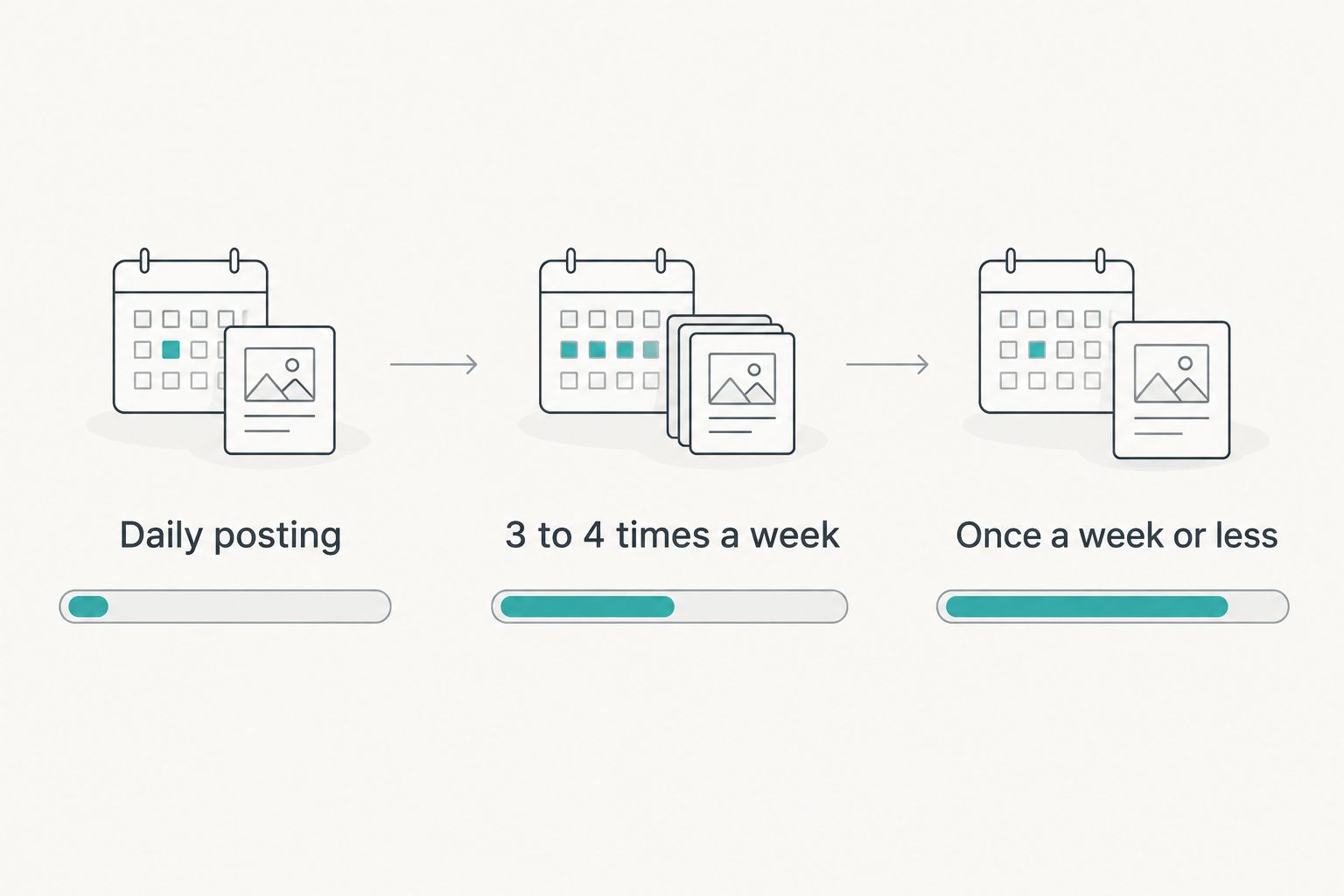
Daily posting: signal in 2 to 4 weeks
Accounts posting once a day with AI-generated scripts and hooks tend to see the fastest algorithm read. Consistency gives the platform enough data points in a short window to start testing your content against broader audiences.
This is also the cadence where format-adaptation tools do the most work — reusing a proven Reel structure daily removes the guesswork about what to say next, which is the actual reason daily posting is sustainable at all.
3 to 4 times a week: signal in 4 to 6 weeks
Most small teams and solo creators land here, not on daily posting. It's a realistic cadence for someone running content alongside client work or a product. The tradeoff is a longer runway before the algorithm has a clear read on your content.
At this cadence, format discipline matters more, not less. Four inconsistent formats a week teach the algorithm nothing; four Reels built on the same proven hook-and-structure pattern teach it something specific to test further.
Once a week or less: signal in 8 to 12 weeks or longer
Weekly posting is common for founders running social media as a side function of the business. Results still arrive, but the timeline stretches — the algorithm needs more calendar time to gather the same number of data points a daily poster gets in a month.
If you're on this cadence, the AI-generation speed matters less than picking formats you can actually sustain for 8-12 weeks straight. Switching formats every few weeks resets the clock.
Why results vary
- Hook strength — a weak first line kills watch time before the algorithm ever gets a full signal read
- Format consistency — switching between Reels, carousels, and long-form resets what the platform learns about your account
- Adapted vs. original structure — reusing a structure proven on similar content skips weeks of trial and error
- Existing audience size — a bigger starting audience shortens the time to visible growth, even with the same posting cadence
- Niche competitiveness — saturated niches need more repetitions before the algorithm differentiates your account
- Posting gaps — a week off resets momentum more than a slow week of low-performing posts does
“A single viral Reel can spike your numbers in days, but repeatable growth is a 60- to 90-day habit, not a one-time output.”
A lot of that testing loop is manual work — pulling competitor Reels, rewriting hooks, rebuilding a carousel from scratch every time. Trndr turns one idea, draft, or successful Reel link into ready-to-post formats and 15+ hooks in your style, which shortens the setup time between posts without changing the underlying testing timeline above.
If you're tracking whether a format is actually working before the 60-90 day mark, the fastest read comes from watch-time and save-rate trends per post, covered in how to analyze Instagram Reels metrics rather than raw follower counts, which lag behind algorithm signal by design.
Start your testing cadence today
Turn one idea into ready-to-post Reels, hooks, and carousels.
Does AI-generated content take longer to rank than human-written content?
No — platforms don't detect or penalize AI-generated scripts as a category in 2026; they respond to watch time, saves, and shares regardless of how the script was written. The timeline differences above come from posting cadence and format fit, not from the content being AI-assisted.
How many AI-generated Reels do you need before results show?
There's no fixed post count, but daily posters typically see algorithm signal inside their first 15-30 posts (2-4 weeks), while weekly posters need a similar number of posts stretched over 8-12 weeks. Volume and time are the same lever — cadence just determines how fast you reach it.
Can one AI-generated Reel go viral immediately?
Yes — a single Reel built on a strong, proven hook can spike reach within days, independent of your posting history. That spike doesn't guarantee repeatable growth on its own; it needs a follow-up cadence to compound into sustained followers by the 60-90 day mark.
For teams that lean on AI Reels scripts specifically, comparing tools before committing to a cadence is worth the hour — see the roundup of AI Reels script generators for how different tools handle hook generation and adaptation.
FAQ
How long does it take to see results from AI generated content?
Algorithm signal on AI-generated content typically shows up in 2 to 4 weeks of daily posting in 2026, with real follower growth compounding over 60 to 90 days. A single strong Reel can spike results in days, but that spike doesn't replace the testing window needed for repeatable growth.
What is the fastest way to see results from AI-generated Reels?
Daily posting with a consistent, proven hook structure produces the fastest algorithm signal, usually within 2 to 4 weeks. Inconsistent formats or gaps in posting reset that timeline.
Is AI-generated content slower to grow than manually written content?
No, growth speed depends on posting cadence and hook strength, not on whether a human or an AI tool wrote the script. Platforms in 2026 respond to engagement signals, not the content's origin.
How many posts before an AI content strategy shows a trend?
Most accounts need roughly 15 to 30 posts, or 2 to 4 weeks at a daily cadence, before a clear performance trend emerges. Weekly posters reach the same post count over 8 to 12 weeks.
Does follower count or engagement rate move first?
Engagement signals like watch time and saves move first, typically within 2 to 4 weeks, while follower count growth lags and usually shows up over a 60 to 90 day window. Watching engagement per post is a faster way to judge if a format is working.
Can a single AI-generated Reel replace a whole content strategy?
One Reel can produce a short-term spike in reach or followers within days, but it doesn't replace a repeatable posting cadence. Sustained growth still requires 60 to 90 days of consistent, tested formats.
Why do results plateau after an early spike?
A plateau after an early spike usually means the follow-up posts didn't repeat the format or hook structure that worked. The algorithm needs repetition, not a one-off win, to keep testing your account against wider audiences.
One last thing
The number that changes outcomes the most isn't posting frequency — it's format repetition. Accounts that stick to one adapted structure for 60-90 days straight consistently outgrow accounts that chase a new format every week, even at the same posting volume. If you're rebuilding your hook and structure from scratch every time, that's the actual bottleneck slowing down how long does it take to see results from AI generated content — not the AI, the rebuild.