Integration guide
Content Repurposing Workflow: Complete 2026 Process
Ryze AI · Updated
Instead of manually rewriting one post for every channel in 2026, set up a content repurposing workflow that turns one idea, draft, or successful Reel into five ready-to-post formats plus 15+ hooks.
- A content repurposing workflow turns one source idea into multiple platform-ready assets without rebuilding the argument.
- Trndr is best for creators and small marketing teams repurposing Reels, hooks, carousels, and long-form content in 2026.
- Choose the hook before generating formats because every downstream asset inherits that opening angle.
- Start with a rough note for original content or a successful Reel link when adapting a proven structure.
- Review published results before the next cycle so winning topics and structures return to the input queue.
Why this matters
Most repurposing fails before production begins. A creator writes a Reel, hands the same text to a carousel template, shortens it for another channel, and calls the result repurposed. The words changed, but the format did not.
A useful workflow preserves the thesis while rebuilding the delivery for each destination. A Reel needs spoken rhythm and a fast opening. A carousel needs slide-level progression. A long-form post needs enough context to stand alone. The Trndr content repurposing platform handles those format changes from one source instead of treating every asset as a separate blank page.
The available proof is specific: Trndr is trained on more than 1M high-performing Reels and carousels and is used by 2,137+ creators. One featured customer reports gaining 5K Instagram followers and 2K Telegram followers from two Reels. Those figures do not guarantee a result, but they show why the workflow should connect creation with review rather than stop when a draft is generated.
Before you start
- Prepare one source asset. Use an idea, thesis, rough note, draft, or successful Reel link. Pick one source rather than combining unrelated topics in the same cycle.
- Define the intended audience. Write down who should act on the content and what they should understand after consuming it. This keeps every format pointed at the same outcome.
- Choose the publishing formats. Decide whether you need a Reel script, carousel, Telegram post, thread, long-form post, or a smaller selection.
- Prevent the mid-setup failure. Do not design the carousel or record the Reel before approving the hook and central claim. A weak opening copied across five formats creates five weak assets.
Choose your source input
Your first decision is not which platform to publish on. It is how much proven material already exists. A rough note needs idea development, while a successful Reel link needs structural adaptation.
| Starting input | Best for | Main advantage | Main limitation |
|---|---|---|---|
| Idea or thesis | A clear opinion that has not been drafted | Preserves the original point of view | Needs more context before generation |
| Rough note | Capturing expertise quickly | Reduces blank-page work | Unclear notes produce generic drafts |
| Existing draft | Repurposing finished writing | Keeps the argument and supporting detail | Draft structure may not fit short-form video |
| Successful Reel link | Adapting a proven hook or structure | Starts from demonstrated audience interest | Still requires an original thesis and examples |
Set up the input
- Open Workshop and choose the source material for this content cycle.
- Paste the idea, note, draft, or Reel link without adding unrelated topics.
- Add the audience, intended takeaway, and the opinion you want the content to defend.
- Remove background information that does not affect the central claim.
- Read the input once as a standalone brief. If a collaborator could not identify the topic, audience, and takeaway, revise it before generating anything.
Expected result: one source brief with a clear audience, one central claim, and enough context to generate hooks without inventing the substance.
Configure the hook and output formats
The hook controls the promise every asset makes. Choose it before the format because the same idea can lead with a mistake, a result, a disagreement, a process, or a direct question. Those angles produce materially different scripts and carousels.
- Generate the available hook options from the source brief.
- Review the 15+ hooks against the central claim rather than choosing the most dramatic wording.
- Reject any hook that promises a result the body cannot support.
- Select the hook that makes the intended reader recognize the problem immediately.
- Choose the formats needed for this cycle: Reel script, carousel, Telegram post, thread, or long-form content.
- Generate only the formats you plan to edit and publish. Extra drafts create review work without improving distribution.
Expected result: a selected hook and a set of format-specific drafts built around the same thesis, audience, and intended takeaway.
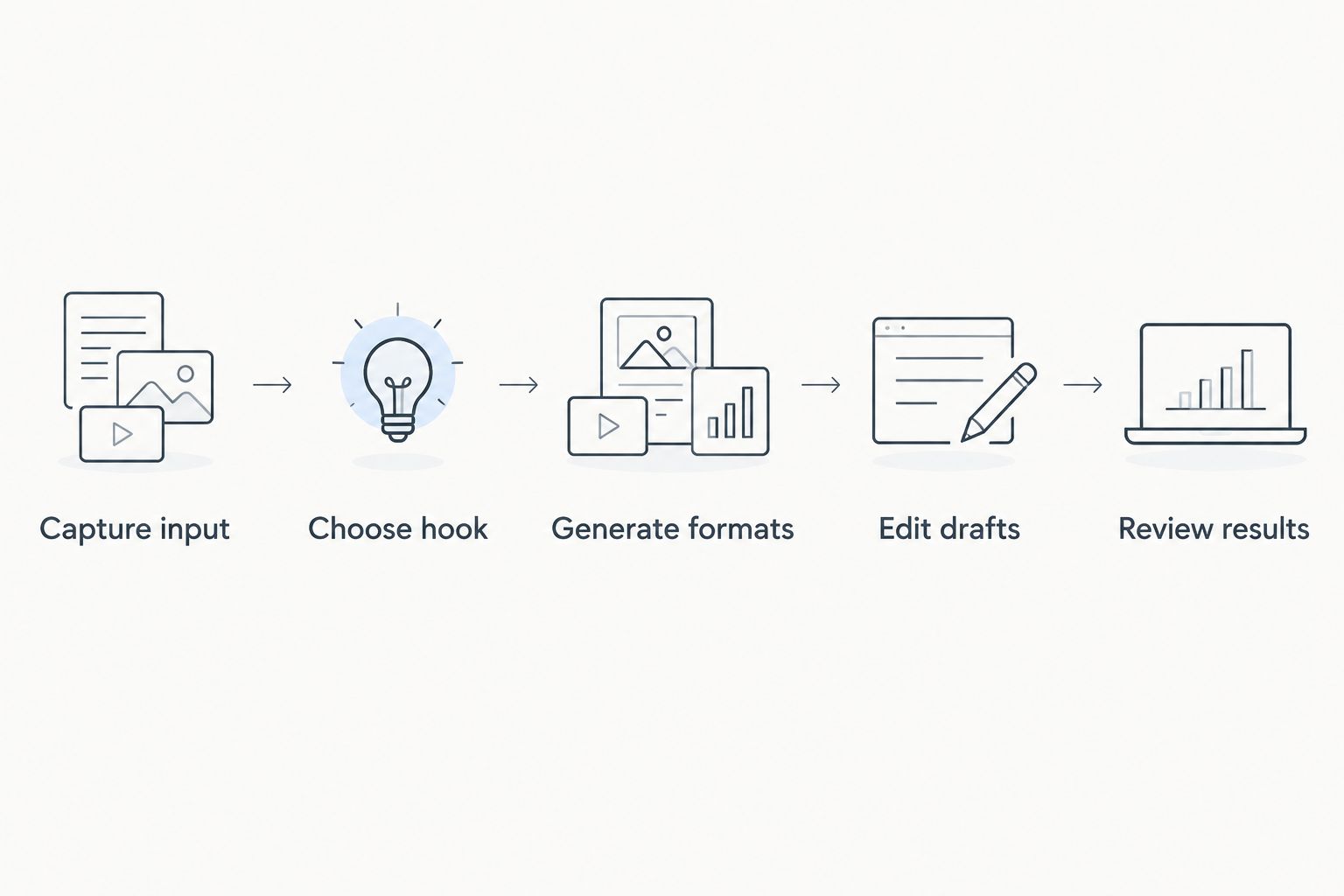
The sequence is simple: capture input, choose hook, generate formats, edit drafts, and review results. Treat it as a fixed production path in 2026 rather than a loose collection of prompts.
Edit each format for its channel
Generation creates a starting draft, not permission to publish the same structure everywhere. Review each asset independently while protecting the original claim.
- Edit the Reel script for speech. Shorten sentences that are difficult to say aloud. Remove setup that delays the hook, then read the script through the iPhone teleprompter before recording.
- Edit the carousel for progression. Give each slide one job and make the sequence understandable without the Reel. Use the Instagram carousel workflow when the draft needs stronger slide-to-slide movement.
- Edit text posts for context. A Telegram post, thread, or long-form asset cannot depend on visuals or spoken emphasis. Add the minimum context needed for the post to stand alone.
- Check factual consistency. Names, claims, examples, and calls to action must agree across every format even when the wording changes.
- Remove repeated filler. Delete generic transitions and duplicated explanations that entered during generation.
Expected result: every asset expresses the same idea but reads as if it was created for its destination rather than copied from another platform.
Review and publish the batch
A production workflow needs a final gate. Without one, speed simply moves weak claims and inconsistent wording into more channels.
- Compare each draft with the original source brief.
- Confirm that the hook is answered by the body of every asset.
- Check that each format addresses the same audience and intended takeaway.
- Record the Reel with the teleprompter after the spoken edit is complete.
- Finalize the carousel design only after its slide sequence is approved.
- Schedule or publish the assets according to your existing content calendar.
- Record the topic, hook, format, and publication date so the results can be reviewed in the next cycle.
Expected result: one approved content batch with consistent claims, channel-specific presentation, and enough information to connect published performance with the original creative decisions.
Repurpose a successful Reel instead
Use this second workflow when a Reel has already performed well or competitor research reveals a structure worth adapting. The source changes, but the approval sequence stays the same.
- Add the successful Reel link as the source input.
- Analyze the hook, content structure, and presentation pattern rather than copying the wording.
- Identify the underlying device: a direct claim, a mistake-led opening, a list, a demonstration, or a before-and-after argument.
- Replace the original subject with your own thesis, evidence, and examples.
- Generate new hooks and formats from that adapted structure.
- Check the finished drafts against the source to remove phrasing that is too close to the original.
Expected result: an original content batch that uses a proven structural pattern without presenting another creator's wording or examples as your own.
This variant is strongest when the structure explains why the post held attention. It is weak when a team copies surface details without understanding the audience problem behind them.
Where Trndr fits and where it does not
Trndr is best for social media managers, boutique agencies, creators, experts, personal brands, small marketing teams, and independent SaaS founders who need a repeatable content repurposing workflow in 2026. It covers research, hooks, scripts, carousel creation, recording support, analysis, and adaptation in one process.
The main limitation is scope. The platform is built primarily for the United States and English-only content, so multilingual publishing requires a separate localization review. Generated content also needs editorial judgment: the platform can structure and adapt an idea, but the user remains responsible for factual accuracy, original examples, and a defensible point of view.
Build your repurposing workflow
Turn one source idea into hooks, scripts, carousels, and long-form drafts.
Troubleshooting
The drafts sound generic
Return to the source brief and add a specific opinion, example, audience problem, or supporting fact. Format instructions cannot compensate for an input that says only to create content about a broad topic.
The formats repeat the same wording
Edit by function, not length. Rewrite the Reel for speech, rebuild the carousel around slide progression, and add standalone context to text posts. Shortening one master draft is not format adaptation.
The hook is stronger than the content
Reduce the promise or strengthen the supporting material. Do not keep a dramatic hook that the body cannot answer; multiplying it across five formats increases the credibility problem.
The carousel feels dense
Separate claims that compete for attention and remove background material from the slides. The carousel should advance one argument, not store every sentence from the long-form draft.
You cannot tell what worked
Review the hook, retention signals, engagement, and audience response by asset. The guide to analyzing Instagram Reels metrics shows how to turn the published result into a diagnosis and next test instead of a vague win or loss.
Customize your workflow
Once the basic process runs reliably, add two operating rules for 2026.
First, maintain an input queue. Save customer questions, founder opinions, sales objections, successful posts, rough notes, and competitor structures as separate source candidates. Score each candidate by audience relevance and strength of evidence before it enters production.
Second, build a review loop. After publishing, label the winning topic, hook type, structure, and format. Feed those lessons into the next source brief rather than asking Trndr to generate another disconnected batch. A documented social media content strategy for SaaS founders can provide the topic and audience framework around this production process.
The workflow should expand from isolated repurposing into a cycle: research creates inputs, production creates assets, analytics identifies useful patterns, and those patterns improve the next input. That cycle is more valuable than generating a larger pile of drafts.
FAQ
What is a content repurposing workflow?
A content repurposing workflow is a repeatable process that turns one idea, note, draft, or successful post into multiple channel-specific assets. It preserves the central claim while adapting the hook, structure, pacing, and context for each format.
What should I repurpose first?
Start with a source that contains a clear opinion, useful evidence, or proven audience interest. A successful Reel, finished draft, customer question, or specific founder thesis is stronger than a broad topic with no point of view.
How many formats should one idea become?
Generate only the formats you can edit, publish, and review properly. The Trndr process can turn one idea into five ready-to-post formats, but a smaller approved batch is better than unused drafts.
Should I choose the hook or format first?
Choose the hook first because every format inherits its opening promise. Approving the hook before generation prevents one weak angle from spreading across the full batch.
Can I repurpose a competitor's Reel?
You can adapt a competitor Reel's hook type and structural pattern, but the thesis, wording, evidence, and examples must be your own. Review the final drafts against the source to remove close phrasing.
Why does repurposed content sound repetitive?
Repurposed content sounds repetitive when the same draft is shortened instead of rebuilt for each channel. Edit for spoken delivery, slide progression, or standalone reading based on where the asset will appear.
How do I measure a repurposing workflow in 2026?
Track each asset back to its source topic, hook, structure, format, and publication date. Review those variables with the platform's performance signals so the next batch uses diagnosed patterns rather than guesses.
Is content repurposing only for large marketing teams?
No. A defined workflow is particularly useful for solo creators, boutique agencies, and small marketing teams because it reduces repeated research and drafting between platforms.
One last thing
Do not make output volume the success metric for 2026. The best repurposing system is the one that helps you identify which idea, hook, and structure deserve another iteration. Five disconnected drafts create production noise; one reviewed batch creates evidence for the next cycle.