Integration guide
Content Repurposing Strategy: A Practical 2026 Framework
Ryze AI · Updated

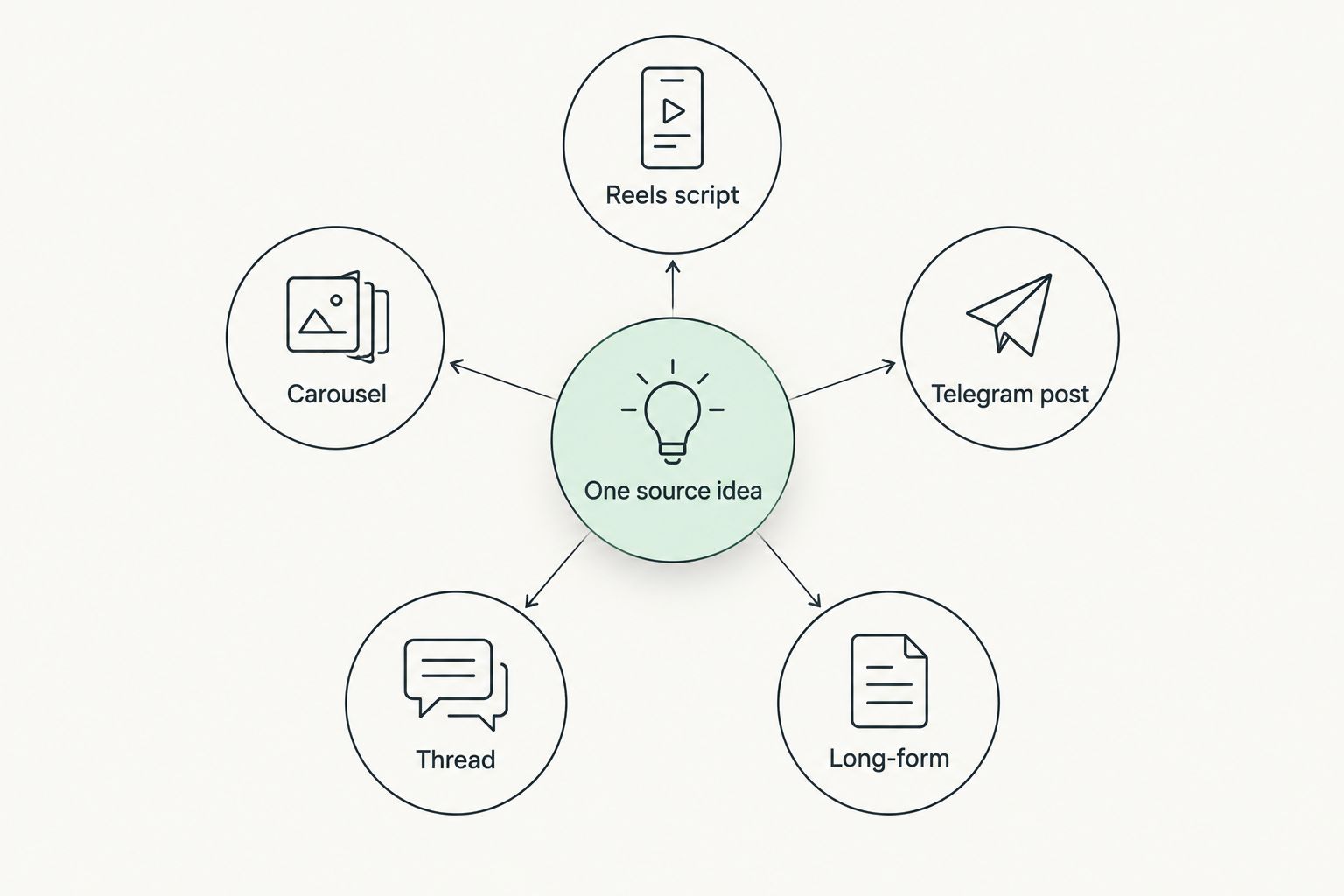
Repurposing one Reel into five formats by hand costs a social media manager an afternoon of copy-pasting: rewriting the hook for a carousel, trimming the script for a thread, reformatting captions for Telegram, and hoping the voice still matches. Instead of manually rebuilding the same idea for every platform, run one workflow in Trender that takes a single idea, rough note, draft, or successful Reel link and turns it into five platform-ready formats plus 15+ hooks in one pass.
- A content repurposing strategy in 2026 means one source input producing five outputs, not five separate writing sessions.
- Trender turns an idea, draft, or Reel link into a Reels script, carousel, Telegram post, thread, and hook set in one workflow.
- Trender is trained on 1M+ high-performing Reels and carousels and is used by 2,137+ creators.
- The workflow has a second mode: repurpose whenever a Reel underperforms, using Reel analysis to diagnose why and rebuild the format.
- Best for social media managers, boutique agencies, and solo SaaS founders who publish across three or more platforms weekly.
Why the manual repurposing workflow breaks down in 2026
Most social media managers in 2026 are running three to five platforms off one content calendar, and the bottleneck was never ideas — it was reformatting. A Reels script does not drop cleanly into a carousel, a thread needs different pacing than a Telegram post, and a hook that works on Instagram often falls flat on a text-first channel.
One Trender customer reports research time dropping from hours to minutes once the repurposing step moved into a single workflow instead of five separate documents. Another gained 5K Instagram followers and 2K Telegram followers off two Reels, which only happens when the same core idea gets adapted correctly across formats instead of copy-pasted.
A real content repurposing strategy treats the source (the idea, the draft, the Reel that already worked) as the one thing you write once. Everything downstream — hooks, script, carousel, thread, Telegram post — gets generated from it, not rewritten from scratch.
Before you start
- A source to work from. Trender needs an idea, a rough note, a draft, or a link to a Reel that already performed well — it does not generate content from nothing.
- A sense of your platform mix. Decide upfront which of the five formats (Reels script, carousel, Telegram post, thread, long-form) you actually need this week, since generating all five without a publishing plan just moves the clutter downstream.
- The gotcha: competitor research inside Trender works best when you give it a specific niche, not a broad category — one SMM specialist found relevant content even in a highly specific client niche precisely because the input was narrow, not because the tool guessed.
Load your source into Workshop
- Open Workshop and choose your entry point: paste an idea, a rough note, an existing draft, or a link to a Reel that already got traction.
- Skip competitor research entirely if you already have a working thesis — Workshop supports starting directly from your own material.
- If you want structural inspiration instead, run competitor research first and pull a proven hook or structure into Workshop before generating.
Expected result: your source content sits inside Workshop, ready to be turned into platform formats, with no research step required if you already know what you want to say.
Generate your five output formats and hooks
- From your loaded source, generate the full output set: Reels script, carousel, Telegram post, thread, and a long-form piece, all pulled from the same core idea.
- Generate the hook set alongside it — Trender produces 15+ hooks in your style per source, trained against a dataset of 1M+ high-performing Reels and carousels.
- Pick two or three hooks per platform rather than defaulting to the first one generated; hook performance varies by platform even when the underlying idea is identical.
Expected result: one source idea now exists as five drafted formats plus a hook bank, without a separate writing pass for each platform.
Design the carousel
A generated carousel script still needs a layout pass before it is postable. Slide count, swipe-through pacing, and closing-slide design decide whether a carousel gets read past slide two, and Trender's carousel design templates handle the layout side once the script exists. If carousel structure is the weak point in your current repurposing output, the carousel swipe-rate guide covers slide-by-slide pacing in more depth than a single workflow step can.
Expected result: a carousel that matches current design conventions instead of a wall of unstructured text slides.
Record with the teleprompter
- Take the generated Reels script and open it in the iPhone teleprompter.
- Adapt pacing and line breaks for how you actually speak on camera — a generated script is a starting point, not a locked transcript.
- Record directly against the teleprompter rather than memorizing the script, which is where most of the reformatting time gets saved versus a manual repurposing workflow.
Expected result: a recorded Reel that matches the script's hook and structure without a separate script-memorization step.
Repurpose whenever a Reel underperforms
The same workflow runs in reverse when a Reel flops instead of hitting. Run Reel analysis on the underperforming post, get a diagnosis and an improvement plan, then feed the corrected structure back into Workshop to regenerate the format instead of guessing at a rewrite. The Reel metrics diagnosis guide walks through which metrics point to a hook problem versus a retention problem, which changes what you fix before repurposing.
A content repurposing strategy only works if you can trace every output back to one source decision — if you cannot name why a hook or format choice was made, the strategy does not exist yet, it is just volume.
Troubleshooting
- Hooks feel generic. Narrow the source input — a vague idea produces vague hooks even from a 1M+ Reel dataset; specificity in, specificity out.
- Carousel doesn't match your usual design. Run it through the carousel design templates rather than publishing the raw generated script as slides.
- Output doesn't sound like you. Feed a draft or an existing successful Reel as the source instead of a bare idea — Trender adapts tone from what you give it, and a thin input gives it less to match.
- Competitor research returns irrelevant content. Narrow the niche term instead of the broad category; a highly specific client niche returns better matches than a generic industry search.
- Teleprompter pacing feels off during recording. Edit line breaks before recording rather than during — pacing is a script-formatting fix, not a delivery fix.
Customize your workflow
Once the core loop works, expand it. Solo SaaS founders repurposing product updates and feature announcements follow a different cadence than agencies managing client accounts — the social content strategy guide for SaaS founders covers that split in more depth. Teams running high volume can also push carousel creation through MCP for automated workflows instead of generating each one manually inside Workshop.
If you are still deciding whether an AI script generator fits your stack at all, the comparison of nine AI Reels script generators puts Trender against the alternatives on the same criteria, with honest tradeoffs either way.
“If you can't trace an output back to one source decision, the repurposing strategy doesn't exist yet, it's just volume.”
FAQ
What's the best content repurposing strategy for 2026?
The best content repurposing strategy in 2026 treats one idea, draft, or proven Reel as the single source and generates every platform format from it, rather than rewriting each format by hand. Trender runs this as one workflow, producing a Reels script, carousel, Telegram post, thread, and hooks from a single input.
Is repurposing one Reel into a carousel worth it?
Yes, if the Reel already proved the idea works with an audience — repurposing it into a carousel extends reach on a platform with different discovery mechanics. Carousel design still needs its own pacing and layout pass, since a script that works spoken doesn't automatically work as swipeable slides.
How many hooks should you test per repurposed post?
Test two or three hooks per platform rather than publishing the first one generated, since hook performance differs by platform even for the same underlying idea. Trender generates 15+ hooks per source, which is enough to A/B across several posts.
Does content repurposing hurt engagement if the same idea appears on multiple platforms?
No, because audiences on different platforms rarely overlap fully, and the format itself changes enough that it doesn't read as duplicate content. The risk is publishing an unadapted copy-paste version, not repurposing itself.
How much does content repurposing software cost in 2026?
Trender offers a free plan with no credit card required, with full access available under early-bird pricing; check the current plan details on the site since terms can change.
Can you repurpose a Reel that didn't perform well?
Yes, but run Reel analysis first to diagnose whether the problem was the hook, the retention curve, or the format, since repurposing a broken structure just spreads the same problem across more platforms.
Do you need competitor research to build a repurposing strategy?
No, you can start directly from your own idea, draft, or note in Workshop without any competitor research step. Competitor research is useful when you want a proven structure or hook to adapt, not a requirement.
What's the difference between repurposing and reposting?
Reposting publishes the same asset unchanged on a second platform; repurposing regenerates the format, pacing, and hook for how that platform's audience actually consumes content. A Reel script reposted as a carousel caption usually underperforms compared to one rebuilt for swipe pacing.
One last thing
The workflow step nobody automates manually is the hook rewrite between platforms, and it's the one with the highest leverage — a mismatched hook kills a repurposed post before the format even matters. Test the hook against the new platform before touching the format itself; getting that one decision right in 2026 buys more reach than another round of carousel design tweaks.