Segment guide
Content Creation for Small Marketing Teams in 2026
Ryze AI · Updated
Content creation for small marketing teams in 2026 means turning one idea into every platform-ready format a brand needs without a dedicated design or copy department, and it only works when a 1-3 person team can go from note to published Reel or carousel in under an hour. Small teams don't get to specialize by channel the way agencies do — the same person who writes the caption also picks the hook, storyboards the carousel, and hits record. The bottleneck isn't the writing. It's the research, the format-switching, and the guessing at what actually works.
- Content creation for small marketing teams in 2026 needs a repeatable hook-to-format pipeline, not more headcount.
- Trender turns one idea, note, or draft into five post formats plus 15+ hooks in a single pass.
- Manual competitor research still works but costs hours per week a 1-3 person team rarely has.
- Generic AI chat tools draft text but skip platform formatting and proven hook structures small teams need.
- Trender is trained on 1M+ high-performing Reels and carousels and fits teams publishing across Instagram and Telegram.
Why content creation matters for small marketing teams
A team of one or two can't out-produce an agency, but it can out-adapt one — if the research step gets shorter instead of skipped. Trender exists for this exact gap: turning an idea, a rough note, or a competitor's successful Reel into five ready-to-post formats without a research afternoon attached to each one.
One SMM specialist working a highly specific client niche reported that Trender still surfaced relevant content to adapt, which is the actual test for a small team — not whether a tool works for beauty and fitness, but whether it works for the odd, narrow niche a real client sits in. Another user says research time dropped from hours to minutes. For a two-person marketing team, that's the difference between publishing three times a week and publishing daily in 2026.
Content creation for small marketing teams in 2026 isn't a volume problem — it's a research-and-format problem, and fixing that is what determines whether two people can compete with a five-person team.
Audit what's already working before creating anything new
Before writing a single new script, small teams need to know which existing posts are actually earning reach, not just likes.
- Pull the last 90 days of posts and sort by saves and shares, not likes
- Note which hooks (first line or first three seconds) correlate with your top three performers
- Check whether video or carousel format wins for your specific audience
- Screenshot three competitor posts that are clearly outperforming their account average
- Write down the pattern, not just the post — what structure is repeating
Build a repeatable hook library instead of writing hooks from scratch
Most small teams lose 20-30 minutes per post just staring at a blank hook line. That time disappears once hooks are treated as a reusable asset, not a fresh creative task every time.
- Keep a running doc of hooks that worked, tagged by format (Reel, carousel, thread)
- Swap in your topic against a proven hook structure instead of inventing a new one
- Test the same hook across two content pieces before retiring it
- Trender generates 15+ hooks per idea by adapting patterns from over 1 million high-performing Reels and carousels, which shortens this step from a blank page to a shortlist
- Rank hooks by specificity — vague hooks underperform specific ones almost every time
Turn one idea into multiple formats instead of one post per idea
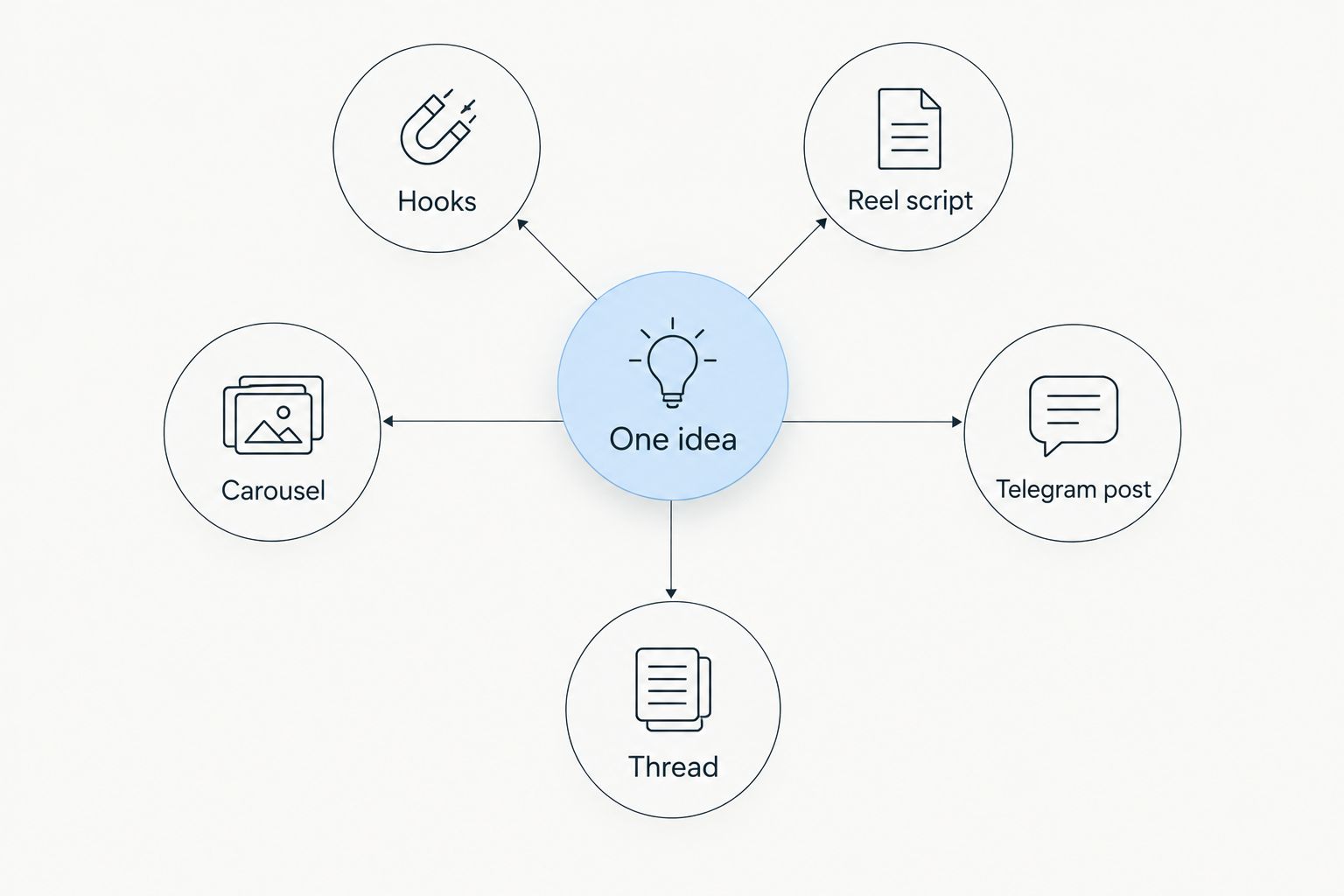
A small team that treats every idea as a single Instagram post is doing five times more work than necessary. One idea should produce a Reel script, a carousel, a Telegram post, and a thread — the underlying thesis doesn't change, only the format.
- Write the core point once, in one sentence, before touching any format
- Adapt that sentence into a video hook, a carousel cover slide, and a text-post opener
- Keep formatting rules per platform in a shared doc so nobody reinvents them weekly
- This is where Trender's core function fits: feed it an idea, a draft, or a link to a successful Reel, and it returns five platform-ready formats in your style, not five separate writing sessions
Design carousels that get swipes, not just views
Carousel design is where small teams either burn hours in Canva or ship something that stops the scroll on slide one. Both outcomes come from the same three or four decisions.
- Front-load the strongest claim on slide one — the swipe decision happens there, not slide three
- Keep text per slide under 15 words so it reads in under two seconds
- Use a consistent template across posts so the account looks intentional, not improvised
- Check the full breakdown on building a carousel that gets swipes before your next batch
Record without wasting takes
Re-recording a Reel five times because the script reads awkwardly out loud is a two-person team's biggest hidden time cost. Reading directly off a phone screen while filming solves most of it.
- Write scripts for speech, not for reading — short clauses, no subordinate clauses
- Use a teleprompter app so eye contact with the camera stays natural
- Time the script against the platform's ideal length before recording, not after
- Trender's iPhone teleprompter is built specifically for adapting and recording scripts on the spot, which cuts re-takes for solo creators and two-person teams
Diagnose why a Reel underperforms instead of guessing
When a Reel flops, small teams tend to either ignore it or rewrite the entire strategy. Neither is right. The fix is almost always in one of three places: the hook, the retention curve, or the CTA.
- Check average watch time against your account's typical retention curve
- Compare the hook against your top three historical performers
- Look at where drop-off spikes — usually within the first three seconds or right before the CTA
- Read the full method in how to analyze Instagram Reels metrics for a diagnosis-and-next-test framework
Set a publishing cadence two or three people can actually hold
Cadence dies the moment it depends on motivation instead of a system. Small teams that publish consistently in 2026 batch-produce on a fixed day and treat publishing as a checklist, not a creative event.
- Batch one week of content in a single 2-3 hour block
- Assign one person to hooks/scripts and one to design, even if it's the same person on different days
- Schedule posts ahead so publishing day isn't also writing day
- Review performance weekly, not daily — daily checks lead to overreacting to noise
Turn one idea into five formats
Start free, no credit card, and adapt your first Reel today.
Comparing content creation options for small marketing teams
| Option | Best For | Key Limitation | Verdict |
|---|---|---|---|
| Manual in-house workflow (docs + Canva) | Teams with a full-time designer and spare research hours | Research and hook-writing still take hours per post | Hold if you have spare capacity |
| Freelance writer or design retainer | Teams with budget to outsource but not manage daily | Turnaround runs days, not hours, and voice drifts between writers | Hold |
| Generic AI chat tools (ChatGPT, Claude) | A quick first draft of text | No platform-specific formatting, no built-in competitor research | Skip beyond a rough draft |
| Dedicated AI Reels/carousel tools (see the AI Reels script generators roundup) | Teams that need format-native output fast | Coverage and output quality vary widely by tool | Compare before choosing one |
| Trender | 1-3 person teams publishing Reels, carousels, and text across Instagram and Telegram | Covers social formats only, not blog or email content | Buy for social-first teams |
The straightforward read: small marketing teams that skip manual research entirely and go straight to a tool built for social formats publish more consistently than teams still bouncing between Canva, a notes app, and a generic chat tool.
Common mistakes small marketing teams make
- Posting the same idea natively across five platforms without adapting the hook or format — reach flatlines when the first line doesn't match the platform's scroll behavior.
- Skipping competitor research because there's no time, then guessing at topics every single week instead of adapting what's already proven to work.
- Perfecting carousel design for an hour before testing whether the hook on slide one even earns a swipe.
- No system for repurposing a win — every new post starts from a blank page in 2026 instead of an existing template or hook.
- Letting whoever writes fastest set the brand voice, which means tone drifts noticeably from post to post within the same week.
FAQ
What's the best content creation approach for small marketing teams in 2026?
The fastest approach is a repeatable pipeline: audit what already works, build a hook library, and turn one idea into multiple formats at once. Tools like Trender automate the format-adaptation step so a 1-3 person team isn't writing five separate posts from scratch.
Is Trender better than ChatGPT for social content?
Trender is built specifically for platform-ready Reels, carousels, and hooks trained on over 1 million high-performing posts, while ChatGPT drafts general text without platform formatting or competitor research baked in. For social-first output, Trender needs fewer editing passes; for general writing tasks, a chat tool still works fine.
How much time does content creation take for a 2-person marketing team?
With a manual workflow, expect 2-4 hours per week just on research and hook-writing before any recording or design starts. Teams using an adaptation tool report research time dropping from hours to minutes, based on user feedback shared by Trender.
Can one person run Reels, carousels, and Telegram posts alone?
Yes, if the person isn't researching and writing each format separately. One idea adapted into five formats at once is what makes solo or two-person output sustainable through 2026.
Do small teams need a dedicated designer for carousels?
No — a consistent template and a strong first slide matter more than custom design skill. Carousel design templates and structure guides close most of the gap a dedicated designer would otherwise fill.
How do you find good hooks without a big content library?
Adapt hooks from proven, high-performing content rather than writing new ones from a blank page. Trender generates 15+ hooks per idea by drawing on patterns from over 1 million analyzed Reels and carousels.
Is competitor research worth it for a small team?
Yes, but only if it's fast — hours spent scrolling competitors defeats the purpose for a 1-3 person team. Tools that surface relevant competitor content automatically, even in narrow niches, keep the research step under 15 minutes.
How do you know if a Reel script actually worked?
Check watch time against your account's typical retention curve and note where drop-off spikes, usually in the first three seconds or right before the CTA. A structured diagnosis beats guessing at a full strategy rewrite after one weak post.
One last thing
The small teams that keep pace with agencies in 2026 aren't writing more — they're rewriting less. One idea, adapted into five formats with a hook already tested somewhere in over a million analyzed posts, beats five separate blank-page sessions every time. Fix the format-switching problem before adding headcount; it's almost always cheaper.