Question page
Can AI predict which TikTok trends will go viral?
Ryze AI · Updated
TikTok creators and social media managers keep asking the same thing before they hit publish: will artificial intelligence catch the next big trend before it explodes, or is it always reacting after the fact?
- AI can't predict which TikTok trends will go viral with full certainty in 2026 — it flags early momentum, not guaranteed outcomes.
- Audio reuse, hashtag velocity, and search spikes are the signals AI models catch earliest and most reliably.
- Brand-new meme formats and creator-specific virality stay unpredictable because no training data exists for what hasn't happened yet.
- Trender adapts patterns from 1M+ high-performing Reels and carousels into ready-to-post content instead of trying to forecast the next trend.
Why This Matters
Chasing a trend after it peaks wastes a posting slot you can't get back. Most creators find out a sound or format is "hot" from a trend report that's already three days late, which means the audio is oversaturated by the time they publish.
The real question isn't whether AI has a crystal ball. It's whether AI can shorten the gap between a trend starting and you noticing it, and whether that gap is short enough to matter for Trender users trying to publish while a format is still fresh in 2026.
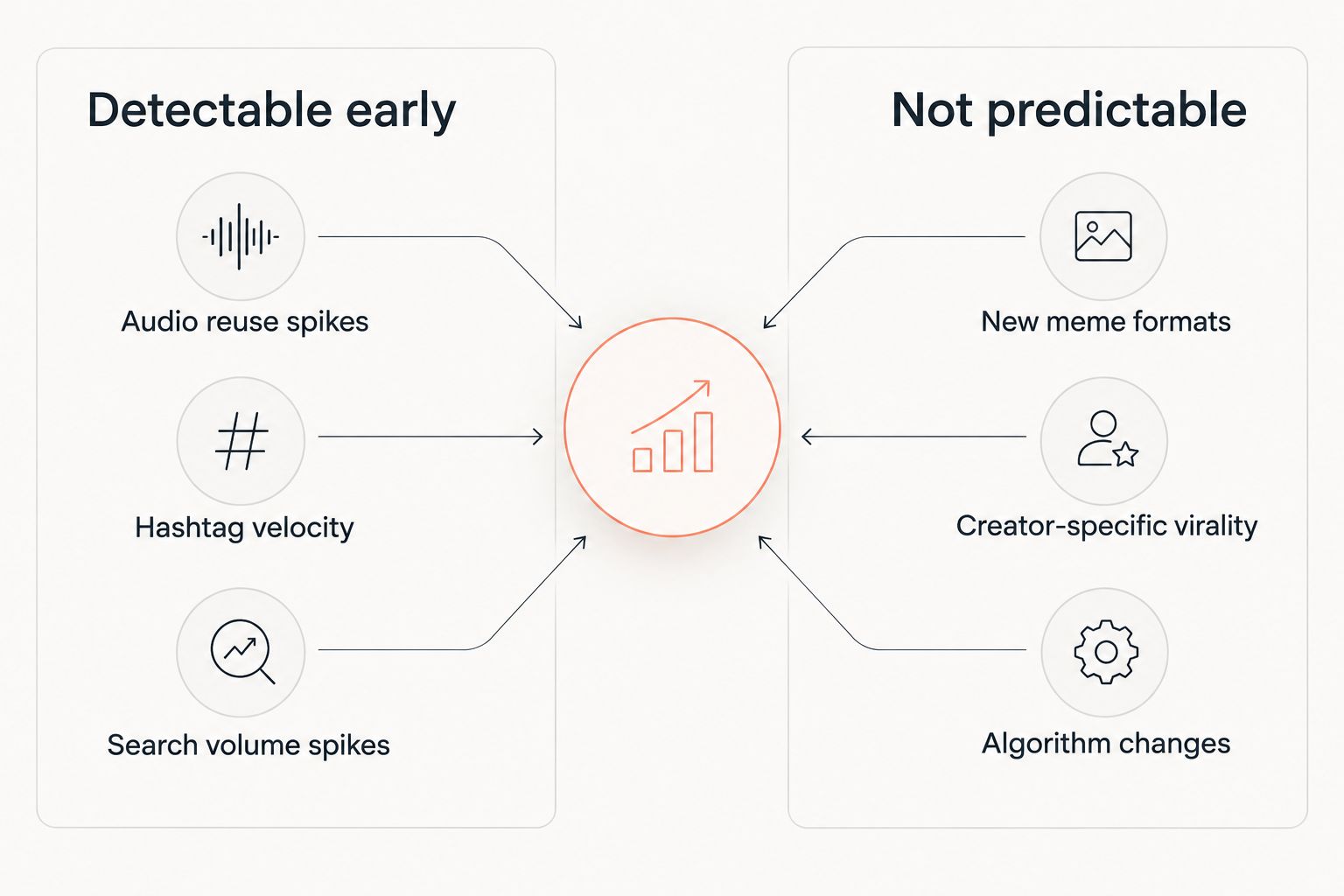
No AI model can tell you with certainty which TikTok video or sound will hit millions of views before it happens — virality depends on real-time human behavior, not just content patterns. What AI can do is score early momentum: audio reuse across unrelated accounts, hashtag velocity, and structural similarity to clips that already went viral, often days before a human trend-spotter would flag the same signals. The catch most tools don't advertise: those scores are built on past viral content, so a genuinely new format or meme has zero training data to match against, and the model misses it every time.
Can AI Predict Which TikTok Trends Will Go Viral?
Verdict: AI predicts momentum, not certainty. It's a probability engine trained on what already worked, which means it's strong on structured signals and blind to anything that hasn't happened before.
| Signal | Can AI Detect It Early? | Why |
|---|---|---|
| Audio reuse across unrelated accounts | Yes | Reuse spikes are countable, structured data that pattern-matching handles well |
| Hashtag and keyword search spikes | Yes | Search and hashtag volume are measurable before mainstream pickup |
| Structural similarity to past viral clips | Yes | Hook and pacing patterns repeat across formats, which is trainable |
| A brand-new meme format nobody has used yet | No | No training data exists for a format that hasn't happened |
| One creator's personal breakout moment | No | Depends on audience trust and timing, not just content structure |
| Platform algorithm distribution changes | No | Not observable until TikTok changes ranking behavior publicly |
The pattern here is consistent: AI is reliable on anything that leaves a data trail before it peaks, and useless on anything that doesn't. Audio and hashtag velocity leave a trail. A completely new joke format doesn't, because it has no history to compare against.
Why AI Trend Predictions Vary in Accuracy
- Training data recency — a model trained on last quarter's viral clips lags behind formats that emerged this week
- Platform algorithm shifts — TikTok adjusts distribution without announcing it, and no model sees the change until after it's live
- Niche size — smaller niches generate less data, so pattern-matching has fewer examples to learn from and gets noisier
- Regional timing gaps — a trend can peak in one market days before it reaches another, and most models don't weight geography evenly
- Sound licensing and takedowns — an audio clip driving a trend can disappear mid-cycle, which breaks the pattern a model was tracking
- Creator-specific factors — existing audience size and posting cadence change how fast a video moves, independent of the content itself
Adapt what's already proven instead
Turn a successful Reel or rough idea into scripts, hooks, and carousels in your style.
Is there an AI tool that predicts TikTok virality before it happens?
No tool guarantees virality before it happens, and any tool claiming a fixed prediction accuracy in 2026 should be treated with suspicion since virality depends on factors outside content alone. Tools trained on large libraries of past performance — Trender's model draws on 1M+ high-performing Reels and carousels — are built to adapt proven hooks and structures rather than forecast something that's never been posted, which is a more honest use of the same underlying pattern-matching.
How early can AI catch a TikTok trend?
AI catches structured signals — audio reuse and hashtag velocity — earlier than most manual trend-watching, because it processes volume spikes continuously instead of checking a feed a few times a day. It still can't catch a trend that started an hour ago and hasn't generated enough data points yet to register as a pattern.
Can AI tell you if your video will go viral before you post it?
No, AI cannot tell you a specific video will go viral before you post it, because post-performance depends on audience behavior AI doesn't control or fully observe. What analysis tools can do is compare your draft's hook, pacing, and structure against clips that performed well, which is a proxy signal, not a guarantee — see how to analyze Instagram Reels metrics for how that comparison actually works in practice.
FAQ
Can AI predict TikTok trends before they go viral?
AI can flag early momentum signals like audio reuse and hashtag velocity before a trend peaks, but it can't guarantee a specific trend will go viral. It has no data for formats that haven't existed yet, so genuinely new memes slip past every model.
What signals does AI use to spot a rising TikTok trend?
Audio reuse across unrelated accounts, hashtag and keyword search spikes, and structural similarity to past viral clips are the three most reliable signals. All three leave a measurable data trail before mainstream pickup happens.
Why do AI trend predictions sometimes miss?
AI trend predictions miss most often on brand-new formats, because the model has no training examples to compare against. Platform algorithm shifts and regional timing gaps also throw off predictions that looked solid a week earlier.
Is AI trend prediction more accurate than a human social media manager?
AI processes volume signals like hashtag spikes faster and more continuously than a person checking feeds manually. A human still reads cultural context and timing better, which is why the two work best paired together, not as a replacement.
Does Trender predict which TikTok trends will go viral?
Trender doesn't predict future trends; it adapts hooks, scripts, and carousel structures from over 1 million high-performing Reels and carousels already proven to work. That's a different job than forecasting something that hasn't happened.
How fast can I turn a trending format into a post?
Speed depends on your workflow, but tools built for adaptation cut research time from hours to minutes according to user feedback on Trender's platform. The bottleneck is usually recording and editing, not spotting the format.
Can AI tell the difference between a real trend and a short-lived spike?
AI can distinguish sustained growth from a one-day spike by tracking velocity over several days rather than a single snapshot. A true trend keeps climbing across multiple accounts; a spike flattens fast.
One Last Thing
The creators actually winning with AI in 2026 aren't the ones trying to predict tomorrow's trend — they're the ones who adapt today's proven format faster than everyone else scrolling the same feed. A trend cycle on TikTok moves in days, not weeks, so the edge isn't foresight, it's turnaround speed once a pattern is confirmed. That's a production problem, not a prediction problem, and it's solvable with the tools you have right now.