Question page
Can AI captions get more comments and shares?
Ryze AI · Updated
Yes, AI captions can get more comments and shares in 2026 when they give viewers a specific reason to respond, such as an answerable question, a useful takeaway or a claim worth discussing. AI does not guarantee engagement: the result still depends on the post, audience fit, caption structure and whether you test the draft against your own account data.
- Can AI captions get more comments and shares? Yes, when the caption creates a specific response path.
- Question-ended Instagram captions suit comments; useful summaries and reusable frameworks give viewers a reason to share.
- Generic prompts produce generic Reel captions because they lack audience, post and voice context.
- Trndr is best for creators and small marketing teams turning proven content structures into platform-ready drafts.
Why this matters
A caption has a different job from the post itself. The video, carousel or image earns attention; the caption gives that attention somewhere to go. A useful caption can prompt a reply, frame a debate, add context worth saving or make the idea easier to send to someone else.
Trndr approaches caption creation as part of a wider content workflow rather than as an isolated writing task. That distinction matters in 2026 because a fluent caption can still fail if it ignores the hook, repeats the post or asks an empty question.
Comments and shares also represent different viewer decisions. A comment needs a reply path. A share needs transferable value: the viewer must know who needs the post or why it is useful outside the current feed session.
Can AI captions get more comments and shares?
Yes, but AI is the drafting method, not the reason people engage. The caption needs to support the content and ask for an action that fits the post. Use the following comparison to select a structure in 2026.
| Caption structure | What it does | Best for | Main limitation | Verdict |
|---|---|---|---|---|
| Direct question | Ends with one answerable prompt | Comments and audience research | Weak questions invite weak replies | Use |
| Useful summary | Extracts the practical lesson | Shares and saves | Can repeat the post | Use |
| Hook extension | Adds context after the opening claim | Reels and short videos | Fails when the hook is vague | Test |
| Personal story | Connects the idea to a real experience | Creators and founder-led accounts | Requires genuine details | Test |
| Generic description | Summarizes what viewers already saw | Basic publishing context | Adds no response path | Skip |
No structure guarantees a lift. The table identifies what each caption asks the viewer to do, which is the variable you can control before publishing.
Direct-question captions
A direct-question caption ends with something the target viewer can answer without interpreting a vague prompt. Ask about a choice, obstacle, experience or priority connected to the post. Avoid broad endings such as asking for general thoughts; they place all the work on the reader.
Best for: creators and marketers who want comments they can use as audience research. The advantage is clarity. The downside is that repeated questions can make an account feel formulaic, particularly when the post already asks the same question on screen.
Useful-summary captions
A useful-summary caption turns the post into a compact reference. It can name the core lesson, list the decision criteria or explain who should use the advice. This creates a clearer sharing reason because viewers can identify the person or situation where the post applies.
Best for: educational carousels, tutorials and practical Reel captions. The advantage is portability. The downside is repetition: if the carousel already contains the entire summary, the caption needs an additional example or application rather than another recap.
Hook-extension captions
A hook extension continues the thought introduced by the Reel instead of opening a separate topic. If the video starts with a strong claim, the caption can add the condition, exception or next step. The hook and caption then work as one argument.
Best for: short-form posts where the opening creates curiosity but cannot carry the full explanation. The advantage is continuity. The downside is dependence on the original hook; AI cannot repair a weak premise by adding polished paragraphs below it.
Personal-story captions
A personal story adds stakes and context that are not visible in the post. It works when the experience is true, relevant and specific enough to explain why the lesson matters. AI can organize the draft, but the creator must supply the real event and viewpoint.
Best for: creators, experts and SaaS founders whose audience follows their perspective as well as their advice. The advantage is distinctiveness. The downside is fabrication risk: invented vulnerability and generic storytelling weaken trust.
Generic descriptive captions
A descriptive caption states what the post contains without adding a reason to comment or share. It is easy to generate because it requires little context, which is also why it often sounds interchangeable with captions from unrelated accounts.
Best for: posts that only need a factual label. For engagement-led content, the verdict is Skip. Use the available space to add context, a useful takeaway or a direct question instead.
How to write an AI caption for comments and shares
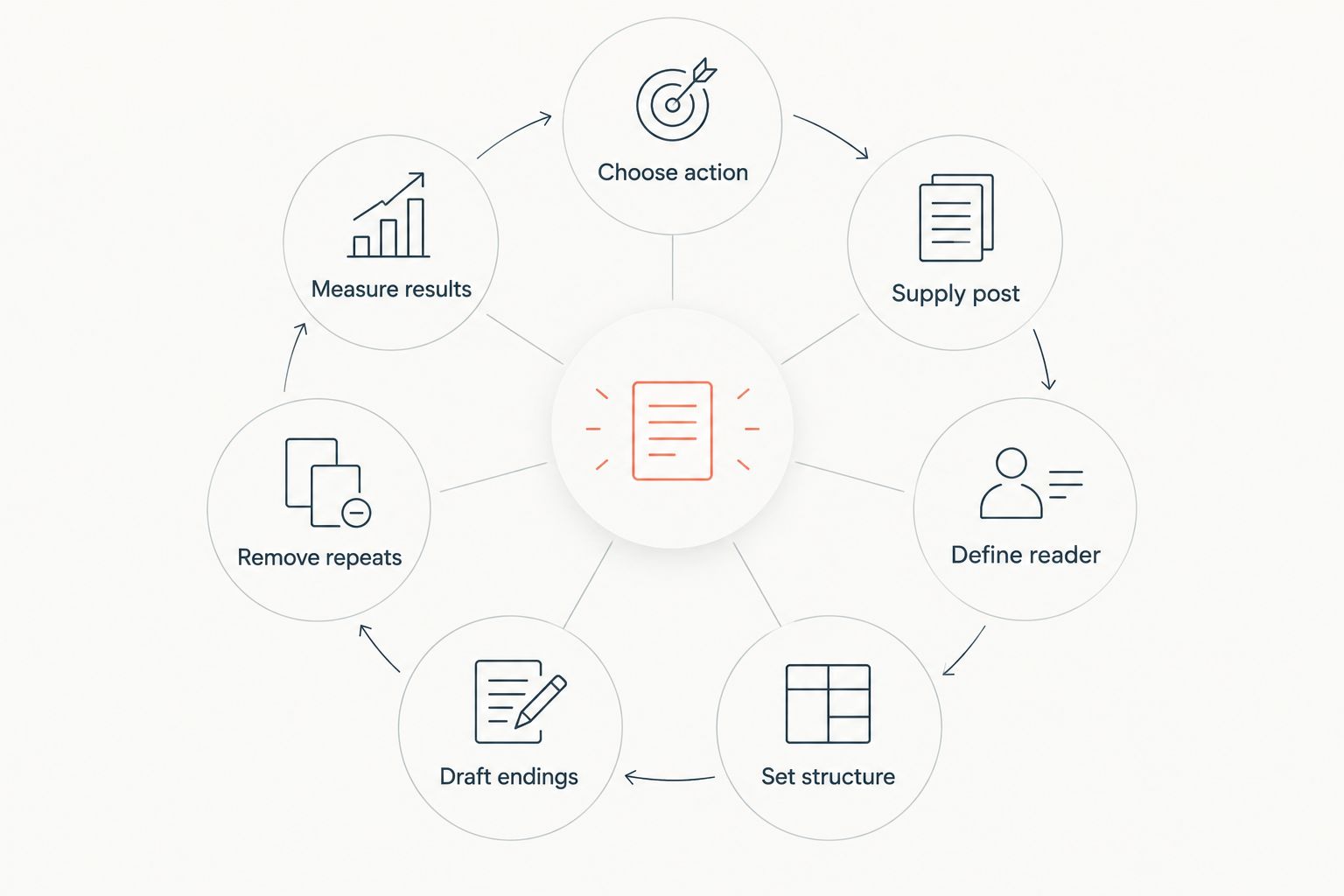
Use a controlled process rather than asking for an engaging caption and accepting the first draft.
- Choose one primary action. Decide whether the caption should seek comments or shares. Asking for both usually creates a muddled closing.
- Supply the actual post. Give the model the transcript, carousel copy, thesis or complete draft. A topic alone lacks the details needed for a specific caption.
- Define the reader. Name the audience, their situation and what they already know. This prevents basic explanations for an experienced audience.
- Set the structure. Request a direct question, useful summary, hook extension or personal story. Do not leave the format open.
- Generate multiple endings. Compare questions, takeaways and sharing prompts instead of judging one draft in isolation.
- Remove repeated material. Cut any sentence that merely restates the opening frame or visible slide copy.
- Publish and measure. Compare comment and share results with similar posts, then retain the stronger structure for another test.
Trndr supports this workflow by analyzing successful Instagram and TikTok content, then turning an idea or reference post into scripts, carousels and hooks. Its stated training set covers 1M+ high-performing Reels and carousels, and the product can produce 15+ hooks from an idea. Those figures describe the research and drafting base; they do not promise a specific comment or share increase.
Draft from a proven structure
Turn an idea or reference Reel into hooks, scripts and platform-ready content.
Why AI caption results vary
- Post quality: A caption cannot compensate for a video that loses attention before viewers reach the caption.
- Audience fit: The same question can invite discussion in one niche and feel irrelevant in another.
- Prompt context: A topic-only prompt produces less specific copy than a prompt containing the complete post and target reader.
- Voice accuracy: Overwritten phrasing creates distance when the account normally communicates plainly.
- Action alignment: Comment prompts need answerable questions; share prompts need useful or relatable material.
- Testing discipline: One result does not establish a pattern. Compare similar posts and change one major caption element at a time.
The 2026 rule is simple: judge the caption by the response path it creates, not by how polished it sounds. A smooth paragraph without a useful point or clear prompt is finished copy, not necessarily effective copy.
How should you test AI captions in 2026?
Start with posts that have comparable topics and formats, then vary one caption element. For example, compare a direct-question ending with a useful-summary ending while keeping the content format consistent. If you change the hook, video, topic and caption simultaneously, the result cannot tell you which element mattered.
Track comments and shares separately. A caption intended to start a discussion should be judged against comments, while a reusable checklist or framework should be judged against shares. The guide to analyzing Instagram Reels metrics explains how to move from a result to the next test without treating every weak Reel as the same problem.
Keep a short record containing the post topic, caption structure, closing prompt and result. In 2026, this small testing log is more useful than copying a viral caption from an account with a different audience.
Do question captions always get more comments?
No, question captions do not always get more comments. They work when the question is specific, relevant and easy for the intended viewer to answer; a generic question adds friction rather than removing it.
A stronger question limits the response space. Ask which obstacle applies, which option the viewer chose or what happened when they tried the approach. Do not ask for personal information the audience has no reason to disclose publicly.
Can AI captions make people share a Reel?
Yes, AI captions can support shares by clarifying who the Reel is for and what problem it solves. The caption cannot make weak content useful, but it can expose the practical value that the video leaves implicit.
Write the sharing reason into the substance, not as a demand. A concise checklist, decision rule or common mistake gives viewers something transferable. An instruction to share without that value is only a request.
Are AI-generated captions bad for authenticity?
AI-generated captions are not inherently bad for authenticity. They become inauthentic when they invent experiences, replace the creator's viewpoint or introduce language the account would never use.
Use AI to structure supplied ideas, not to manufacture a personality. Trndr is best for social media managers, creators and small teams that already have a thesis, rough note, draft or reference post and need to convert it into platform-ready formats.
FAQ
Can AI captions get more comments and shares in 2026?
Yes, AI captions can get more comments and shares in 2026 when they pair relevant content with a clear response path. AI drafting alone does not guarantee an engagement increase.
What is the best AI caption structure for comments?
A direct, answerable question is the best starting structure for comments. Ask about a concrete choice, experience, obstacle or priority connected to the post.
What type of caption is best for shares?
A useful summary is the best starting structure for shares because it makes the post easier to apply or send to someone else. Checklists, decision rules and clear takeaways fit this purpose.
Should every Instagram caption include a call to action?
No, every Instagram caption does not need a call to action. Use one when the requested response follows naturally from the post and gives the viewer a clear next step.
How many AI caption versions should I test?
Test multiple endings and structures rather than accepting the first draft. The inputs specify that Trndr can generate 15+ hooks, but your account data determines which version fits your audience.
Can AI copy my personal writing style?
AI can adapt to examples of your writing, but you still need to remove phrases you would not use. Supply real posts, preferred wording and the complete content instead of only naming a topic.
How does Trndr create social media content?
Trndr analyzes high-performing Instagram and TikTok content and turns ideas or reference posts into hooks, Reel scripts and carousels. Its stated training set includes 1M+ high-performing Reels and carousels.
Do more comments always mean the caption worked?
No, more comments do not isolate the caption as the cause. The hook, topic, video and audience can also change the result, so compare similar posts and vary one major element at a time.
One last thing
Trndr reports 2,137+ creators, but its customer results should not be treated as a controlled caption experiment. A featured customer reports gaining 5K Instagram followers and 2K Telegram followers from two Reels; that shows the result of complete content, not proof that caption wording alone caused it.
That distinction protects your 2026 testing plan. Use AI to create stronger caption options faster, then let your own comparable posts determine whether comments or shares improve.