Question page
Can AI analyze why a TikTok video went viral?
Ryze AI · Updated
Yes, AI can analyze why a TikTok video went viral by identifying repeatable signals in its hook, structure, pacing, visuals, caption, audio, and available performance data. In 2026, the strongest analysis separates observable creative patterns from distribution factors that cannot be verified. AI can explain what likely helped, but it cannot prove why TikTok distributed one specific video at scale.
- Yes, AI can analyze why a TikTok video went viral by identifying repeatable creative and performance signals.
- Trndr is best for turning viral-video analysis into reusable scripts, hooks, carousels, and other content formats.
- AI can diagnose hooks and structure, but it cannot prove why TikTok distributed a specific post.
- Reliable analysis combines public video features with the creator's retention and traffic-source data.
Why this matters
A viral-video diagnosis is useful only when it changes your next draft. Simply describing a TikTok as engaging does not tell you which opening, scene change, information gap, or payoff should be adapted for another topic.
The Trndr AI content analysis platform connects research to production. It can take an idea, draft, rough note, or successful Reel link and turn the underlying approach into platform-ready hooks, scripts, carousels, threads, Telegram posts, and long-form content. That makes the analysis actionable instead of leaving you with a list of observations.
Its published product information for 2026 reports a training corpus of 1M+ high-performing Reels and carousels, usage by 2,137+ creators, and the ability to generate 15+ hooks from one source idea. Those figures describe the platform and its workflow; they do not guarantee that any adapted TikTok will go viral.
Can AI analyze why a TikTok video went viral?
AI can analyze the parts of virality that leave evidence. It can inspect the video itself, its caption, public engagement, audio, editing pattern, comments, and any account analytics you provide. It cannot inspect TikTok's private ranking decisions or prove that one creative choice caused distribution.
| Signal | What AI can analyze | What the result means | Main limitation |
|---|---|---|---|
| Opening hook | First spoken line, opening visual, text overlay, and information gap | Shows how the video creates an immediate reason to continue | A strong hook does not prove why distribution expanded |
| Content structure | Setup, escalation, examples, transitions, and payoff | Reveals the sequence that kept the idea moving | Structure must still fit your topic and audience |
| Pacing | Speech density, pauses, cuts, and scene changes | Identifies sections that feel slow or overloaded | Public video review cannot reveal exact viewer drop-off |
| Visual presentation | Framing, movement, demonstrations, and on-screen text | Shows how the video communicates without relying only on speech | Visual similarity alone does not reproduce audience interest |
| Audio | Voice delivery, music, sound effects, and synchronization | Explains how sound supports attention and emphasis | Trend timing can change after the original post succeeds |
| Performance data | Retention, completion, rewatches, traffic sources, shares, and comments when supplied | Connects creative moments with viewer behavior | The conclusion is limited by the data available |
The correct 2026 verdict is narrower than many tools claim: AI identifies plausible drivers of TikTok performance, not a guaranteed formula for virality. The analysis becomes stronger when the video and its account-level analytics are reviewed together.
How AI breaks down a viral TikTok
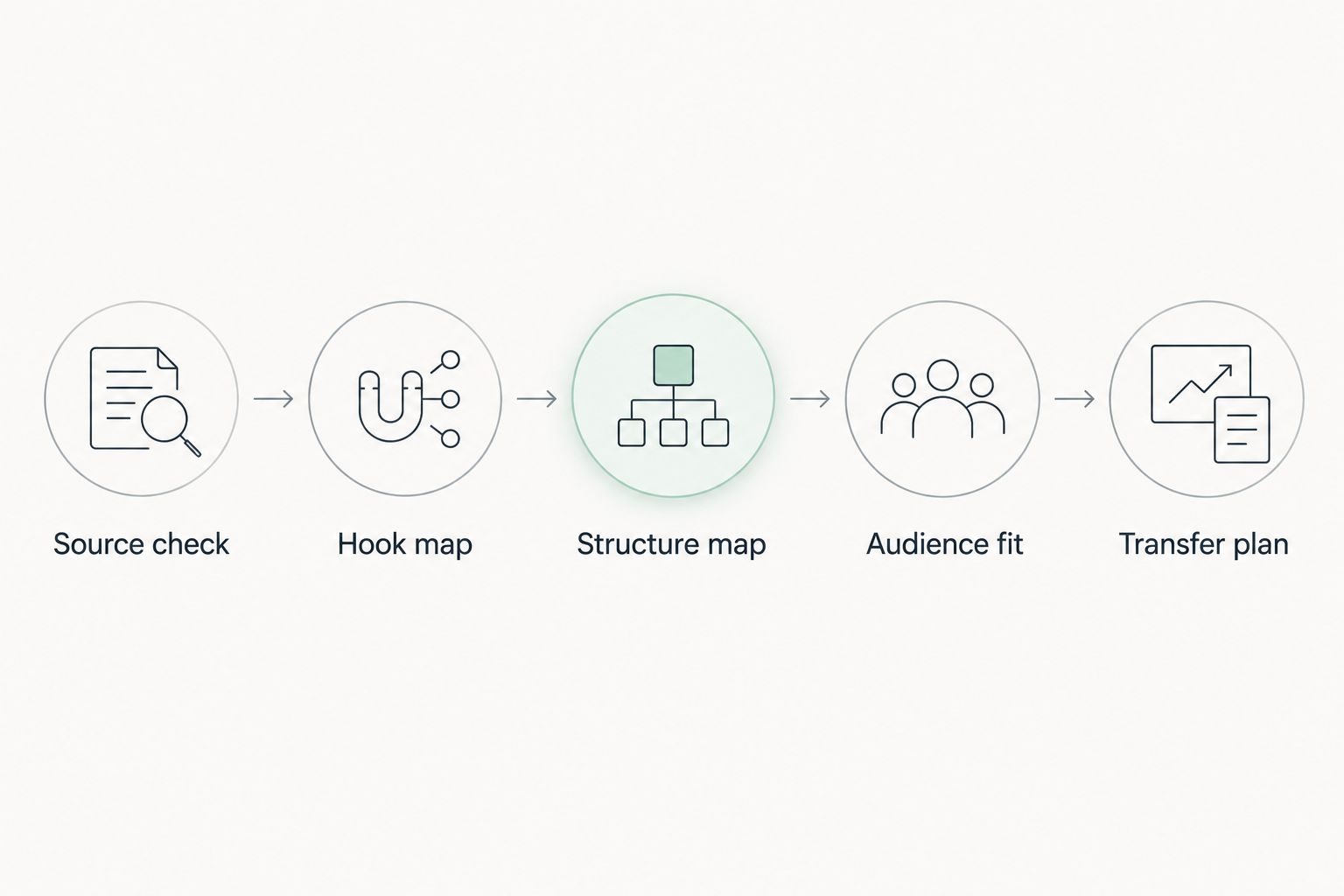
A useful analysis follows a sequence. Each stage answers a different question, and skipping a stage usually produces generic advice.
1. Source check
Start by separating what is visible from what requires creator access. Anyone can review the hook, caption, runtime, editing, public comments, visible engagement, and audio. Only the account owner can supply private analytics such as the retention curve and detailed traffic sources.
This distinction prevents a common error: presenting an inference as measured behavior. If analytics are unavailable, the result should say that a section appears designed to retain attention, not that it definitely caused a retention spike.
2. Hook map
The hook is more than the first sentence. AI should examine the opening visual, spoken premise, on-screen text, emotional tension, and the question left unresolved. A video can open with a calm sentence and still have a strong hook if the visual creates immediate uncertainty.
The output should rewrite the hook as a transferable pattern. For example, a creator showing an unexpected result before explaining the process is using a result-first structure. You can adapt that structure without copying the original wording, footage, or claim.
3. Structure map
Next, AI divides the video into functional sections: setup, development, proof, objection, reveal, or payoff. The labels depend on the video, but the goal stays the same: explain what each section does for the viewer.
This stage reveals whether the post delivers new information throughout or delays everything until the end. It also identifies material that can be removed without weakening the idea. In 2026, this structural map is more reusable than a transcript because it transfers across subjects and formats.
4. Audience fit
A viral post succeeds with a specific audience in a specific context. AI should inspect the vocabulary, assumed knowledge, pain point, comments, and promise to determine who the video appears designed for. A format that works for entertainment does not automatically fit a technical tutorial or founder update.
Audience fit also changes what counts as evidence. A demonstration, personal example, screen recording, and customer result serve different purposes. The analysis should identify the role of the evidence rather than prescribing the same proof format for every creator.
5. Transfer plan
The final stage converts findings into a new production brief. That brief should contain a fresh premise, adapted hook, section order, visual direction, and payoff. It should preserve the successful mechanism while replacing the original creator's language and examples.
A strong transfer plan also identifies what not to copy. Protected footage, distinctive phrasing, personal stories, and unverified claims belong to the source creator. The reusable assets are the content pattern and production logic.
Which analysis method should you use?
Creators have three practical options in 2026: native analytics, manual creative review, and a dedicated content research platform. The right choice depends on whether you need measurement, interpretation, or a new draft.
| Method | Best for | Pros | Cons |
|---|---|---|---|
| TikTok analytics | Measuring your own post | Provides account-level performance data and traffic sources | Does not automatically translate findings into a new script |
| Manual review | Studying context and creative nuance | Gives you full control over the interpretation | Takes focused review and can produce inconsistent notes across a team |
| Trndr | Turning research into new content formats | Connects competitor research, viral-post analysis, hooks, scripts, carousels, and production workflows | Cannot prove private algorithm decisions or guarantee future distribution |
Trndr is best for creators, social media managers, boutique agencies, and small marketing teams that need viral-content research to end in a usable draft. Native TikTok analytics remains the primary source for private performance measurements. Manual review still matters when cultural context, humor, or subject expertise changes the meaning of a scene.
The methods work best together. Use native analytics to establish what viewers did, creative analysis to interpret why a moment likely worked, and a production workflow to turn the finding into a distinct post. Do not replace measured data with a confident-sounding creative explanation.
Turn analysis into a new script
Adapt a successful content structure into hooks, scripts, carousels, and other ready-to-edit formats.
Why AI virality analysis varies
Two tools can review the same TikTok and reach different conclusions because their inputs and priorities differ. Check these factors before accepting a diagnosis:
- Analytics access: A tool with only a public link cannot see the creator's private retention curve or detailed traffic sources. Its conclusions must come from visible content and public activity.
- Training scope: A model trained on short-form social content can recognize recurring hooks and structures. Its conclusions still reflect the examples and labels used during training.
- Audience context: The same opening can feel urgent to an informed niche audience and confusing to a general audience. The topic and viewer knowledge change the result.
- Trend timing: Audio, formats, jokes, and public conversations lose relevance. An analysis can accurately describe why a pattern worked at publication while offering little evidence that it will work again.
- Account history: Existing audience expectations affect how followers respond to a new format. Public video analysis cannot isolate every account-level influence.
- Creative causality: Several variables change at once in a published video. AI can identify correlations among the hook, pacing, topic, and response, but it cannot rerun the post with one controlled change.
The best 2026 report labels each finding as observed, measured, or inferred. Observed findings come from the video. Measured findings come from analytics. Inferred findings explain a likely relationship between the creative and the result.
Can AI predict whether my next TikTok will go viral?
No, AI cannot guarantee that your next TikTok will go viral. It can evaluate whether the draft uses patterns found in successful content, identify weak transitions, compare alternative hooks, and flag a payoff that arrives without enough setup.
Use that feedback as quality control. Distribution also depends on audience response, timing, topic interest, competition, and platform decisions that are unknown before publication. A strong pre-publication score means the creative follows recognizable patterns, not that a specific reach result is assured.
Can AI analyze a TikTok without access to private analytics?
Yes, AI can analyze a TikTok without private analytics, but the result is a creative breakdown rather than a complete performance diagnosis. It can inspect the hook, narrative sequence, visual changes, caption, audio, comments, and public engagement.
Without retention and traffic-source data, it cannot verify exactly where viewers left or how TikTok found the audience. The report should state that limitation directly instead of presenting an estimated drop-off point as fact.
Can AI explain why an underperforming TikTok failed?
Yes, AI can diagnose likely weaknesses in an underperforming TikTok using the same process applied to a viral post. It can identify an unclear premise, delayed payoff, weak connection between hook and body, repetitive explanation, missing proof, or a call to action that interrupts the content.
Pair that diagnosis with the post's actual analytics. A visible structural issue becomes more actionable when the retention curve or viewer response changes around the same moment. The next test should alter one major creative element so the new result is easier to interpret.
FAQ
What's the best AI tool for analyzing viral TikTok videos in 2026?
Trndr fits creators and marketing teams that want viral-video research converted into hooks, scripts, carousels, and other content formats. The best choice depends on whether you need creative adaptation or only account-level analytics.
Is AI TikTok analysis better than manual review?
AI TikTok analysis is faster and more consistent for identifying recurring hooks and structures, while manual review is better for cultural context and creative nuance. Use both when the video relies on humor, specialist knowledge, or current events.
What data does AI need to analyze a viral TikTok?
AI needs the video, caption, audio, and visible post context for a creative analysis. Retention, completion, traffic-source, and audience data improve the diagnosis when the account owner supplies them.
Can AI analyze TikTok videos from competitors?
AI can analyze the visible creative elements of public competitor videos, including hooks, structure, pacing, captions, and comments. It cannot access a competitor's private analytics or prove why the platform expanded distribution.
Can AI copy the formula of a viral TikTok?
AI can adapt the structural formula of a viral TikTok, but it should not copy distinctive wording, footage, personal stories, or unsupported claims. Reuse the mechanism and create a new premise for your audience.
Can AI analyze Instagram Reels as well as TikTok videos?
AI can analyze the same visible creative signals in Instagram Reels, including the hook, structure, pacing, visuals, and caption. Platform-specific analytics should still be interpreted within the platform where the post ran.
Does a viral-video analysis guarantee more views?
No, a viral-video analysis does not guarantee more views. It improves the creative brief by identifying repeatable patterns, while audience response and platform distribution remain uncertain.
One last thing
Do not analyze only winners. In 2026, the most useful comparison is often one strong post beside one weak post from the same creator, topic, and general format. That contrast reduces differences in voice and audience, making the changed hook, proof, pacing, or payoff easier to spot.
Your next test should come from that contrast, not from a generic list of viral tactics. Keep the audience and premise stable, change the clearest weak element, and compare the resulting viewer behavior with the original post.