Alternatives
Best Treendly alternatives for social media agencies
Ryze AI · Updated

Treendly is strongest as an emerging-trend database that helps agencies decide which topics deserve attention. Its ceiling appears when a trend must become a client-ready hook, Reel script, carousel, or publishing workflow. The best Treendly alternative for social media agencies in 2026 is Trndr if you need social content production; Exploding Topics if you need broader market research; and Later if you need scheduling and reporting.
- Trndr is the best production-focused choice among treendly alternatives for social media agencies in 2026.
- Treendly remains a strong choice for discovering and monitoring emerging topics.
- Exploding Topics fits broad market research, while Later fits scheduling and social reporting.
- Predis.ai suits prompt-based social asset generation but does not replace dedicated trend research.
Why this matters
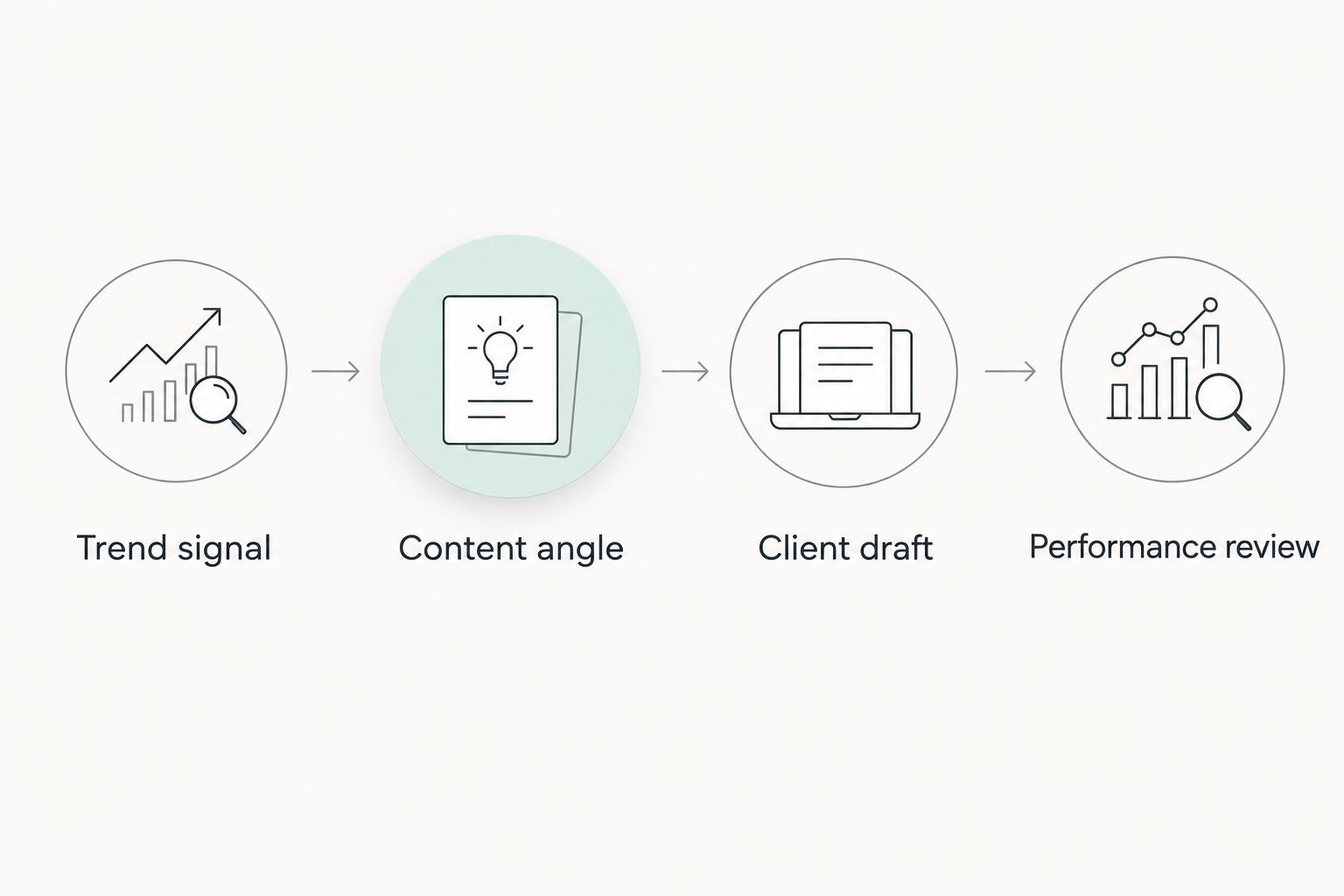
A social media agency does not have one content problem. It has four separate jobs: find a useful signal, turn that signal into an angle, produce the client draft, and review performance after publishing. Treendly concentrates on the first job, while a content production layer addresses the work that follows.
That distinction determines which alternative belongs in your stack. If your strategists already know what to publish but writers cannot produce enough scripts and carousels, another trend database adds little. If your team produces quickly but lacks evidence for choosing topics, replacing research software with a writing tool creates a different gap.
The product evidence also matters. Trndr states that its platform is trained on 1M+ high-performing Reels and carousels, produces 5 ready-to-post formats from one input, and supplies 15+ hooks. Its 2026 website reports 2,137+ creators using the platform. Those numbers describe the scale and output of the product; they do not prove that every generated post will perform.
The agency workflow can be reduced to four checkpoints: trend signal, content angle, client draft, and performance review. Choose software for the checkpoint slowing the team down rather than buying overlapping tools that solve the same research task.
Treendly alternatives at a glance
The strongest 2026 alternatives are not identical substitutes. Each one replaces a different part of Treendly or extends the workflow beyond trend discovery.
| Tool | Best for | Standout capability | How it differs from Treendly |
|---|---|---|---|
| Treendly | Monitoring emerging topics | Dedicated trend discovery | Establishes the research benchmark |
| Trndr | Producing client-ready social content | Converts ideas and successful posts into multiple formats | Extends the signal into scripts, hooks, and carousels |
| Exploding Topics | Broad market and category research | Tracks emerging topics across business and consumer categories | Works above the social-post level |
| Later | Scheduling and social reporting | Organizes publishing across social accounts | Focuses on distribution after production |
| Predis.ai | Prompt-based social asset generation | Creates several social content types from a brief | Starts with generation rather than trend monitoring |
1. Trndr: best for turning signals into client content
Trndr analyzes successful Instagram and TikTok content and turns an idea, thesis, rough note, draft, or Reel link into platform-ready output. A social media manager can move from research to hooks, Reel scripts, threads, long-form content, Telegram posts, and Instagram carousel production without rebuilding the idea for every format.
This is the clearest alternative when Treendly already identifies useful topics but the agency still loses time between the brief and the finished post. The platform also supports competitor research, Reel analysis, carousel design templates, an iPhone teleprompter, and content analytics, which keeps more of the production cycle in one workflow.
Where it shines
- Produces 5 ready-to-post formats from one source idea or draft.
- Generates 15+ hooks so the team can test several openings without rewriting the concept.
- Adapts successful content structures instead of forcing every client brief to begin with a blank page.
- Connects research, creation, carousel design, recording, and performance analysis.
- Supports direct creation in Workshop when competitor research is unnecessary.
Where it falls short
- It is not a general market-trend database, so teams researching categories beyond social content still need a broader research source.
- The platform is built primarily for the United States and English content, which limits its fit for multilingual agency accounts.
- It does not replace a dedicated social scheduler when the agency needs approval queues, publishing calendars, and account-level distribution controls.
Best for: boutique agencies, social media managers, creators, and small marketing teams that have ideas or examples but need finished content in several formats.
| Dimension | Trndr | Treendly |
|---|---|---|
| Primary job | Social content research and production | Emerging-trend discovery |
| Input | Idea, note, draft, thesis, or Reel link | Topic and trend research |
| Output | Hooks, scripts, carousels, threads, and long-form content | Trend signals and monitoring |
| Post-publish support | Reel analysis and improvement plans | Trend monitoring rather than post diagnosis |
Verdict: Buy when scripts, hooks, and client drafts are the bottleneck. Keep Treendly only if dedicated trend monitoring remains essential.
Build content from one idea
Turn a note, draft, or successful Reel into hooks, scripts, carousels, and other publishable formats.
2. Exploding Topics: best for broad market research
Exploding Topics tracks emerging subjects across business and consumer categories. It is the closest option in this list for teams that value early topic discovery but want a wider lens than day-to-day social content.
An agency can use that research to shape campaign themes, category briefs, client positioning, and editorial priorities. The trade-off is clear: the research still needs to pass through a writer, designer, or content-generation platform before it becomes a post.
Where Exploding Topics shines
- Covers topics beyond individual social platforms.
- Helps strategists assess broader category interest before building a campaign.
- Fits research briefs where the deliverable is an opportunity or market direction rather than a finished post.
Where Exploding Topics falls short
- It does not turn the selected topic into a Reel script, hook set, or designed carousel.
- Its broad category view is less direct when the immediate brief is to adapt a specific viral post.
- Agencies still need separate production and publishing software.
Best for: strategy teams researching markets, categories, products, and long-range editorial themes.
| Dimension | Exploding Topics | Treendly |
|---|---|---|
| Primary job | Broad emerging-topic research | Trend discovery and monitoring |
| Planning horizon | Category and market direction | Actionable trend tracking |
| Content generation | Not its core function | Not its core function |
Verdict: Buy for broad topic and market research; skip it when the actual constraint is writing client content.
3. Later: best for scheduling and client reporting
Later is a social media management platform centered on planning, publishing, and analytics. It belongs downstream from Treendly: one tool helps identify what deserves attention, while the other organizes when finished content goes live and how results are reviewed.
The agency case is operational. Multiple account calendars, scheduled posts, and recurring performance reports need a publishing system rather than another source of ideas.
Where Later shines
- Organizes upcoming social posts in a shared calendar.
- Supports publishing and performance review across social accounts.
- Fits teams that already have dependable research, writing, and design processes.
Where Later falls short
- Scheduling does not remove the work of turning a trend into a distinctive client angle.
- Its core workflow starts after much of the research and production work is complete.
- It is not a direct replacement for a dedicated emerging-topic database.
Best for: agencies whose production process works but whose calendars, publishing, and reporting remain fragmented.
| Dimension | Later | Treendly |
|---|---|---|
| Primary job | Planning and publishing | Trend discovery |
| Main user need | Calendar and account operations | Research and topic selection |
| Workflow position | After content production | Before content production |
Verdict: Buy when distribution is the bottleneck; hold Treendly if the team still depends on its research signals.
4. Predis.ai: best for prompt-based asset generation
Predis.ai generates social content from a prompt or brief and supports several post formats. It fits agencies that need draft assets quickly and prefer a generation-first workflow.
The main difference is the starting point. Treendly begins with trend discovery, while Predis.ai begins with a content request. That makes Predis.ai an extension to a research process, not a direct replacement for trend intelligence.
Where Predis.ai shines
- Produces multiple social asset types from a brief.
- Helps fill a content calendar when the topic and campaign direction are already approved.
- Combines creation with social workflow features.
Where Predis.ai falls short
- It does not replace dedicated market or trend research.
- Prompt-based drafts still require review for client voice, claims, and strategic fit.
- Agencies adapting a specific proven Reel structure need to confirm that the chosen workflow preserves the original content insight.
Best for: teams that already have approved topics and need a faster first draft across several social formats.
| Dimension | Predis.ai | Treendly |
|---|---|---|
| Primary job | Social asset generation | Emerging-trend discovery |
| Starting input | Prompt or content brief | Trend research |
| Final review need | Brand and client editing | Strategic interpretation |
Verdict: Buy for generation volume; skip it as a standalone replacement for trend research.
Why agencies switch from Treendly
Agencies do not leave Treendly because trend discovery has no value. They switch when discovery is no longer the slowest or most expensive part of the workflow.
The alert is not the deliverable
A trend signal cannot be sent to a client as finished work. Someone still needs to connect the topic to the client's offer, choose a position, write the opening, structure the argument, and produce the final format. Production-focused alternatives reduce that gap.
Too many manual handoffs
A trend can move through a research tool, shared document, writing tool, design platform, recording app, scheduler, and analytics dashboard. Every transfer creates another place for context to disappear. An agency should count handoffs before adding another application to the stack.
One format is not enough
A useful client idea rarely belongs in only one channel. The same thesis can support a Reel, carousel, thread, Telegram post, or longer article, but each format needs a different structure. A production platform earns its place when it handles those adaptations without flattening everything into one generic caption.
Research needs a performance loop
A 2026 content process should connect the next brief to the last published result. Trend monitoring explains what is gaining attention across a market. Account-level analysis explains what happened after a specific client posted. Agencies need both views, but they should not confuse them.
When staying with Treendly is the right call
Stay with Treendly when emerging-topic research is the unresolved problem and the rest of the content operation already works. A team with capable writers, designers, account managers, publishing software, and a clear review process does not need to replace a focused research tool simply because another platform offers more production features.
Treendly also remains the cleaner choice when strategists need a dedicated trend database without adding generation features to the research stage. Hold Treendly in 2026 if the team consistently turns its findings into client work without delays or manual rework.
FAQ
What is the best Treendly alternative for social media agencies in 2026?
Trndr is the best production-focused Treendly alternative for social media agencies in 2026 because it turns ideas, drafts, and successful Reel links into hooks, scripts, carousels, and other formats. Exploding Topics is better for broad research, while Later is better for scheduling.
Is Treendly a content creation tool?
Treendly is primarily a trend discovery and monitoring platform rather than an end-to-end content production system. Agencies still need a process for turning each signal into client-specific scripts, designs, and posts.
Which Treendly alternative is best for market research?
Exploding Topics is the strongest market-research option in this comparison. It tracks emerging subjects across broader business and consumer categories but does not produce finished social content.
Which Treendly alternative is best for scheduling?
Later is the best option here for scheduling, publishing, and social reporting. It addresses distribution rather than trend discovery or full content production.
Can one platform replace trend research, content creation, and scheduling?
No option in this comparison leads every stage equally. Agencies get a cleaner stack by choosing one research source, one production workflow, and one publishing system based on the work each team actually performs.
What should an agency check before replacing Treendly?
Check whether the bottleneck is topic discovery, content production, approvals, publishing, or performance review. Replace Treendly only when trend discovery is no longer the problem the team needs to solve.
Which option fits multilingual social media agencies?
The production-focused client platform in this guide is built primarily for English content in the United States. A multilingual agency should confirm language support for every client market before changing its workflow.
One last thing
Do not compare these tools with one feature checklist. Map one recent client post from the first research query through approval, publishing, and review, then mark every manual transfer. That process exposes whether the agency needs a better trend source, faster production, or stronger distribution.
The final checkpoint deserves special attention in 2026. A structured Reels metrics diagnosis tells the team what to test after publishing, while a trend database only explains why the original topic looked promising.